Chapter 9
Keeping the building standing
Buildings wear out. A congregation that defers maintenance pays for it later, at a premium, in emergency repairs, overdraft interest, and finally a building that costs everyone in it 0.2 satisfaction a week. This chapter explains the building's systems, its roof, and its heating and cooling, and how to keep them all standing for the least money.
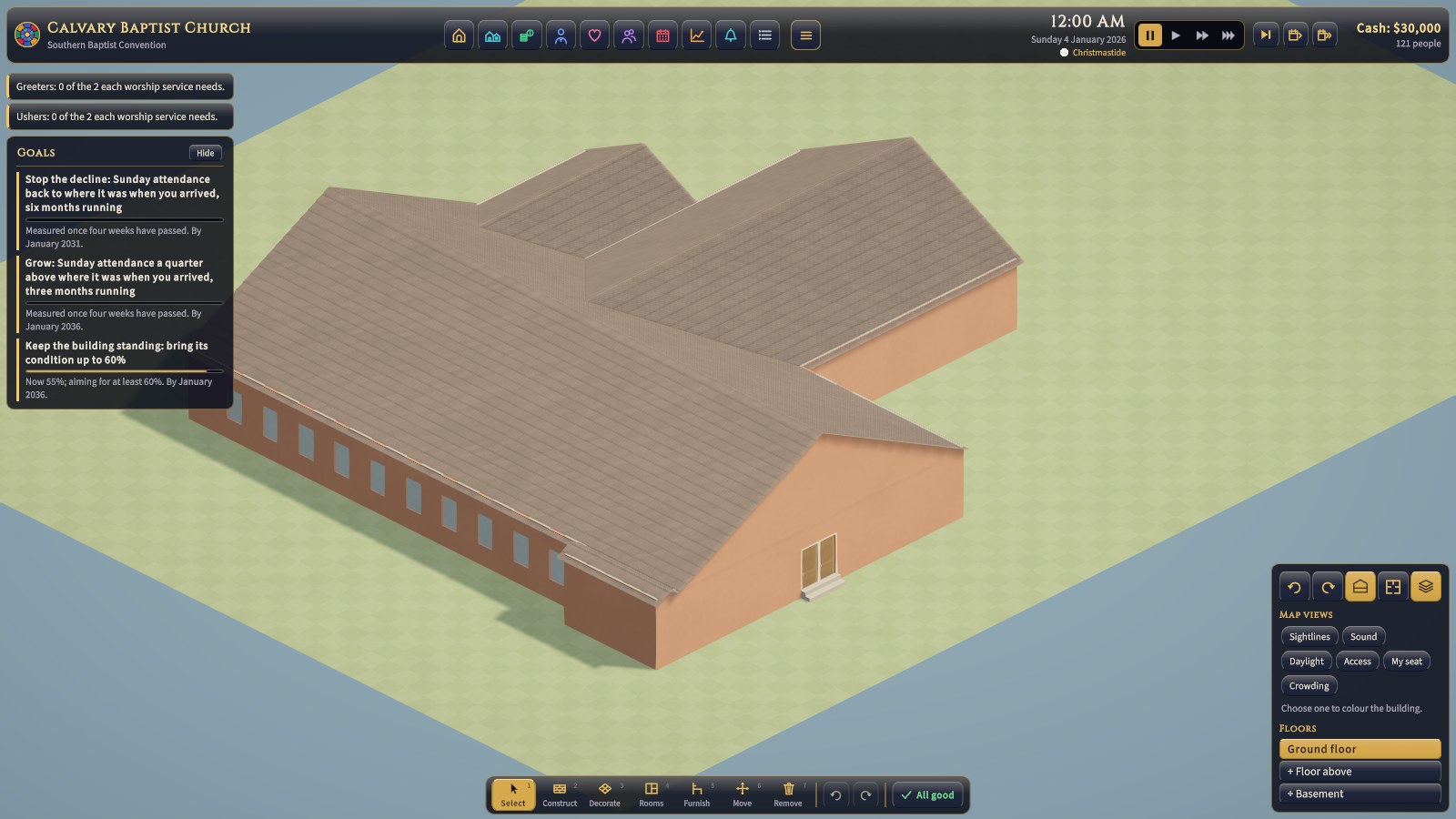
The building systems
The building is a set of systems, each with a condition from 1 (new) to 0 (worn out). Its heating and cooling units wear the same way, one by one (below). The building's overall condition, the units' with the systems', is what scenarios measure, and what people feel.
| System | Covers | Lasts | Replacing it costs |
|---|---|---|---|
| Roof | Slates, flashing, and gutters. "A leaking roof ruins everything under it." How long it lasts and what it costs depend on the roof you choose (below). | 20 to 90 years | $95 to $310 per m² of footprint |
| Plumbing | Water and drains. | 40 years | $40 per m² |
| Electrical | Wiring, panels, and lights. | 35 years | $35 per m² |
| Pipe organ | Leather, wind, and thousands of pipes. Only if you have a Pipe organ. | 40 years | 30% of the organ's price |
| Furnishings | Pews, chairs, prayer carpet, cushions, floor sheets, tables, and cabinets: scuffed, worn, and eventually beyond repair. | 30 years | 60% of the seating and furniture's price |
Wear
- Each system's condition falls by 1 ÷ (lifespan × 12) a month: a 30-year roof loses about 0.28% a month.
- Every hour a ministry or tenant uses the building each month, or a main service beyond the week's first holds it, wears it 0.5% faster. A preschool's 40 hours a week makes the building wear a fifth faster.
- A caretaker (the role once called the sexton) slows wear by up to half; so does a Jain center's pujari, who keeps the shrines, and a Chinese temple's temple keeper. Where congregations share a hall (the Latter-day Saints, the Witnesses), its members clean it and there's no caretaker to hire.
Failures
Each month, each system has a chance of failing:
chance = 0.001 + 0.1 × (1 − condition)³
| Condition | Chance of failing each month |
|---|---|
| 1.0 | 0.1% |
| 0.7 | 0.37% |
| 0.5 | 1.35% |
| 0.35 | 2.8% |
| 0.2 | 5.2% |
A failure is an emergency repair costing 10 to 50% of the system's replacement cost, and it doesn't renew the system: it's still just as worn afterwards. The boiler's risk rises in the heating season.
Maintenance
The maintenance budget (Finances → Budget, in steps of $100 a month) goes wherever it's most needed and restores condition at the replacement-cost rate. Small, steady budgets are far cheaper than failures:
A small building on $200 a month stays at full condition. Left alone for 20 years, the same building costs about $68,000 in emergency repairs and ends at 0.11.
Replacing a system
The Budget tab lists every system with its condition, its risk of failing next month, and a Replace button with the price. Replacing renews it to full condition. Replace a system when its risk passes about 3 to 4% a month and you can afford it, paying from a capital campaign's fund first (a repairs campaign is popular, at 0.8). The Overview warns you once any system reaches 4%.
What a worn building costs you
- Below 0.5 overall, the building costs everyone up to 0.2 satisfaction after every service.
- Below 0.35, tenants start to give notice (a one-in-four chance a month).
- In the dying congregation, condition below 0.2 condemns the building and loses the game.
Roofs
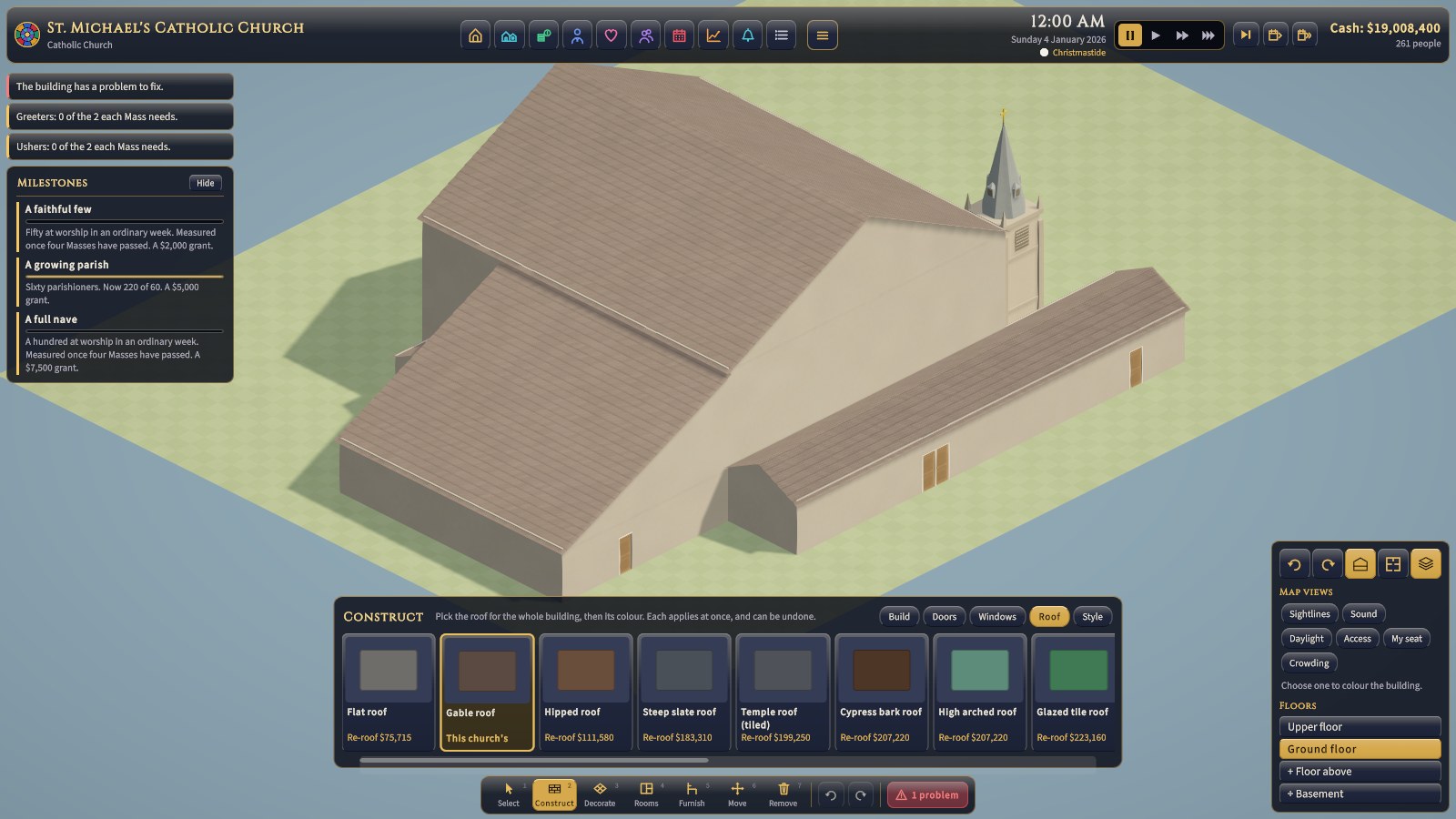
Choose the roof in the builder: Construct, then the Roof tab. Its cards are the kinds of roof, then its colour: as built, brown, black, grey, off-white, stone slates, or yellow (a Chinese temple's imperial glaze), one colour over every part of the roof. A colour is free while the building is first going up; after that it's a recoat, at 15% of what re-roofing would cost. Opening the tab puts the walls up in full, so you can see the roof. The roof is what the roof system costs to replace and how long it lasts, so a big footprint under a short-lived roof needs the most upkeep. Re-roofing costs the new roof's price over the building's footprint, and the roof starts new. A listed building keeps its roof, and its colour. The roof's share of the maintenance budget is its own line in the books, Roof upkeep, in the forecast and every report.
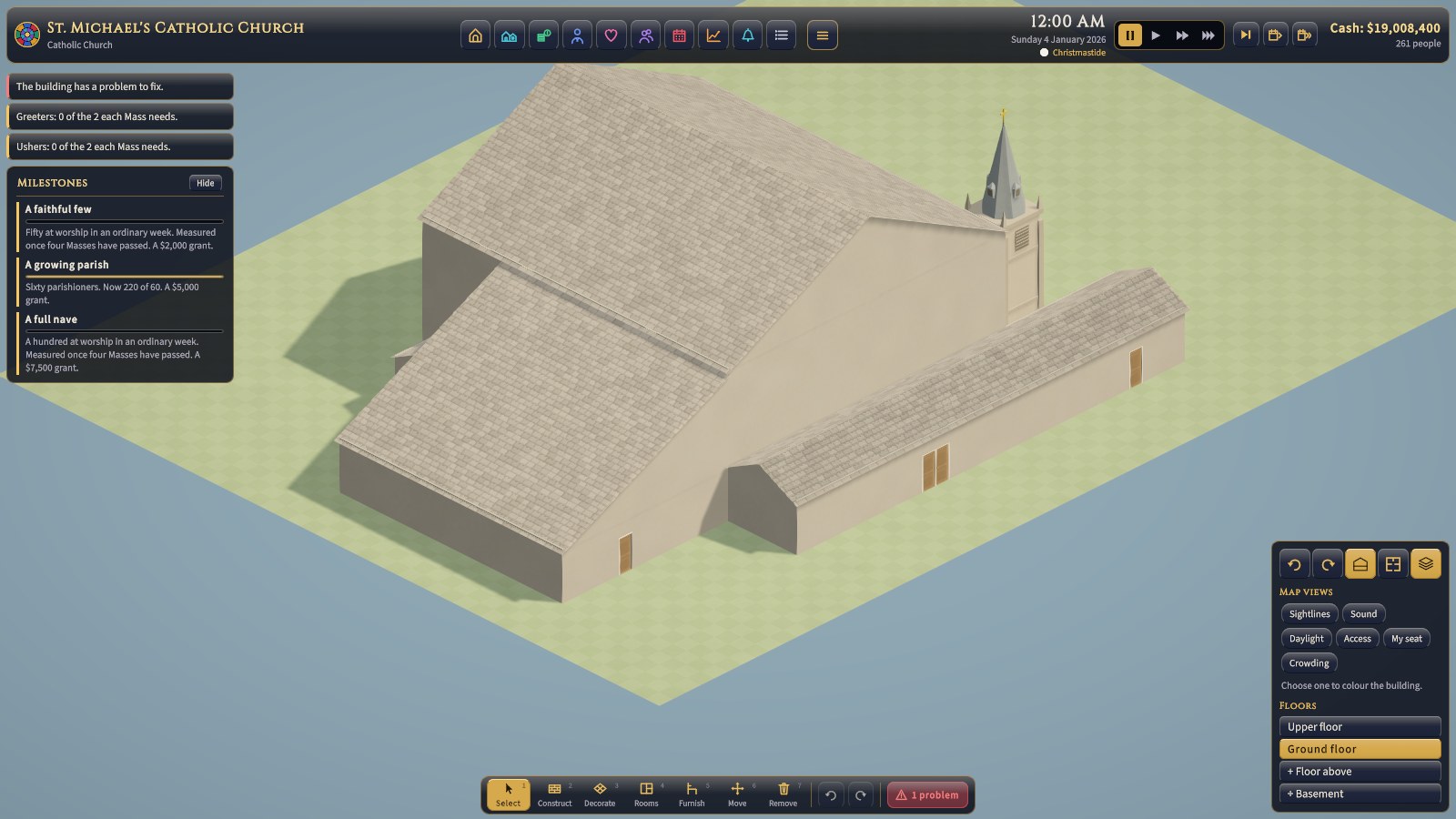
Solar panels, a steeple, a dome, a temple tower, or a rooftop heat pump go on the roof by pointing at the roof itself; panels lie along a sloping roof. With the walls cut away there's no roof, so they're hidden until the walls are up again. With the walls shown in full (V), the building is drawn roofed as a builder would roof it: one roof over everything that stands at one height, whatever rooms are under it, its gables meeting in valleys where wings join, and a lower wing leaning against a taller worship room. Cut away, the roofs come off so you can see in.
| Roof | Shape | Lasts | Per m² | Upkeep for 200 m² |
|---|---|---|---|---|
| Flat roof | Membrane behind a parapet. Cheapest to put on, soonest worn. | 20 years | $95 | about $79 a month |
| Gable roof | Two shingled slopes and gable ends: the ordinary roof, and the default. | 30 years | $120 | about $67 a month |
| Hipped roof | Slopes on all four sides. | 35 years | $140 | about $67 a month |
| Steep slate roof | Slate on a Gothic pitch. The scenarios' Gothic churches have one. | 90 years | $230 | about $43 a month |
| High arched roof | A barrel vault in copper. | 70 years | $260 | about $62 a month |
| Temple roof (tiled) | Grey clay tiles on a hip-and-gable roof curving up to deep eaves, turned up at the corners, as on a Japanese temple. | 60 years | $250 | about $69 a month |
| Layered temple roof | Two tiers of glazed tiles, a skirt roof and a steep gable above, as on the temples of Thailand and Laos. The dearest. | 50 years | $310 | about $103 a month |
| Glazed tile roof | Green glazed tiles on a hip-and-gable temple roof, eaves turned up, and a tall swallowtail ridge sweeping up and forking at each end, a flaming pearl at its middle and little figures down the hips: a Chinese temple's roof. Choose yellow for the imperial glaze. | 70 years | $280 | about $67 a month |
| Cypress bark roof | Thick layers of cypress bark on a gable, with forked finials (chigi) crossing above each gable end and short logs laid across the ridge: a Shinto shrine's roof. Bark wears faster than tile, and few can lay it. | 35 years | $260 | about $124 a month |
A Steeple and bells (or a Plain spire, a dome, a Minaret, a Stupa, a pagoda tower, a Shikhara, a Vimana, a gilded dome, solar panels, or a rooftop heat pump) can stand on the roof over the rooms, taking no floor, or freestanding on the grounds, at the same price. Place it over the building and it goes on the roof; outside, it stands on the ground. If you take away a wall under something on the roof, the building check says so.
Heating and cooling
Nothing heats or cools the building but the units you place (Furnish → Utility). Each heats or cools a volume: one that serves the whole building through ducts or pipes shares it among every room, by volume; a wall unit serves only the room it faces into. A room needs its volume (floor area × ceiling height), and in a Gothic church a third more heating. The building check warns of any worship room given less than 90% of what it needs.
| Unit | Heats | Cools | Serves | Running cost | Lasts | Price |
|---|---|---|---|---|---|---|
| Electric wall heater | 150 m³ | — | its room | ×2.5 | 20 years | $450 |
| Window air conditioner | — | 180 m³ | its room (and blocks most of its window's light) | ×1.3 | 10 years | $650 |
| Ductless heat pump | 400 m³ | 400 m³ | its room | ×0.6 | 15 years | $5,000 |
| Gas furnace | 1,600 m³ | — | the whole building | ×1 | 20 years | $6,500 |
| Central air conditioner | — | 1,400 m³ | the whole building (outside, or on the roof) | ×1 | 15 years | $7,500 |
| Packaged heat pump | 3,000 m³ | 3,000 m³ | the whole building (outside, or on the roof) | ×0.7 | 18 years | $24,000 |
| Cast-iron boiler | 6,000 m³ | — | the whole building | ×1.15 | 40 years | $38,000 |
| Commercial HVAC plant | 15,000 m³ | 15,000 m³ | the whole building | ×0.85 | 25 years | $140,000 |
Comfort. How much heating or cooling a room needs follows the month where the building stands (all of it in a Midwestern January or July), and more in snow, a blizzard, or a heat wave. Whatever its units leave unmet is felt by everyone in the room after the service: up to −0.2 for a cold room and −0.15 for a hot one. A room kept comfortable on a hard day is worth +0.02.
Wear. A unit wears by (0.5 + 0.5 × load) ÷ (lifespan × 12) a month. Its load is how far into its season the month is, times how stretched it is (what its space needs against what it and the units sharing it give, from half to double): an undersized unit wears out much sooner. A worn unit gives up to 40% less and costs up to 50% more to run. The maintenance budget keeps units up with the rest of the building, and the caretaker slows them too.
Breakdowns. Each month a unit may break down on some day of it, at the same chance as a system (above) times its load, so a furnace dies in January and an air conditioner in July. The repair is paid at once (10 to 50% of the unit's price), and the unit is out for 2 to 9 days, so a breakdown the day before the main service (a Sunday, a Shabbat, a Friday's Jumu'ah) leaves the building cold for it. A unit at 90% wear or more that breaks down is beyond repair: it's out until it's replaced.
Finances → Budget → Heating and cooling lists every unit with its condition, its risk, and two buttons: Service ($150 and the work to make it good as new, at the price maintenance pays) and Replace (a new one, running at once).
Solar panels
The congregation's vans and buses wear, are kept up, and break down the same way, by each week's driving rather than the season (The congregation in its community).
Solar panels cost $12,000 each and $160 a year in upkeep, take a month to install, and then each take 5% off every utility bill but the telephone (in an ordinary place's sun: more in sunny regions, less in grey ones; see Rooms, materials, styles and lots). Put up as many as you like: they add up to 30% off with six ($72,000), and more save nothing more. Traditions that lean liberal are a little gladder of their services for them (+0.02), with one panel or many.
A maintenance plan
- Heat the worship space before the first winter, and cool it before the first summer: size the units to the space, with a little to spare.
- Set a maintenance budget on day one: $200 to $300 a month for a small building, more for a large or Gothic one.
- Watch the system and unit risks on the Budget tab every few months, and service a worn furnace in the autumn.
- When a system's risk passes 3%, run a repairs campaign and replace it.
- Hire a caretaker once the building is big or busy with ministries.
- Don't let a repair push you into overdraft: take a loan instead.