Chapter 13
Faiths and traditions
Your tradition decides what the building needs and which way it faces, when the congregation gathers and what it calls things, who approves your projects, how your leaders come, what you owe the wider body above you (if there is one) and what it can do to you, how your people belong and give, and what your congregation will and won't do. Eighty ship, in nine faiths: 44 Christian, 5 Jewish, 5 Muslim, 7 Buddhist, 10 Hindu, a Sikh gurdwara, 2 Jain, 3 Shinto, and 3 of Chinese religion. Nearly all are specific bodies (the Assemblies of God, not "Pentecostal"; the Union for Reform Judaism, not "Judaism"; BAPS, not "Hindu"; the Buddhist Churches of America, not "Pure Land"), a few the pattern many independent congregations share (the nondenominational church, the Sunni Islamic center, the Soto Zen center, the Hindu community temple, the gurdwara, the Jain center, the Chinese folk temple). This chapter says how traditions differ, from their words and their week to the way they face and the way they give, then gives every tradition a short practical profile, faith by faith. Then it covers the wider body and everything it does, changing practice, stances, leaving, and founding a tradition of your own. Every tradition: services and what they need has every tradition's services and the full list of what its building needs.
Every tradition is a draft awaiting review by people of that tradition, and some numbers (what's owed upward and what dues come to, especially) are estimates. Each describes how its American congregations commonly work, not every one; where the research was thin, the tradition's description says which choice the game made. The twenty newest (the Hindu, Sikh, Jain, Shinto, and Chinese traditions, and the Chinese Buddhist temple) rest on thinner research than most, and their descriptions say so where it matters.
In this chapter
- Part 1The words, the week and the yearWhat each tradition calls things, the days and hours it gathers (a day of rest, services timed by the sun, open hours, the minyan), and the calendars that make its year.
- Part 2The buildingWhich way it faces, pews, chairs, or the floor, the front of the room, the rooms each faith needs, and the towers, domes, and gates that crown it.
- Part 3Giving, leaders and life togetherHow the money comes in, how the leader comes and what they're called, and the ministries, fundraisers, and dilemmas that belong to each faith.
- Part 4The traditions at a glanceHow to read the profiles, and every tradition side by side.
- Part 5Christianity44 traditions, in 12 families: Catholic and Orthodox; Anglican and Lutheran; Reformed and united; Methodist and holiness; Baptist; Pentecostal; Anabaptist, Moravian, and Friends; Restorationist; Independent churches and networks; Charismatic; Latter-day Saints and Community of Christ; and Distinct traditions.
- Part 6Judaism5 traditions: Reform Judaism, Conservative Judaism, Modern Orthodox Judaism, Reconstructionist Judaism, and Chabad-Lubavitch.
- Part 7Islam5 traditions: Sunni Islamic Center, Community of Imam W. Deen Mohammed, Twelver Shia Islamic Center, Ahmadiyya Muslim Community, and the Nation of Islam.
- Part 8Buddhism7 traditions: Buddhist Churches of America, Vietnamese Buddhist temple, Chinese Buddhist temple, Soka Gakkai International-USA, Soto Zen center, Theravada temple, and Tibetan Buddhist dharma center.
- Part 9Hinduism10 traditions: Hindu temple, Indo-Caribbean mandir, BAPS Swaminarayan Sanstha, International Swaminarayan Satsang Organisation, International Society for Krishna Consciousness, Arya Samaj, Vedanta Society, Chinmaya Mission, Self-Realization Fellowship, and Sri Sathya Sai Organization of USA.
- Part 10SikhismOne tradition: Gurdwara.
- Part 11Jainism2 traditions: Jain center, and Jain Vishva Bharati.
- Part 12Shinto3 traditions: Shinto shrine, Konko Churches of North America, and Tenrikyo.
- Part 13Chinese religion3 traditions: Chinese folk temple, Daoist temple, and Yiguandao (I-Kuan Tao).
- Part 14The wider body, schism, and a tradition of your ownThe body above the congregation and what it can do, changing practice and stances, belonging, splitting or leaving, founding your own tradition, and tradition packs.
Choosing a faith and a tradition
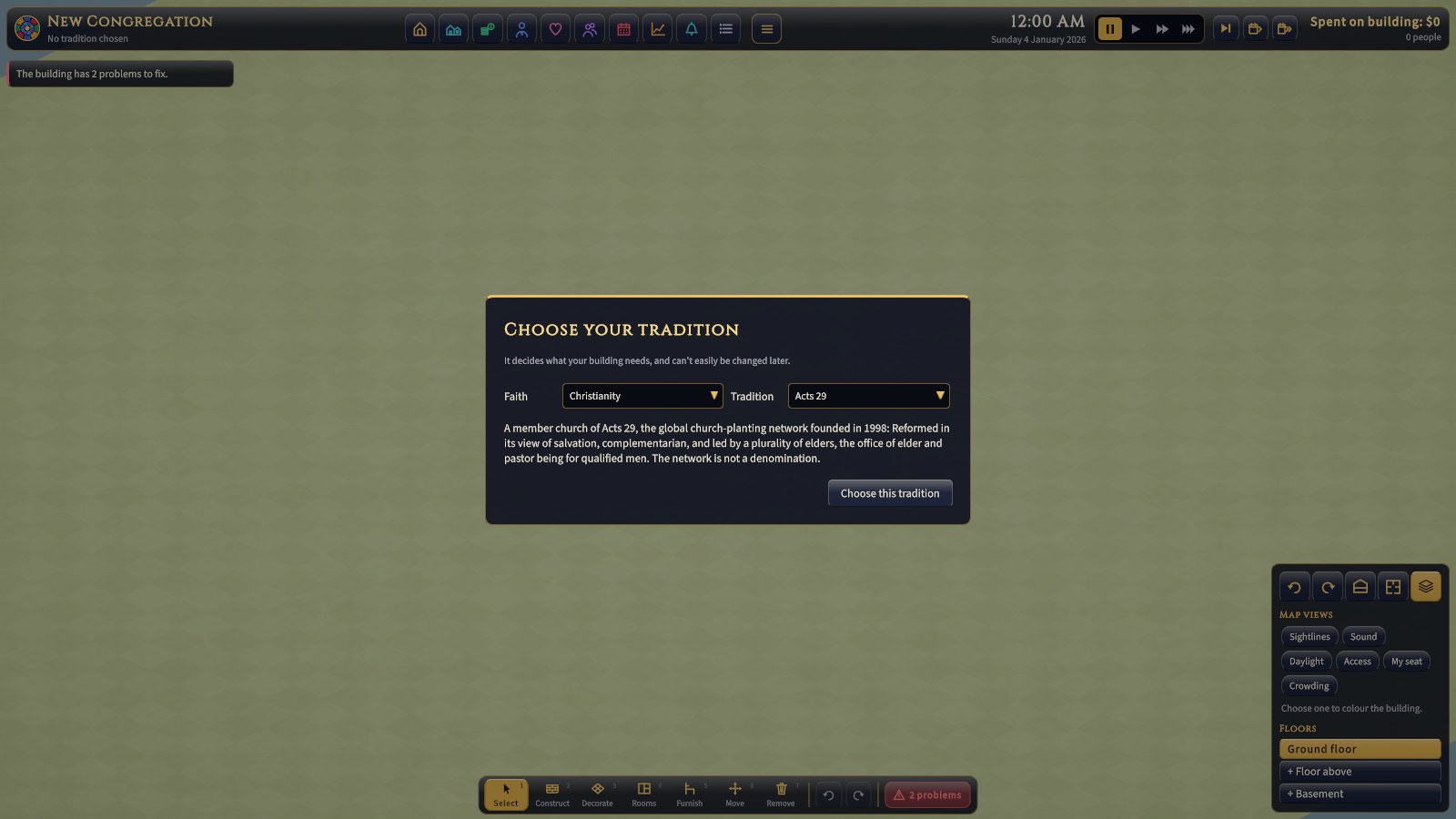
A new game's tradition picker chooses in two steps, from two drop-downs: first the faith (Christianity, Judaism, Islam, Buddhism, Hinduism, Sikhism, Jainism, Shinto, or Chinese religion), then one of its traditions, in name order. The opening sentences of the chosen tradition's description show beneath it, and Choose this tradition settles it. The sandbox lists every tradition at once, under its faith and in name order, with the whole description of the one chosen beside the list. A scenario offers its own few traditions instead, with its Play as buttons (see Scenario walkthroughs).
- Christianity (44): the Catholic, Orthodox, and Coptic churches; the Anglicans and Lutherans; the Reformed, Methodist and holiness, Baptist, and Pentecostal churches; the Anabaptists, Moravians, and Friends; the Restoration churches; independent and charismatic churches and their networks; the Latter-day Saints and Community of Christ, under Christianity as both describe themselves; and the Adventists, the Witnesses, Christian Science, and the Unitarian Universalists.
- Judaism (5): Reform, Conservative, Modern Orthodox, Reconstructionist, and Chabad-Lubavitch.
- Islam (5): a Sunni Islamic center, the community of Imam W. Deen Mohammed, a Twelver Shia Islamic center, the Ahmadiyya Muslim Community, and the Nation of Islam (see the note under Islam).
- Buddhism (7): the Buddhist Churches of America (Jodo Shinshu), a Vietnamese temple, a Chinese Buddhist temple (a branch of a Taiwanese order, as Fo Guang Shan's are), Soka Gakkai International-USA, a Soto Zen center, a Theravada temple (as the Thai temples keep it), and a Tibetan dharma center.
- Hinduism (10): an independent community temple, an Indo-Caribbean mandir, BAPS, the International Swaminarayan Satsang Organisation, ISKCON, the Arya Samaj, a Vedanta Society, a Chinmaya Mission center, a Self-Realization Fellowship temple, and a Sathya Sai center (the last two listed here as scholars class them; neither calls itself Hindu: see the note under Hinduism).
- Sikhism (1): the gurdwara.
- Jainism (2): a Jain center, with Shvetambara and Digambara shrines under one roof, and Jain Vishva Bharati, of the Terapanth.
- Shinto (3): a Shinto shrine, a Konko church, and a Tenrikyo church. Konko and Tenrikyo each describe themselves as a religion of their own, and sit beside the shrine for their history, as the Latter-day Saints sit under Christianity (see the note under Shinto).
- Chinese religion (3): a Chinese folk temple (to Mazu, as written), a Daoist temple, and Yiguandao. The Chinese Buddhist temple is under Buddhism.
This chapter groups the Christian traditions by family. A tradition belongs to one family or two (the Free Methodists are holiness and Methodist; Acts 29 is independent and Reformed), and in play a family counts for little: it's the smallest part of how alike two traditions are, which decides how readily newcomers from another congregation settle in (see Belonging and giving). Likeness is judged within each faith, so two synagogues are as alike, to the game, as two churches typically are.
Some bodies are really two or more kinds of congregation, and have variants you choose when you found the congregation: traditional or contemporary United Methodists and Nazarenes, white or Black American Baptist churches, the Moravians' Northern or Southern Province, a Salvation Army corps with a brass band or a praise band, an IPHC church of transfer members, a Unitarian Universalist congregation or a lay-led fellowship, a Christian church with traditional or contemporary worship, a Vineyard church or a Spanish-speaking La Viña, an Acts 29 church that baptizes believers or one that baptizes infants, and a Baptistic, charismatic, or Reformed-leaning nondenominational church; a Conservative synagogue's traditional (non-egalitarian) minyan, a Modern Orthodox shul with a women's gallery, and a Reconstructionist havurah; a Hanafi Sunni center; a Vietnamese temple run by a lay association, the Theravada temple's Lao, Cambodian, Sri Lankan, and Burmese heritages, and a Dharma Drum branch of the Chinese Buddhist temple; a North Indian temple, a BAPS stone mandir (shikharbaddha), an ISSO temple of the Vadtal diocese, a Chinmaya center with a temple, a lay-led Self-Realization Fellowship center, and a Sathya Sai center with a hall of its own; a gurdwara keeping the SGPC's calendar, and a Sikh Dharma gurdwara; a Digambara jinalaya and a Sthanakvasi sthanak; and a Chinatown association temple, a Fujianese village temple, and a Daoist priest's own temple. A scenario picks one for you.