Chapter 2
How people feel
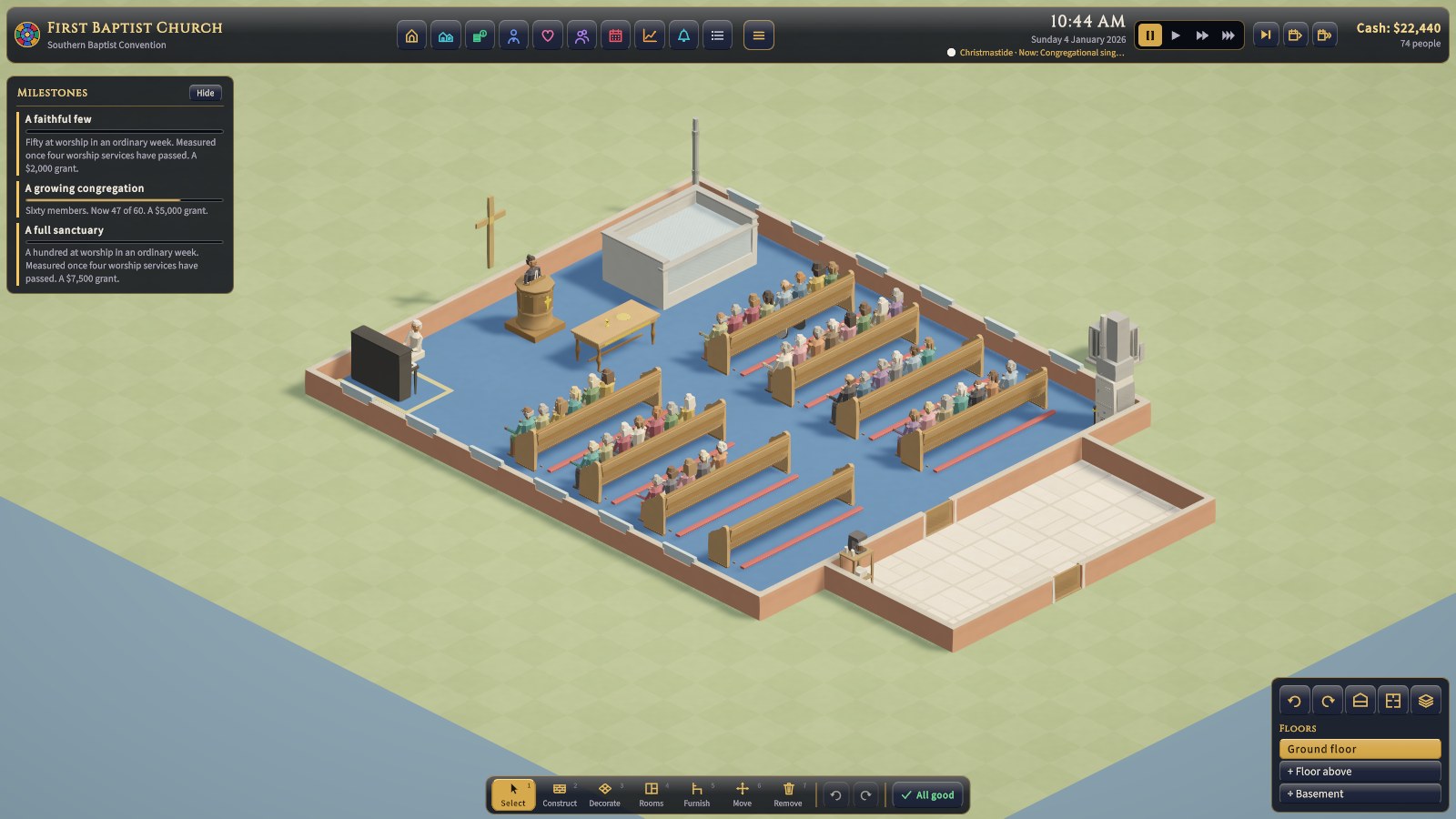
Almost everything in Rejoice! runs on satisfaction: each person's feeling about their congregation, from 0 to 1. It decides whether they come, whether they give, whether they stay, and whether visitors come back. Learn how it moves and the rest of the game follows.
How satisfaction moves
After every main service a person attends, everything they experienced is added up as factors: a good seat, the sermon (or khutbah, katha, or dharma talk), a cold welcome, a building in disrepair. Their satisfaction then moves toward a target:
target = 0.5 + 0.5 × (the sum of the factors)
- Regulars and members move 15% of the way toward the target each service. They're slow to change and forgiving of one bad week.
- Visitors move 60% of the way. Their first service nearly decides what they think of you.
- A visit at open hours (darshan at a Hindu temple, bowing at a gurdwara, the puja at a Jain center, a shrine's or a folk temple's visitors) counts a quarter as much: a visitor moves 15% of the way, a regular a little under 4%. A visit is felt for the building and its worship room, and, for a visitor, for whether anyone welcomed them (and at a gurdwara, whether scarves hang by the door); seats, the sermon, and the leader don't come into it (Worship and the year).
A congregation whose factors add up to zero settles everyone at 0.5. That sounds fine, but it's the edge of trouble. Every +0.1 of factors you add lifts the settled level by 0.05. A healthy congregation wants its people's factors to sum to about +0.2 or more, settling them near 0.6.
The thresholds that matter
| Satisfaction | What happens |
|---|---|
| below 0.25 | They give nothing at all. |
| below 0.45 | Their household starts to drift away. Each month there's a chance of 0.6 × the shortfall below 0.45, cut by 15% for every friend they have in the church. |
| 0.5 | Regulars of a year or more can join as members (15% a month). A visiting household needs more than this even to come back. |
| 0.55 | A visiting household that has come three times and is this happy starts attending regularly. |
| 0.8 | Full giving. Engagement, which scales giving and pledges, rises from nothing at 0.25 to full here. |
Attendance
A household of regulars comes to a given week's main service with a chance of 0.2 + 0.65 × satisfaction, plus 0.1 if anyone in it is a member, capped at 95%. At 0.6, a member household comes about 69% of the time; at 0.45, about 59%. Summer holidays shave June by 7% and July and August by 15%.
The short daily services (a mosque's five prayers, a weekday minyan, a Hindu temple's aratis, a gurdwara's Rehras at sunset, morning zazen) draw differently: people come one by one rather than by household, those 13 and over, each at their usual chance times the service's small draw (a tenth, unless the tradition gives its own). The retired come twice as often; people of working age half as often on a weekday between nine and five. These services don't move satisfaction either way, unless too few come for a quorum (below). See Faiths and traditions. Open hours draw in the same way, at the window's share of each person's chance (from 4% to 20% a day, as the tradition sets it), and at a Hindu temple or a gurdwara a household comes together; each visit counts a quarter of a main service, as above.
A congregation of 0.5s doesn't collapse, but it doesn't grow either. Visitors don't come back, nobody gives much, and a few bad weeks tip households into drifting away. Push the factors positive.
Seeing what people feel
The person inspector
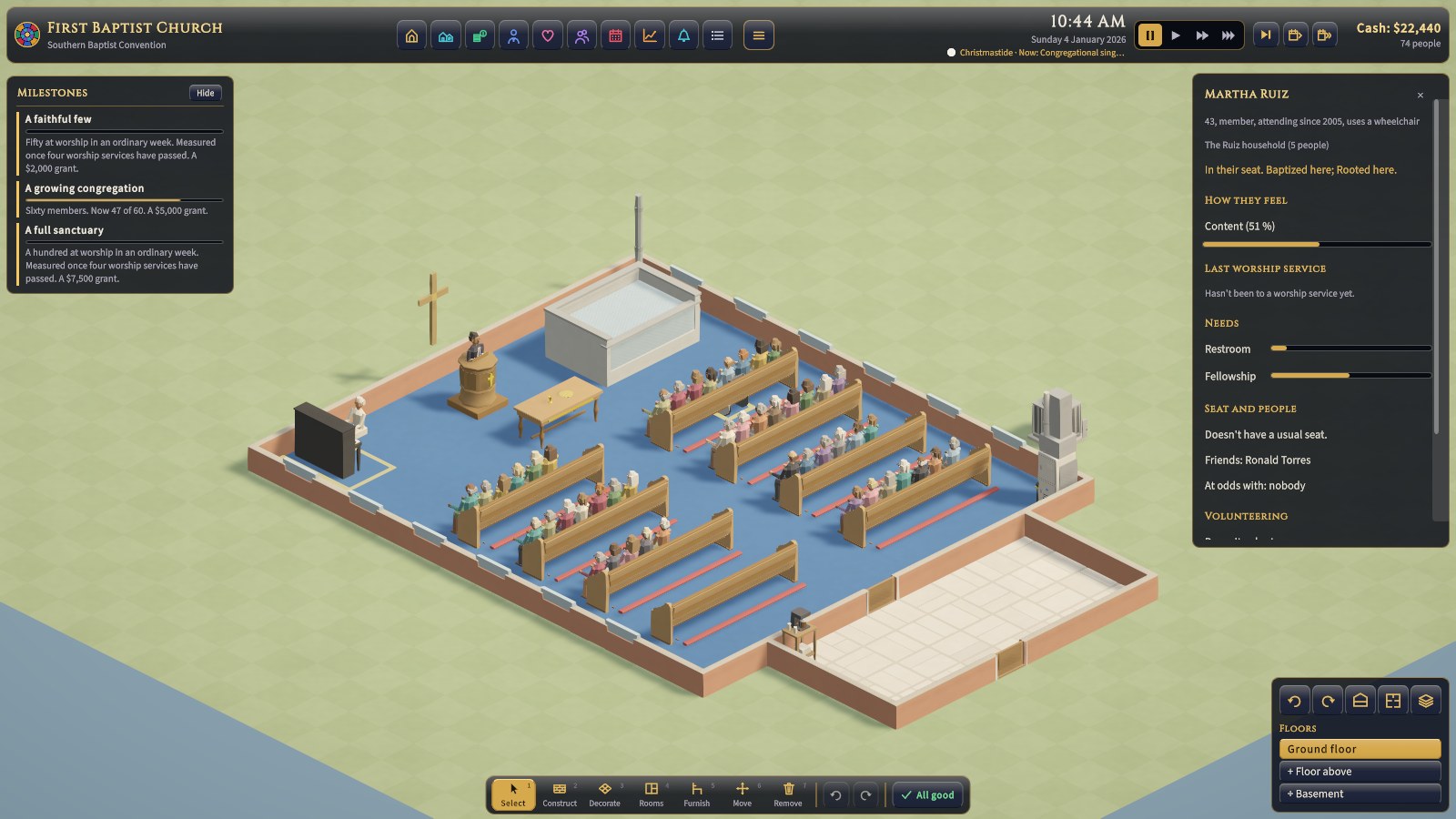
Click anyone in the church to see them. The inspector shows:
- Who they are: age, whether they're a member or a regular and since when, and their household.
- Where they are: in their seat, walking in, standing at the back.
- How they feel: their satisfaction as a word and a bar.
- Last service: every factor that applied to them, positive and negative. This is the most useful thing in the game for finding out what's wrong.
- Needs: how much they need a restroom, fellowship, and so on.
- Seat and people: whether they've claimed a usual seat, their friends, and who they're at odds with.
- Volunteering: what they do, and Ask buttons to recruit them to a role.
The service report
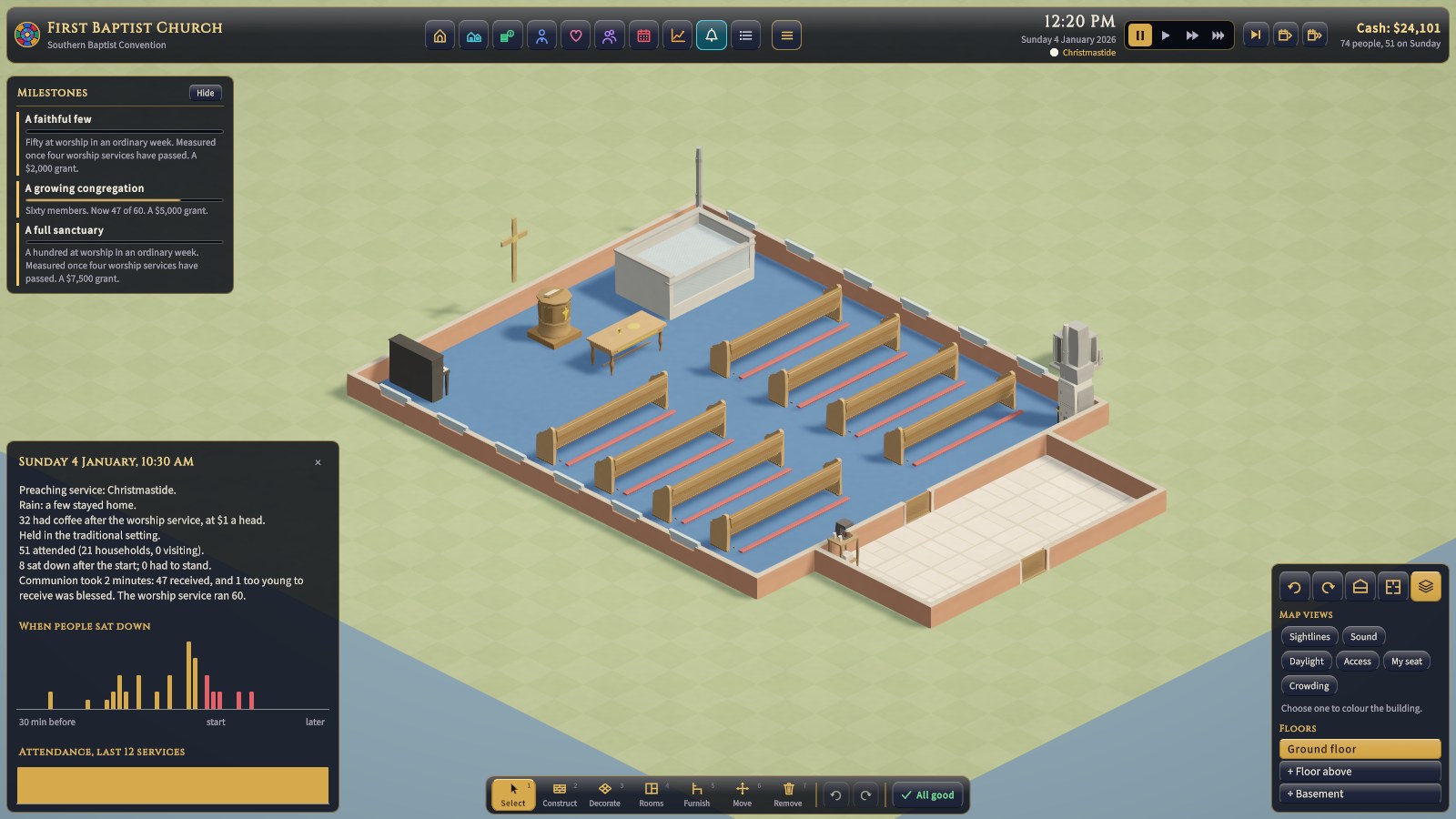
Last service opens the report on the most recent service. Late arrivals show as red bars after the start on the "When people sat down" chart. If many people sit down after the start, your entrance is a bottleneck (see Building your house of worship).
Every factor
These are all the factors scored after a service, roughly from biggest to smallest. "Everyone" means everyone at the service.
The building and the tradition
| Factor | Amount | How to win it |
|---|---|---|
| Building fit | up to ±0.15 | Furnish with what suits the tradition. The fit score is shown on each card in the Furnish tray and in every item's entry in The item catalogue. |
| Required item or room missing, or a forbidden one present | −0.08 each | The building check names them: a synagogue's ark, bimah, and Torah scroll; a mosque's prayer carpet and wudu room; a gurdwara's palki and sachkhand (and pews, which it forbids); a Hindu temple's murti shrines; a shrine's kami altar and torii; a church's pulpit or font. Missing required and expected things together cost at most −0.3. |
| Expected item or room missing, or a discouraged one present | −0.03 each | A synagogue expects a ner tamid and a social hall; a mosque a mihrab, a minbar, and a shoe rack; a Hindu temple a bell and a hundi; a gurdwara the golak and a kirtan stage; a shrine the honden and an amulet counter; a Catholic parish statues and an organ. A Zen center or a mosque finds pews discouraged, and Baptists statues and icons. |
| Building in disrepair | up to −0.2 | Applies below 0.5 overall condition. See Keeping the building standing. |
| Too cold / too hot | up to −0.2 / −0.15 | For everyone in a room its heating or cooling leaves short, by how hard a day it is (more in snow or a heat wave). Size the units to the room: see Keeping the building standing. |
| Comfortable on a hard day | +0.02 | A room kept warm in deep winter, or cool in high summer. |
| Solar panels | +0.02 | For traditions that lean liberal (Keeping the building standing). |
| Architectural style | up to ±0.06 | A style whose formality matches the tradition's: Gothic or Jain marble for the most formal (a Catholic parish, a Conservative or Orthodox synagogue, a South Indian temple, a Zen center), colonial brick for the least (a Baptist church, the Arya Samaj, a Sathya Sai center), and the Islamic, synagogue, temple, gurdwara, and shrine styles between them. See Rooms, materials, styles and lots. |
| Acoustics | up to ±0.05 | Organs and choirs want a ringing room; bands want a dry one; a tradition with neither (a mosque, a gurdwara, a shrine, most Buddhist temples) a room in between. See Building your house of worship. |
| Sightline | down to −0.06 | For a seat whose view of the front is blocked or poor. |
| Seasonal decor | ±0.04 × formality | Only where the day calls for decor the faith can buy: in Christian traditions, paraments always and the Advent wreath, Christmas candles, and Easter lilies in season; in every other faith, its festivals' decor in season (the sukkah and the Hanukkah lamp, Ramadan's lanterns, Diwali's lamps, Vaisakhi's lights, the New Year couplets, the Obon and Vesak lanterns, the kadomatsu), and nothing out of season. See Worship and the year. |
| Orientation | ±0.04 | Where the tradition asks it: a mosque faces the qibla (it's required); synagogues and the Eastern churches face east. Turn the lot in Church → Church (Building your house of worship). |
| Daylight | −0.04 to +0.02 | One plain south-facing window per 10 m² of worship space for full light. |
| Choir loft | +0.02 | With four or more singing from it. |
The service itself
| Factor | Amount | How to win it |
|---|---|---|
| Had a seat | +0.05 | Enough seats for your busiest service: a place on the prayer carpet, the floor sheets, or a cushion counts as one, as a pew or a chair does. |
| Had to stand | −0.15 | More seats, or more services (up to eight main services a week). |
| Late to their seat | −0.08 | A crowded entrance hall or a single door makes a bottleneck. Widen the entrance, add doors, add services. |
| Service ran long | −0.05 per 10 min over (−0.2 at most) | Communion for a big crowd is what runs long, in the Christian traditions that keep it: add communion stations or a longer rail. Other faiths' services keep to the length you set. |
| No restroom | −0.1 | For anyone who needs one: build a restroom. |
| No nursery | −0.08 | For families with infants: a nursery room with a nursery volunteer on duty. |
| Friends at the same service | +0.03 each, up to +0.1 | Friendships form by themselves as people sit together. |
| Someone they resent there | −0.05 | Grudges form by themselves too. |
| Trouble over a seat (someone in theirs) | −0.08 (regular), −0.1 (visitor) | Regulars claim a seat after three services in it, whether a pew, a row of chairs, or a row of prayer carpet, cushions, or floor sheets. More seats ease it. |
| Ushered to a seat | +0.03 | Visitors, with ushers on duty. |
| Greeted / not greeted | +0.15 / −0.1 | Visitors only, at a main service or at open hours. See Growing the congregation. |
| Head scarves at the door / none | +0.02 / −0.03 | Visitors, where heads are covered (a gurdwara, where everyone covers): a rack of head scarves by an outside door. |
| Shared a meal / no room at it | +0.04 / −0.03 | A community meal, or a free meal such as langar, Mahaprasad, or a Swamivatsalya lunch; short of cooks, those it can't feed go without (−0.02). See Worship and the year. |
| No minyan (no quorum) | −0.08 | Where the tradition counts a quorum (ten adults, or ten men, in Conservative, Orthodox, Reconstructionist, and Chabad synagogues): fewer than ten there at the start. See Faiths and traditions. |
Leadership and music
| Factor | Amount | Notes |
|---|---|---|
| Preaching | −0.08 to +0.08 | (the leader's performance − 0.5) × 0.16, for everyone. A skilled, unstretched rabbi, imam, granthi, head priest, teacher, or pastor is worth a lot. |
| The sermon's message | −0.1 to +0.08 | The topic you chose for the sermon, khutbah, katha, or talk, as your tradition takes it. See Worship and the year. |
| No leader | −0.1 | For everyone, except at a gathering the laity lead: a Friends meeting, SGI's gongyo meeting, a Jain center's Sunday at the derasar, a Sathya Sai center's bhajans, Yiguandao's Tao meeting, a Daoist temple's Sunday practice, a Latter-day Saint sacrament meeting, the Witnesses' meetings, and every visit at open hours. A tradition with a service for when there's no leader (a synagogue's lay-led Shabbat service, the Catholic Sunday Celebration, an Episcopal or Mennonite lay-led service) holds it instead, for −0.04. |
| Music staff | up to +0.06 | For everyone: a cantor; a gurdwara's ragi jatha; Tenrikyo's service teacher; a Shin temple's organist; a church's or synagogue's choir director, organist, or pianist. |
| Youth director | up to +0.08 | For households with someone under 19. |
| A choir of four or more | +0.04 | For everyone, wherever four or more volunteers sing at the service. |
| Ministries that serve them | up to +0.08 | See The congregation in its community. |
People's own situation
| Factor | Amount | How to win it |
|---|---|---|
| No step-free way in | −0.2 / −0.05 | −0.2 for wheelchair users (who also come only 30% as often), −0.05 for limited mobility (85% as often). Build a ramp at a stepped door, or a lift between levels. |
| Hard of hearing | −0.03 to −0.08, or +0.03 | Worse in a ringing room. A hearing loop turns it into a gain. |
| Worn out volunteering | up to −0.25 | Don't overwork volunteers (Staff and volunteers). |
| A conflict they oppose | −0.06 | Until it's settled (Projects, approvals and conflict). |
| The congregation's stances | −0.2 to +0.06 | For those with strong views (Faiths and traditions). |
| Unsettled by a change of practice | −0.08 | For a season (Faiths and traditions). |
| Another congregation renting the worship room | −0.01 | The congregation in its community. |
Putting it together
A typical visitor's first main service in a well-run house of worship might add up like this. Here it's a gurdwara's Sunday diwan; a mosque's Jumu'ah, a synagogue's Shabbat morning, or a church's Sunday service adds up the same way, without the scarves.
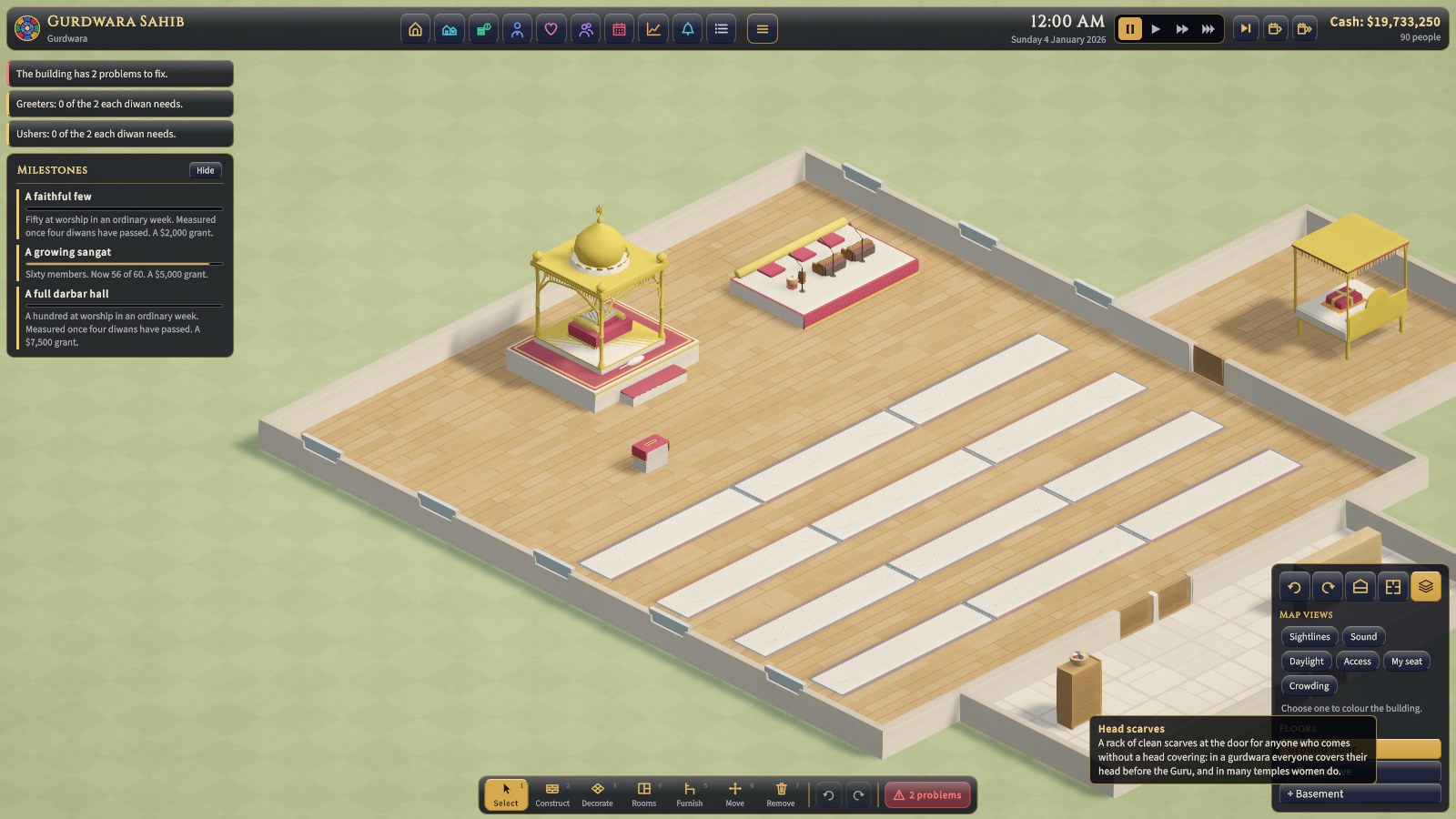
| Factor | Amount |
|---|---|
| Greeted at the door | +0.15 |
| Found a head scarf to borrow by the door | +0.02 |
| Had a seat (a place on the floor sheets) | +0.05 |
| Ushered to it | +0.03 |
| Building fits the tradition (the palki, the golak, the kirtan stage, and the floor sheets, each +0.5) | +0.075 |
| The Gurdwara style suits it | +0.05 |
| A good granthi | +0.04 |
| A neutral katha | +0.015 |
| Sum | +0.43 |
| Target (0.5 + half the sum) | 0.715 |
A visitor moves 60% of the way there after one service, so a visitor arriving at 0.5 leaves at about 0.63, well above the 0.55 they need to keep coming back. Now take away the greeting (−0.1 instead of +0.15) and the scarves (−0.03 instead of +0.02), and make them stand at the back (−0.15, and no usher). The sum falls to −0.10 and the target to 0.45, so they leave at about 0.47, below the 0.5 a visitor needs even to come back. Same building, same granthi; a rack of scarves, two volunteers, and a few more places on the floor made the difference.
At open hours the arithmetic is gentler and slower. A visitor at a Hindu temple's darshan who is welcomed (+0.15) in a building that fits well (+0.10) has a target of 0.625, but a visit counts a quarter, so they move only 15% of the way: from 0.5 to about 0.52. Six such visits (as many as it takes to settle in from open hours) bring them to about 0.58, past the 0.55 they need. Unwelcomed (−0.1), the same visitor's target is 0.5, and no number of visits will settle them. At a temple, a shrine, or a gurdwara that lives on its open hours, the welcome at the door matters every day, not just on the great day.
Every factor
Everything the game scores after a service, in its own words, with what it's worth and who feels it. This list is made from the game itself, so nothing is left out. Some land differently in each tradition: its page in Every tradition: services and what they need says how.
| What they feel (as the game says it) | Worth | Felt by | |
|---|---|---|---|
| The house of worship feels right for their tradition / The house of worship doesn't feel like their tradition How well the worship space's furnishings suit the tradition. | up to ±0.15 | everyone | more |
| Something their tradition expects is missing or out of place Something the tradition requires or expects is missing, or something it discourages is there. | −0.08 each required, −0.03 each expected (−0.3 at most) | everyone | more |
| Found a seat | +0.05 | those seated | more |
| Had to stand | −0.15 | those standing | more |
| Reached their seat after the start | −0.08 | the late | more |
| The service ran long The service ran well past its scheduled length. | −0.05 per 10 minutes over (−0.2 at most) | everyone | more |
| Couldn't find a restroom | −0.1 | those who needed one | more |
| No nursery for their little one | −0.08 | parents of infants | more |
| Saw friends | +0.03 a friend (+0.1 at most) | those with friends there | more |
| Someone they resent was there | −0.05 | those with a grudge | more |
| Trouble over a seat A regular found a visitor in their pew, or a visitor was made to feel they were in someone's seat. | −0.08 (regular), −0.1 (visitor) | the two at odds | more |
| Someone welcomed them A visitor was welcomed on arrival. | +0.15 | visitors | more |
| Nobody welcomed them A visitor wasn't welcomed by anyone. | −0.1 | visitors | more |
| The building is falling apart The building is run down: stained ceilings, wobbly pews, a boiler that clanks. | up to −0.2 (below 0.5 condition) | everyone | more |
| A good sermon / The sermon fell flat How good the preaching and pastoral care are (either way). | −0.08 to +0.08 | everyone | more |
| The congregation has no leader The church has no pastor. | −0.1 | everyone (but where the laity lead) | more |
| The music was lovely A music director made the music worth hearing. | up to +0.06 | everyone | more |
| The kids love the youth group A youth director looks after the children and teenagers. | up to +0.08 | households with young people | more |
| Worn out from volunteering Worn out from volunteering too much. | up to −0.25 | overworked volunteers | more |
| An usher showed them to a seat A visitor was shown to a seat by an usher. | +0.03 | visitors ushered | more |
| The choir sang The choir sang. | +0.04 | everyone | more |
| The architecture feels right / The building doesn't feel like a house of worship How the building's architecture suits the tradition (#62). | up to ±0.06 | everyone | more |
| The music sounded wonderful in there / The room sounds wrong for the music How the worship space sounds for this tradition's music (#58). | up to ±0.05 | those in the room | more |
| A good view from their seat / Couldn't see much from their seat How well they could see the pulpit or altar from their seat (#59). | down to −0.06 | those with a poor view | more |
| Light and airy / Dark and gloomy inside Daylight in the worship space (#60). | −0.04 to +0.02 | those in the room | more |
The church faces the way the tradition expects (#60). | ±0.04 | everyone, where it matters | more |
| Had to be helped up the steps No step-free way in for someone who needs one (#61). | −0.2 (wheelchair), −0.05 (slow walkers) | those who need one | more |
| Couldn't hear the sermon Couldn't hear well, and no hearing loop (#61). | −0.03 to −0.08 | the hard of hearing | more |
| The hearing loop let them hear every word A hearing loop let them hear clearly (#61). | +0.03 | the hard of hearing | more |
| The choir sang from the loft The choir sang from a choir loft (#64). | +0.02 | everyone | more |
| The house of worship was dressed for the season / The house of worship wasn't dressed for the season The church was, or wasn't, dressed for the season (#67). | up to ±0.04 × formality | everyone | more |
| Upset about the changes Upset about a change the church is making (#73). | −0.06 | those opposed | more |
| Glad of what the congregation does through the week Glad of what the church does through the week (#77). | up to +0.08 | those they serve | more |
| Glad the building is used all week / Uneasy about others using the house of worship How they feel about others using the church (#78). | −0.01 or a little more | those uneasy | more |
| Glad of where the congregation stands / At odds with where the congregation stands How the church's social stances sit with their own views (#84). | −0.2 to +0.06 | those with strong views | more |
| Unsettled by the congregation changing its ways Unsettled by a change in the church's practice (#85). | −0.08 | everyone, for a season | more |
| The sermon's message spoke to them / The sermon's message troubled them What the sermon was about, as their tradition takes it: stirring, or troubling. | −0.05 to +0.04 (times strength) | everyone | more |
| Shared a meal with the congregation Stayed for a community meal. | +0.04 | diners | more |
| No room at the meal Wanted to stay for a community meal, but there was no seat at the tables. | −0.03 | those turned away | more |
| Went to religious school Went to Sunday school this week. | +0.04 | those who went | more |
| No seat at religious school Came to Sunday school this week and found no seat. | −0.05 | those turned away | more |
| Feels cut off from the congregation Two weeks or more without coffee hour, a meal, or a group: cut off from the church. | −0.03 | two weeks without fellowship | more |
| Met with their small group Met with their small group this week. | +0.03 | group members | more |
| Saw a baptism Saw someone baptized at the service. | +0.03 | everyone else there | more |
| Was baptized Was baptized at the service. | +0.1 | the baptized | more |
| Glad of the congregation's giving to {missionsDescribed} Glad of what the church gives to missions. | up to +0.2 × the share given away (missions) | everyone | more |
| The leader is on sabbatical The pastor is away on sabbatical; a supply preacher fills in. | −0.02 (and weaker preaching) | everyone | more |
| The leader was at their other congregation The pastor, shared with another church, was there instead. | −0.03 | later services | more |
| Glad of the leader's spouse The leader's spouse has a part in the church's life (the First Lady, the Matushka). | +0.01 | everyone | more |
| A visit from the wider body The wider body's leader visited. | +0.03 (−0.02 below 0.5 regard) | everyone | more |
| Worship was on Sunday, not the Sabbath (or Shabbat) A Sabbath-keeping church worshipped on Sunday, not the Sabbath. | −0.12 | a Saturday congregation at a Sunday service | more |
| No minyan: too few to read the Torah or say Kaddish / Too few for the prayers that need a congregation Too few were there for the prayers that need a quorum (#faiths: no minyan). | −0.08 | everyone at a main service with fewer than ten | more |
| Sat comfortably on a cushioned pew Sat on a cushioned pew. | +0.02 | those on cushions | more |
| Couldn't follow the service: no bulletin, and no words on a screen No bulletin and no words on a screen: hard to follow the service. | −0.02 (regular), −0.06 (visitor) | everyone | more |
| Sang along with the words on the screen The words were up on a projection screen. | +0.02 | everyone | more |
| A rite of their tradition was kept A rite of their tradition was kept at the service. | up to +0.06 | those there | more |
| A rite of their tradition couldn't be held: the congregation lacks what it needs A rite their tradition keeps couldn't be held: the church lacks what it needs. | up to −0.06 | those who keep it | more |
| The sanctuary is handsomely finished The worship space's walls are handsomely finished. | up to +0.02 | those in the room | more |
| The children have a playground Their children have a playground at church. | +0.02 | families with young children | more |
| Waited in line for the restroom They waited in line for the restroom: there are too few toilets for the crowd. | −0.03 | those who waited | more |
| Gave up waiting for the restroom They gave up waiting for the restroom. | −0.06 | those who gave up | more |
| The coffee had run out The coffee had run out by the time they got to coffee hour. | −0.02 | late to coffee hour | more |
| The service was short of its helpers The service lacked a helper the tradition requires (an acolyte, a lector). | −0.03 each required | everyone | more |
| Lay helpers served in the service A helper the tradition hopes for served (a crucifer). | +0.02 each expected | everyone | more |
| The service was in the style they love The service was in the style they lean to, where the church holds both. | +0.02 | those at their style's service | more |
| A lay reader led their service / One of the members led their service Their room's service, side by side with another, had no clergy left to lead it. | −0.04 | everyone | more |
| Shivered through the service / Chilly in the sanctuary Cold in church: the room's heating falls short of the weather (#hvac). | up to −0.2 (more in snow) | those in the room | more |
| Sweltered through the service / Stuffy and warm in the sanctuary Hot in church: the room's cooling falls short of the weather (#hvac). | up to −0.15 (more in a heat wave) | those in the room | more |
| Comfortable inside, whatever the weather Comfortable inside on a bitter or sweltering day (#hvac). | +0.02 | those in the room, on a hard day | more |
| Glad the house of worship runs on the sun Glad the church cares for creation (its solar panels), in a tradition leaning liberal. | +0.02 | traditions leaning liberal | more |
| Was confirmed Was confirmed at the service (#initiation). | +0.1 | the confirmed | more |
| Was received into the congregation Was received into the church at the service. | +0.1 | those received | more |
| Saw one of the family baptized or confirmed Was there when one of their household was baptized, confirmed, or received. | +0.05 | their family there | more |
| Saw new members confirmed and received Saw people confirmed or received into the church. | +0.03 | everyone else there | more |
| Got a ride in the congregation's van Came in the church's van or bus (#vehicles). | +0.03 | those given a ride | more |
| Went without at the {Words.Lower(Worship.NameOf(sim?.Worship.TraditionGathering))}: too few cooks Went without at a meal free to all: too few cooks to feed everyone (#more-faiths). | −0.02 | those a free meal's cooks couldn't feed | more |
| There was no {Words.Lower(Worship.NameOf(sim?.Worship.TraditionGathering))} after the service The meal free to all their tradition holds (langar) wasn't held. | −0.04 | regulars, when the tradition's meal isn't held | more |
| Found a scarf at the door to cover their head / Had nothing to cover their head with, and no scarves at the door A visitor, where heads are covered, found scarves at the door to borrow (or found none). | +0.02 (−0.03 without) | visitors, where heads are covered | more |