Chapter 5
Rooms, materials, styles and lots
This chapter is the reference for everything you build with that isn't an item: the 26 room types, the floor materials, walls, doors and windows, the twelve architectural styles, the three kinds of lot, and the climates.
Room types
A room is an enclosed space you've assigned a type with the Rooms tool. To count, it must meet its minimum area and hold the items it needs. The room inspector (click the room with Select) shows both.
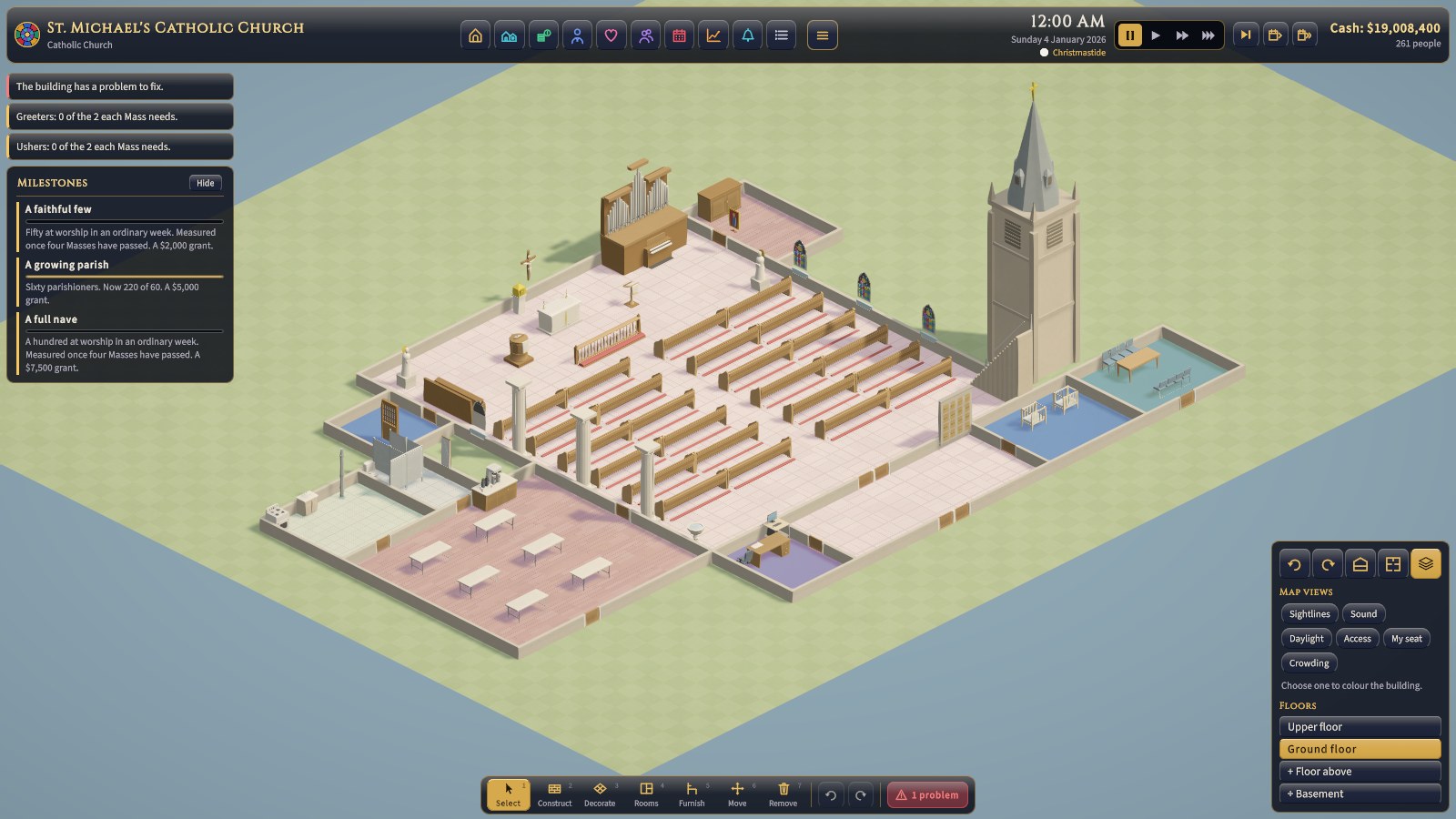
Worship rooms
| Room | Min. area | Needs | What it does |
|---|---|---|---|
| Worship room (the Nave tool), named by the tradition: Sanctuary, Prayer hall, Shrine hall, Darbar hall, Derasar, Haiden, Main hall, Hondo, Zendo, Temple room, Nave | 40 m² | At least one row of prayer carpet, row of floor sheets, set of meditation cushions, oak pew, row of chairs, or meeting bench | The worship room, where the congregation sits (or kneels, on carpet, sheets, or cushions) for worship. Every synagogue, mosque, temple, gurdwara, shrine, and church needs one. This guide calls it the worship room where it means any tradition's. |
| Entrance hall, named by the tradition: the narthex in a Christian tradition, the lobby at a synagogue or mosque, the Latter-day Saints' foyer, and the entrance hall elsewhere | 12 m² | A door to the outside | Where people arrive, are greeted, and gather (a mosque's, a temple's, or a gurdwara's is where the shoes come off, and a gurdwara's where heads are covered). Every building needs one. It adds +0.45 to a visitor's chance of being welcomed. |
| Balcony | 12 m² | Pews, chairs, prayer carpet, floor sheets, or cushions | A gallery of seats above the back of the worship room, on the upper floor with stairs up to it. People take the floor seats first. Where a tradition seats women in a gallery (the Modern Orthodox variant, the Ahmadis), this is it. |
| Chancel | 9 m² | Nothing | A church's area worship is led from, around the altar, table, or pulpit. Also called the sanctuary or platform. |
| Choir loft | 9 m² | Choir stalls, chairs, or pews | A gallery above and behind the congregation where the choir sings. With four or more singing from it, everyone gains +0.02. |
| Sacristy | 6 m² | A Vestment cabinet | Where vestments, sacred vessels, and paraments are kept and prepared. Required in Christian traditions whose worship is formal and whose clergy robe (Catholics, Lutherans, and the Orthodox among them); only Christian traditions need one. |
| Reconciliation room | 4 m² | A Confessional screen | A private room for confession. Expected by Catholics and the Orthodox. |
The chancel, sacristy, choir loft, and reconciliation room are a church's rooms. Every other faith keeps its holiest things at the front of the worship room itself: a synagogue's ark and bimah, a mosque's mihrab and minbar, a gurdwara's palki, a Hindu temple's murti shrines, a Jain derasar's jin shrine, a Buddhist temple's image or altar, a shrine's kami altar (with the honden outside, behind it), and a Chinese temple's deity altar. The rooms each of them adds behind or beside it (a wudu room, a sachkhand, a changing room, priests' or monks' quarters) are in the next table.
Gathering, teaching and support rooms
| Room | Min. area | Needs | What it does |
|---|---|---|---|
| Hall: the fellowship hall in a Christian tradition and the social hall in another faith, unless the tradition has its own word: the langar hall, the community hall, the dining hall, the bhojanshala, the prasadam hall, the banquet hall | 40 m² | A table (folding or wooden), or pangat mats | Langar and a temple's Sunday lunch, a synagogue's social hall for the kiddush (expected in every synagogue), coffee hour, suppers, and receptions. Coffee hour gathers round a Coffee pot here (or in the entrance hall if the hall has none). Community meals and the free meals a tradition holds (langar, Mahaprasad, Swamivatsalya, the Sunday Feast) are held here, at tables or in rows on pangat mats, for as many as it seats (16 at a folding table, 20 at a wooden one) and there's food for: 60, and 80 more for each Commercial stove in the hall or kitchen. Services move here while the worship room is a building site. Hosts the food pantry, youth group, scouts, twelve-step groups, and parties. Needed for the last two growth stages (a full synagogue, mosque, temple, gurdwara, or church; then a campus: see Building your house of worship). |
| Kitchen | 12 m² | A Commercial stove and a Sink | Langar, the monks' meals, suppers, and the food pantry. With one, community meals cost $2 a diner instead of $3 (more where the kitchen keeps kosher or halal, or keeps out onion and garlic or root vegetables: see Faiths and traditions). Required at twelve traditions: a gurdwara and a Jain center; a Hindu temple, an Indo-Caribbean mandir, BAPS, ISSO, ISKCON, and the Arya Samaj, for their free meals and offerings; a Theravada, Vietnamese, or Chinese Buddhist temple, where the monks or nuns are fed; and Yiguandao. Expected at a Chabad house, for the Shabbat table. |
| Classroom | 12 m² | A table, and seating (a row of chairs, a pew, or a bench) | The school (Hebrew school, a weekend Islamic school, Dharma School, Bal Vihar, a Punjabi school, pathshala, a Chinese school, Sunday school), study, and meetings. Required by Chinmaya Mission, for Bala Vihar, and by the Latter-day Saints. A class takes as many as its seating holds, with a teacher on duty. Hosts the preschool, youth group, scouts, and twelve-step groups. The Campus stage needs three. |
| Nursery | 10 m² | A Crib and a Sink | Care for infants and toddlers during worship. Opens only with a nursery volunteer on duty. Families with infants lose 0.08 without one. |
| Office | 8 m² | A Desk | An office for the leader or staff (a rabbi's study, an imam's office, a temple manager's counter). Needed for the Campus stage; a twelve-step group can meet in it. |
| Cultural hall | 60 m² | Nothing | A Latter-day Saint meetinghouse's big hall, for basketball, dinners, dances, and plays. Required by the Latter-day Saints (with a classroom and an office). |
| Reading Room | 8 m² | A table or desk, and chairs | A quiet public room for reading and study. Required by Christian Science, whose literature outreach goes out from it alone; another tradition's literature can go out from it or from an office. |
| Social-service office | 6 m² | A desk and chairs | Where caseworkers meet those who come for help. Required by the Salvation Army. |
| Beit midrash | 16 m² | A table, and seating | A synagogue's study hall, where people learn in pairs; the weekday minyan often prays here too. Expected by Orthodox synagogues and Chabad. Torah study and the chevra kadisha meet here. |
| Mikveh | 8 m² | A mikveh pool | The ritual bath, in a quiet, private room: for women each month, brides, converts, and some men before Shabbat. |
| Imambargah | 40 m² | Prayer carpet or chairs | The Shia hall for the majlis, the gatherings that remember Husayn at Karbala, full night after night in Muharram. Required by a Twelver Shia center. |
| Wudu room | 6 m² | A wudu station | Where people wash before prayer. Required wherever worship faces the qibla. Its station needs plumbing. |
| Ghusl room | 8 m² | A ghusl table | A tiled room where a mosque's funeral committee washes and shrouds the dead before the funeral prayer. |
| Monks' quarters | 12 m² | Nothing | Rooms for the monks or nuns who live at a temple. Required at a Theravada, Vietnamese, or Chinese Buddhist temple, at ISKCON (its ashram), at a Vedanta Society, and at Jain Vishva Bharati (the samanis'). |
| Priests' quarters | 16 m² | Nothing | Rooms for the priests who live at the temple, often with their families, with a kitchen of their own, so they can keep the shrines from the first rite at dawn to the last at night. Expected at a Hindu temple whose priests are housed; required at a Tenrikyo church. |
| Sachkhand | 6 m² | A sukhasan bed | The Guru Granth Sahib's own room, where it rests at night and is carried from at dawn. Required at a gurdwara. |
| Changing room | 6 m² | Puja clothes lockers | Where people change into their puja clothes before going into the sanctum. Expected at a Jain center with images. |
| Restroom | 4 m² | A Toilet and a Sink | "Visitors notice whether they can find one." Anyone who needs one and can't find one loses 0.1. As many can use it at once as it has toilets; anyone who waits five minutes in line loses 0.03, and after ten gives up (−0.06). Stall walls and stall doors (built in Construct, like walls and doors) and a mirror finish it. |
| Columbarium | 8 m² | Columbarium niches | A room of niches for cremated remains, kept by some churches and Buddhist temples (Jewish and Muslim practice buries the dead). |
Toilets, sinks, wudu stations, a mikveh pool, a shrine's chozuya, and baptistries need a Plumbing stack within 12 metres. Put the restroom, kitchen, nursery, and wudu room side by side and one stack serves them all.
Floors
Floors are laid by the square metre. They change how a room sounds (its absorption) and how it looks. In the build bar, Floors has a tab for each kind: carpet in eight colours; tile, wood, and stone, each in several patterns. Carpet soaks up sound and suits a band; wood is a middle way; tile, stone, and concrete make a room ring, as an organ and a choir like. A tradition that wants a room in between (a mosque, a gurdwara, a shrine, most Buddhist temples) is often happiest with wood, or with stone in a low room; read the reverb in the room inspector (Building your house of worship).
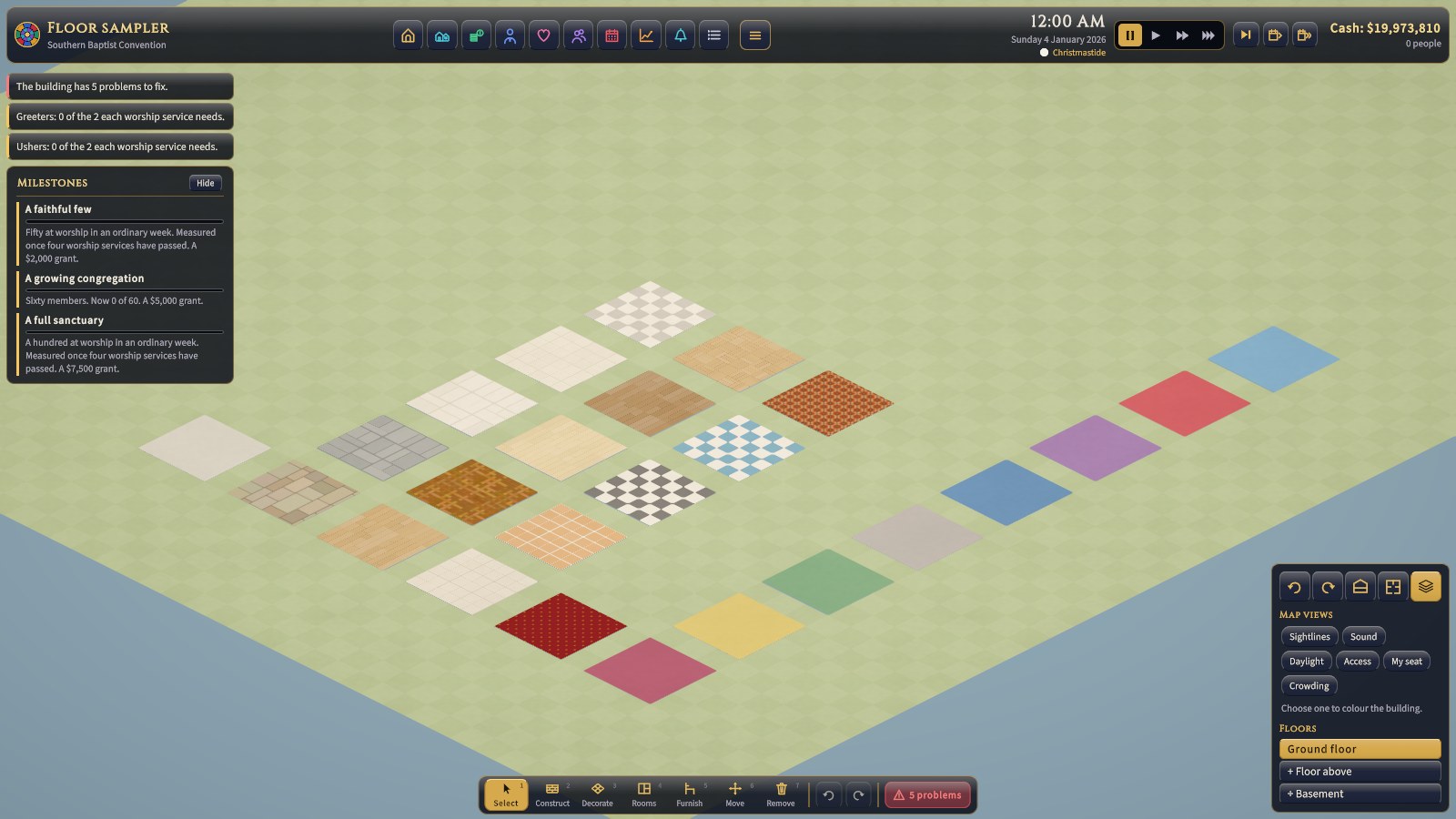
| Floor | Pattern | Cost | Looks | Absorption | |
|---|---|---|---|---|---|
| Carpet | |||||
| Burgundy carpet | $60/m² | 3 | 0.30 | ||
| Gold carpet | $60/m² | 3 | 0.30 | ||
| Green carpet | $60/m² | 3 | 0.30 | ||
| Grey carpet | $60/m² | 3 | 0.30 | ||
| Navy carpet | $60/m² | 3 | 0.30 | ||
| Purple carpet | $60/m² | 3 | 0.30 | ||
| Red carpet | $60/m² | 3 | 0.30 | ||
| Royal blue carpet | $60/m² | 3 | 0.30 | ||
| Tile | |||||
| Ceramic tile | Tiles with grout | $90/m² | 4 | 0.02 | |
| Terracotta tile | Tiles with grout | $95/m² | 5 | 0.02 | |
| Checkerboard tile | Chequer | $100/m² | 5 | 0.02 | |
| Blue and white tile | Chequer | $110/m² | 5 | 0.02 | |
| Wood | |||||
| Oak boards | Boards | $120/m² | 6 | 0.10 | |
| Maple boards | Boards | $130/m² | 6 | 0.10 | |
| Walnut boards | Boards | $160/m² | 7 | 0.10 | |
| Oak parquet | Parquet | $170/m² | 7 | 0.10 | |
| Stone | |||||
| Slate flags | Flagstones | $190/m² | 7 | 0.02 | |
| Stone flags | Flagstones | $200/m² | 8 | 0.02 | |
| Limestone squares | Tiles with grout | $210/m² | 8 | 0.02 | |
| Marble chequer | Chequer | $320/m² | 9 | 0.02 | |
| Other | |||||
| Sealed concrete | $30/m² | 1 | 0.02 | ||
Floor above the ground costs 2.5 times the price; a basement floor 4 times.
Walls, doors and windows
| Part | Cost | Looks | Notes |
|---|---|---|---|
| Wall | $900 a metre | 3 | An interior or exterior wall, one metre long, times the style's wall cost: three times the price in Gothic. |
| Wooden door | $1,500 | 4 | A panelled wooden door. Every door absorbs a little sound (0.1). |
| Glass door | $2,400 | 5 | Glass in a slim frame, with a push bar. Lets in half a plain window's daylight. |
| Double doors | $1,800 a door | 6 | A pair of panelled doors on two walls side by side, meeting in a two-metre doorway; on one wall alone, a narrow pair. |
| Glass double doors | $2,600 a door | 6 | A pair of glass doors. Each lets in half a window's daylight. |
| Window | $1,200 | 5 | A clear window with a square top, from a sill. Lets in daylight by the way it faces; absorbs a little sound (0.05). Stained glass fits into any window. |
| Round-topped window | $1,600 | 6 | A round arched head on piers of wall. 0.95 of a plain window's light. |
| Full-length window | $2,000 | 6 | Nearly to the floor, with a square top. 1.5 times a plain window's light. |
| Full-length round-topped window | $2,400 | 7 | Nearly to the floor, under a round arch. 1.45 times a plain window's light. |
Door colours. A door is in its own colour (oak, or a glass door's dark frame) unless it's painted: red or black (looks 7), white, forest green, or navy (looks 6), $250 a door. Doors and windows to the outside add to curb appeal by their looks. Paint it as it goes in, or repaint one later; taking the paint off is free. Putting a different door in its place takes the paint off with the old door.
Wall finishes and curb appeal
Each face of a wall can be finished on its own, from the Decorate tray's Walls tab: the paint tool finishes the side of each wall you can see, so a wall between two rooms can be different on each side. Any finish goes on any face; some are usually for inside or outside, as their cards say. A face with no finish keeps the style's own. Finishes cost by the metre of wall, one face at a time, and taking one off is free. A listed building's outside has to stay as it was built.
| Finish | Side | A metre | Looks | Notes |
|---|---|---|---|---|
| Butter yellow paint | Either | $60 | 4 | A warm, sunny yellow. |
| Cream paint | Either | $60 | 4 | A soft cream, kind to old plaster and candlelight. |
| Dove grey paint | Either | $60 | 3 | A light, neutral grey. |
| Dusty rose paint | Either | $60 | 4 | A muted pink, warm in a nursery or a parlour. |
| Navy paint | Either | $60 | 5 | A deep blue: striking on a door wall or a chancel's east end. |
| Sage paint | Either | $60 | 4 | A quiet grey-green. |
| Sky blue paint | Either | $60 | 4 | A pale blue, airy in a plain meeting room. |
| White paint | Either | $60 | 3 | Two coats of a clean, warm white. |
| Plaster | Inside | $180 | 4 | Smooth lime plaster, left in its own warm white. |
| Clapboard siding | Outside | $280 | 5 | Painted wooden boards lapped one over the next: the white country church. |
| Wainscot | Inside | $300 | 6 | Wooden panelling to a chair rail, cream plaster above. |
| Stucco | Outside | $320 | 5 | A smooth lime render, warm and weatherproof. |
| Oak panelling | Inside | $480 | 7 | Oak boards from floor to ceiling: a vestry, a library, a chancel. |
| Red brick | Either | $650 | 6 | A veneer of red brick laid in running bond: the colonial church's face. |
| Buff brick | Either | $700 | 6 | Pale yellow-brown brick, laid in running bond. |
| Dressed stone | Either | $1,100 | 8 | Squared stone blocks in courses: the look of a cathedral's walls. |
- Curb appeal is 40% the finishes on the walls' outer faces, 20% the doors and windows, and 40% the grounds (trees, flowers, a fountain), the grounds with diminishing returns. At its best it brings 15% more newcomers.
- Doors and windows count by their looks: glass or double doors, round-topped or full-length windows, and painted doors (red and black look 7; navy, forest green and white 6). A door to the outside counts double. The plain door and window, unpainted, count for nothing, like walls left in the style's own finish. Painting a plain front door red is the cheapest lift there is.
- A worship space with finished walls lifts everyone by up to +0.02 a service, and weddings by up to 0.15.
- A playground pleases families with children under 13 (+0.02 a service).
Architectural styles
There are twelve styles. Two are the ones American churches made familiar (colonial brick and Gothic); ten belong to the other faiths' buildings in America. Any tradition may build in any of them: a style is judged only by how formal it is, so a synagogue can be Gothic, a gurdwara colonial brick, and a church a Japanese temple hall.
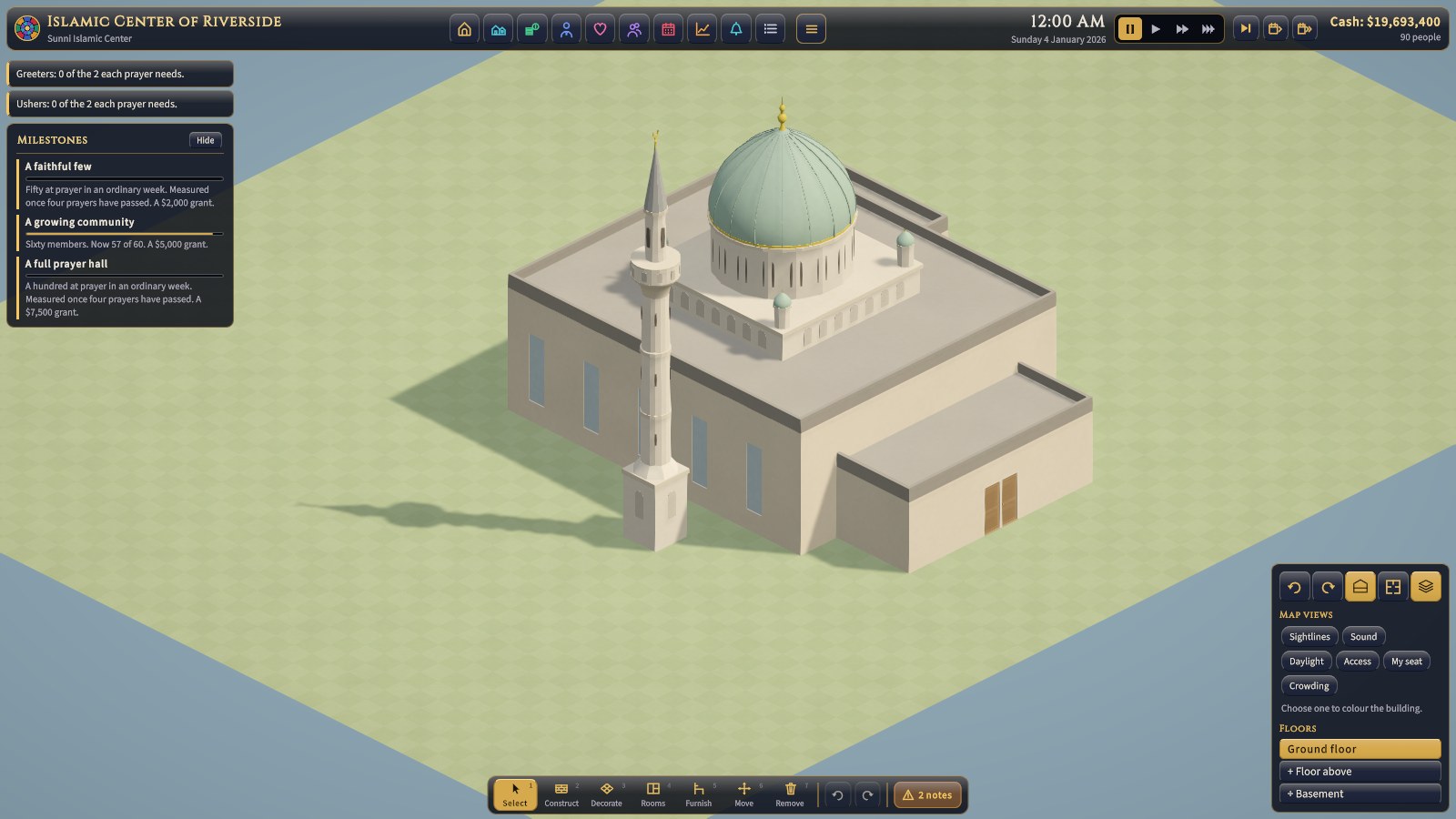
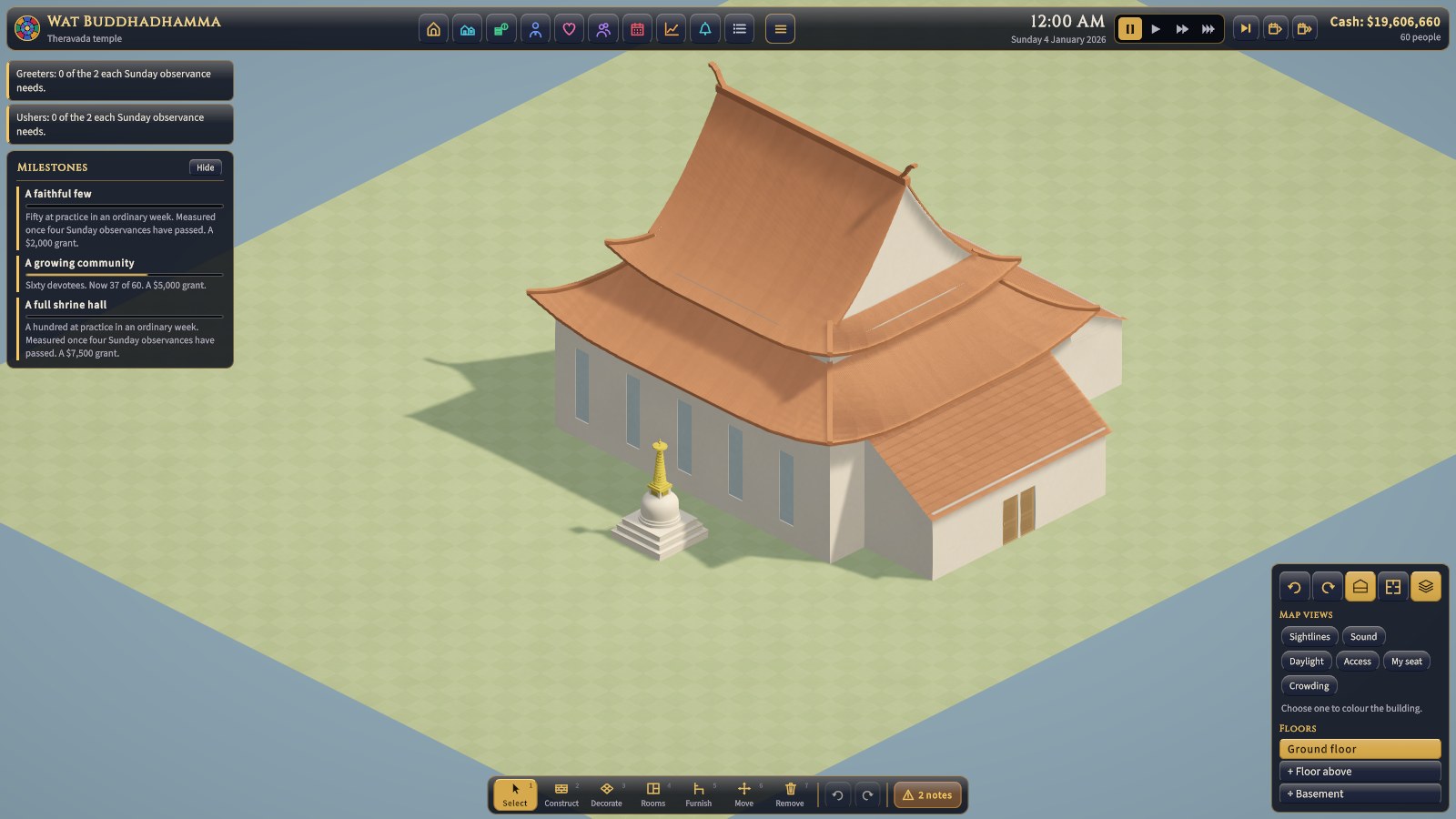
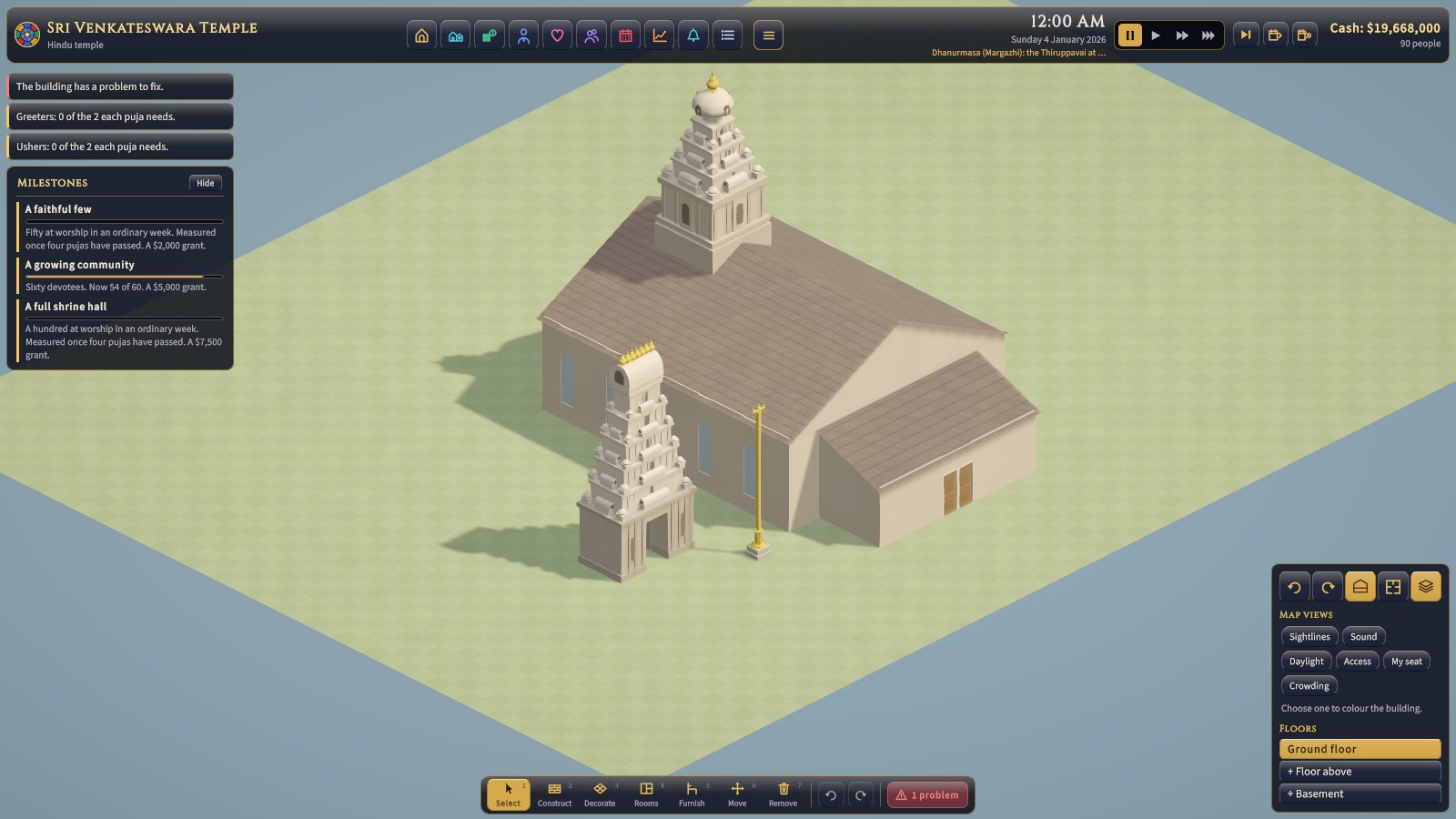
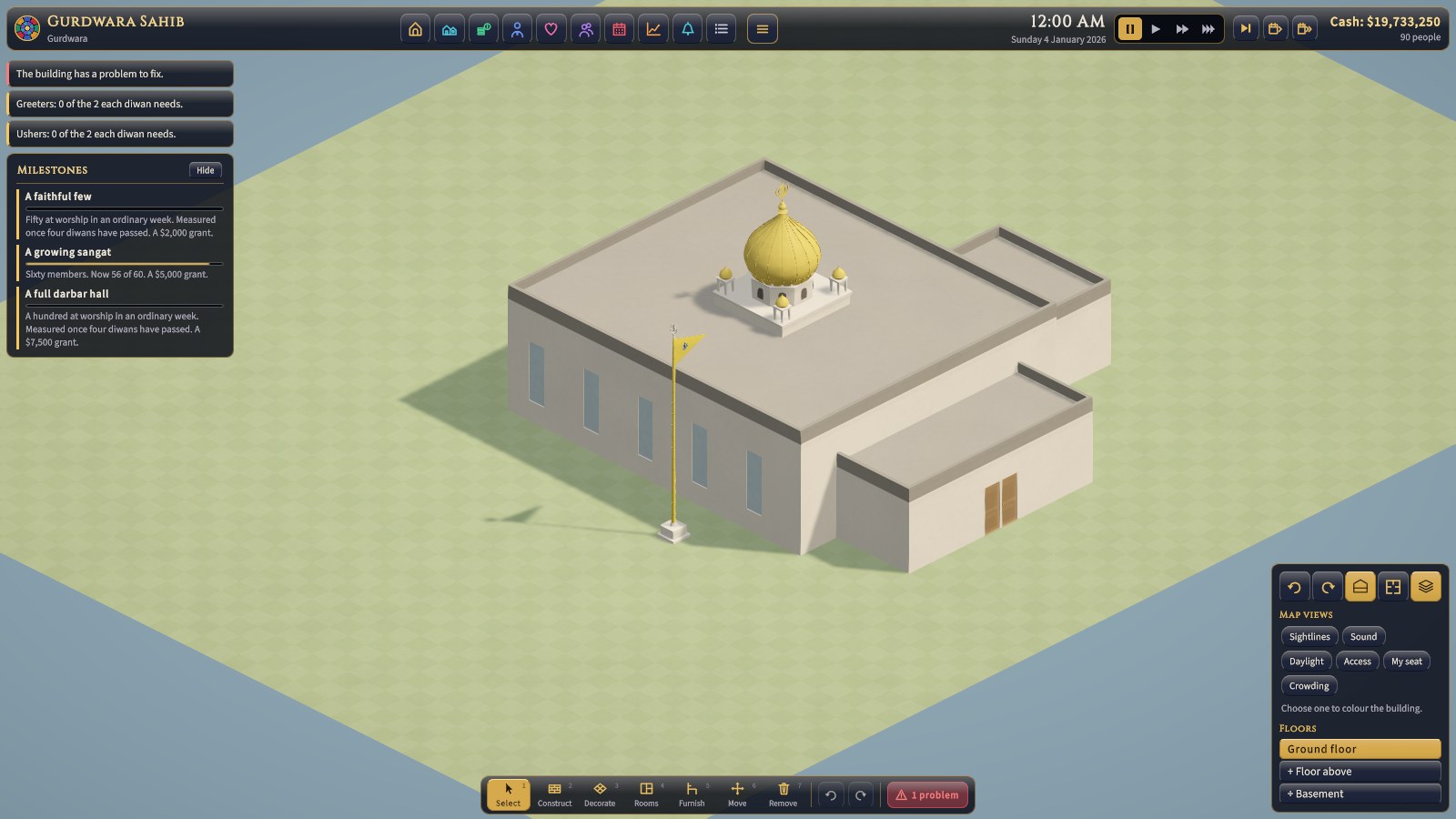
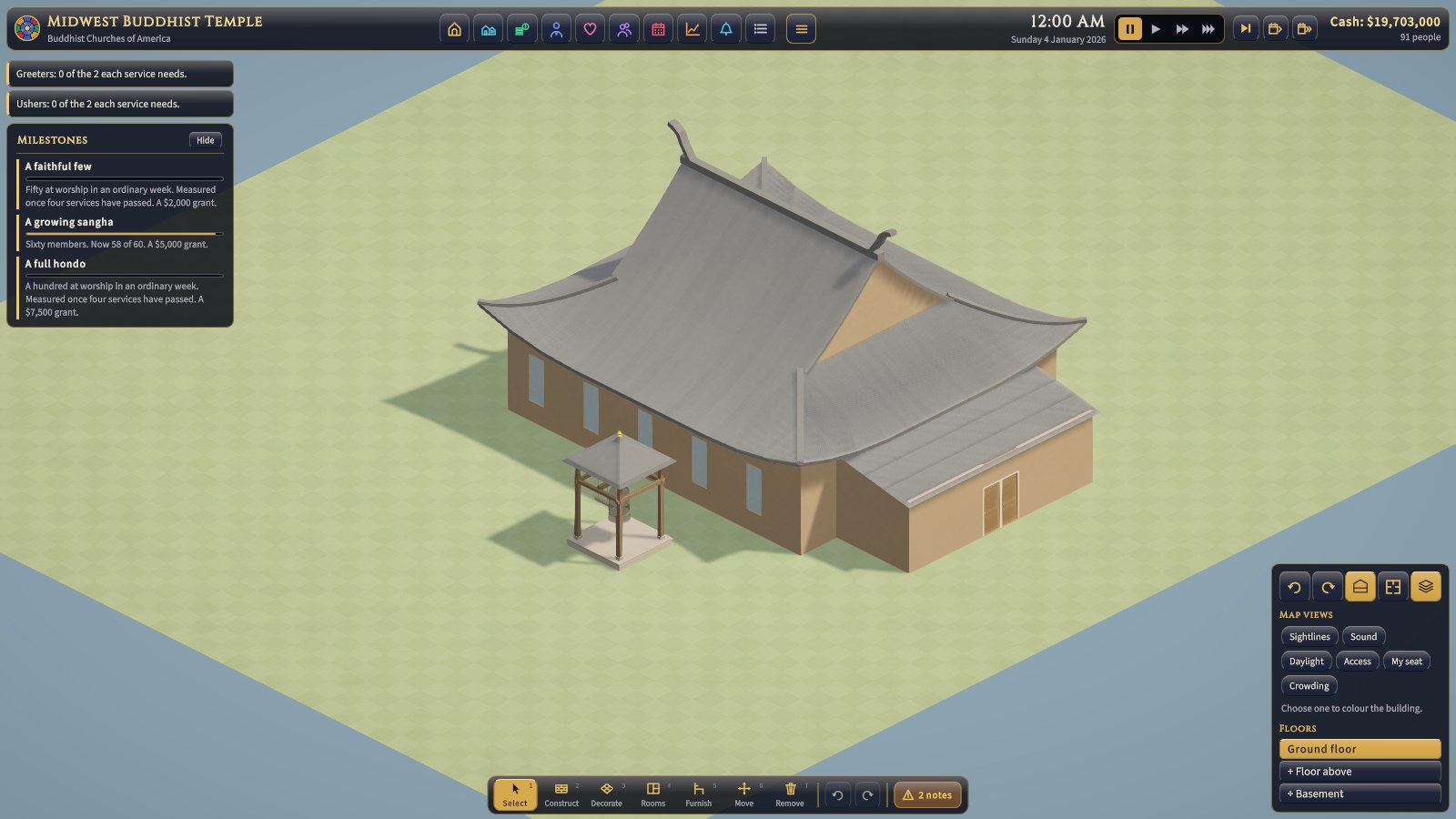
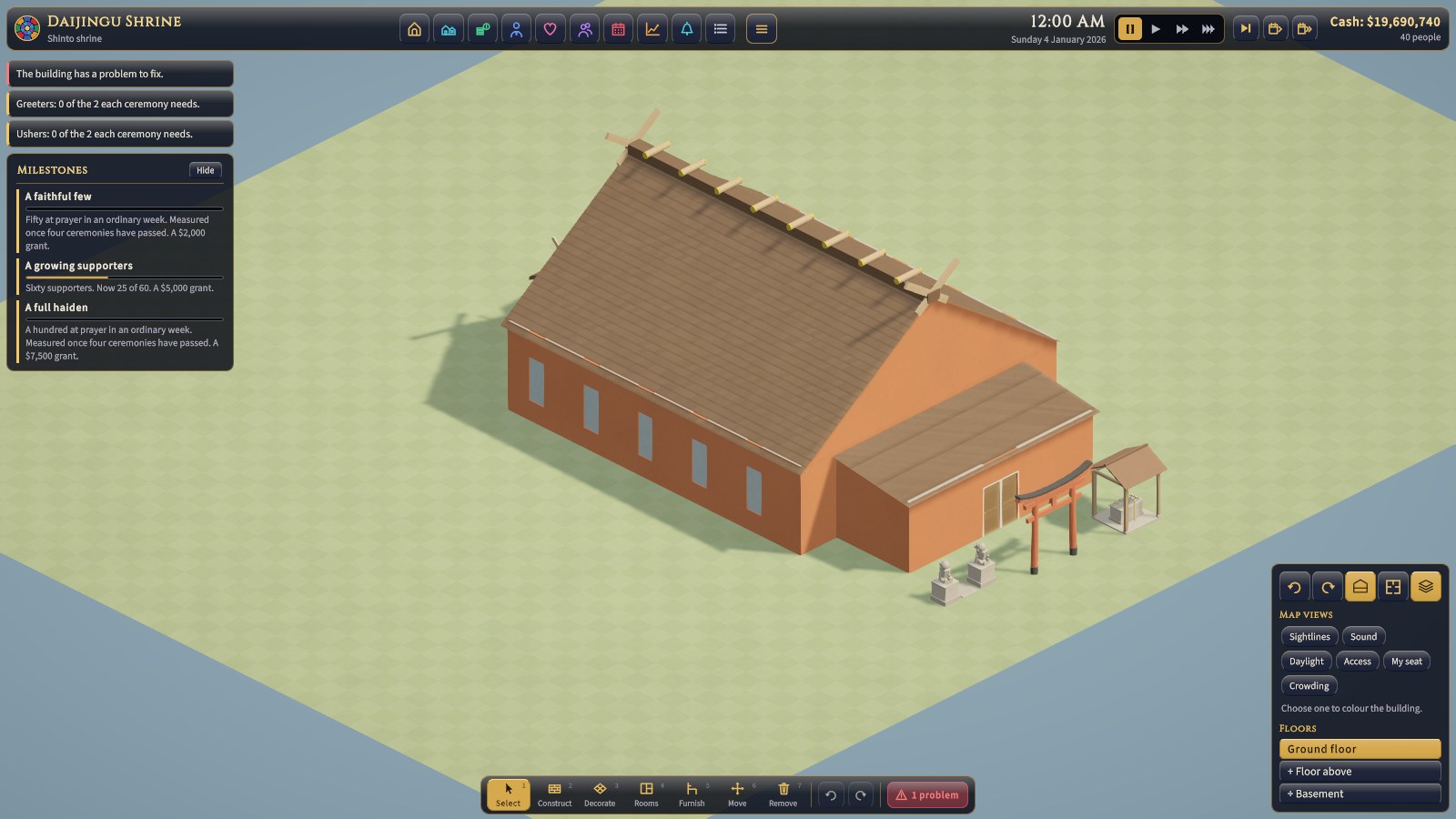
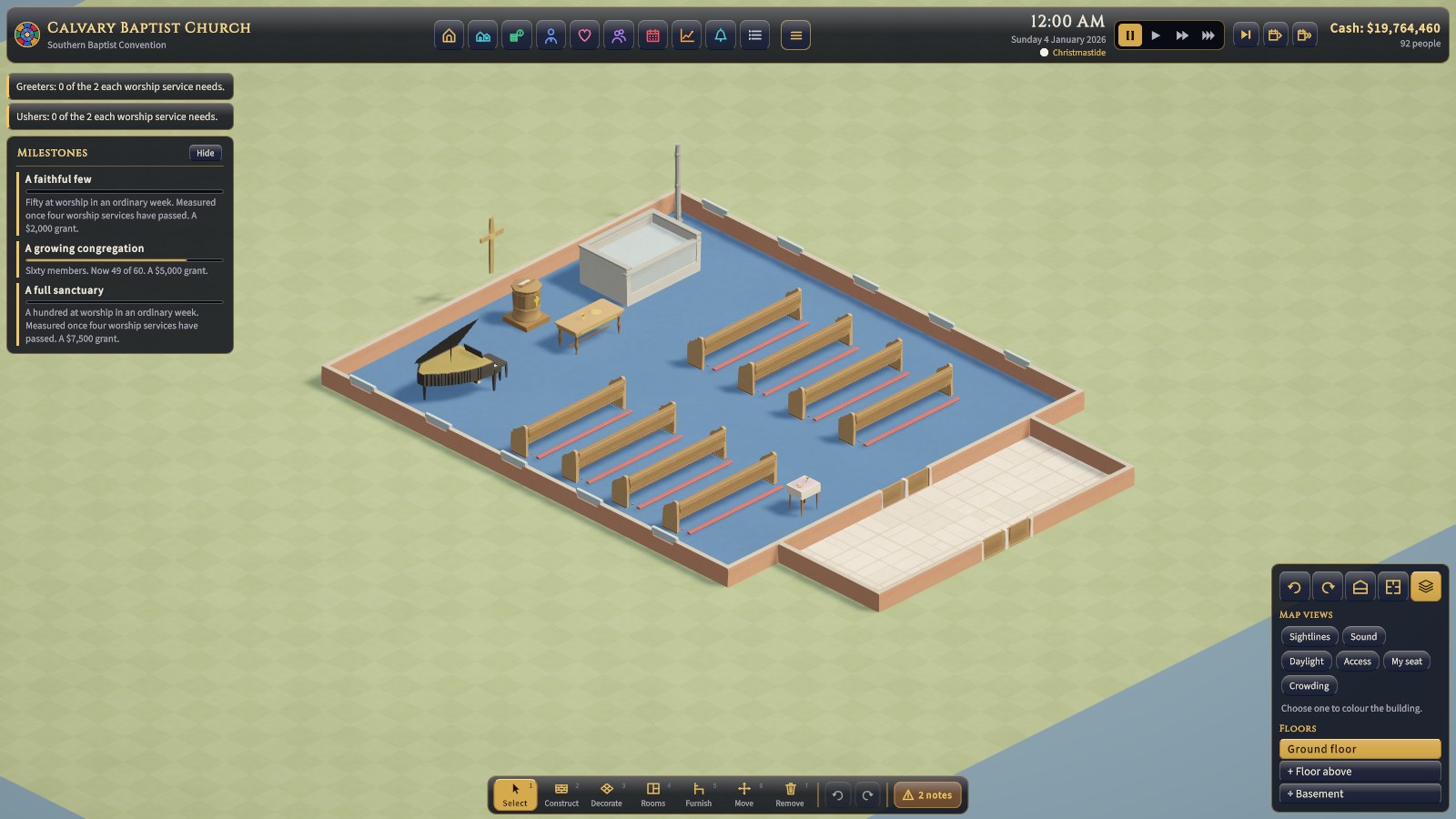
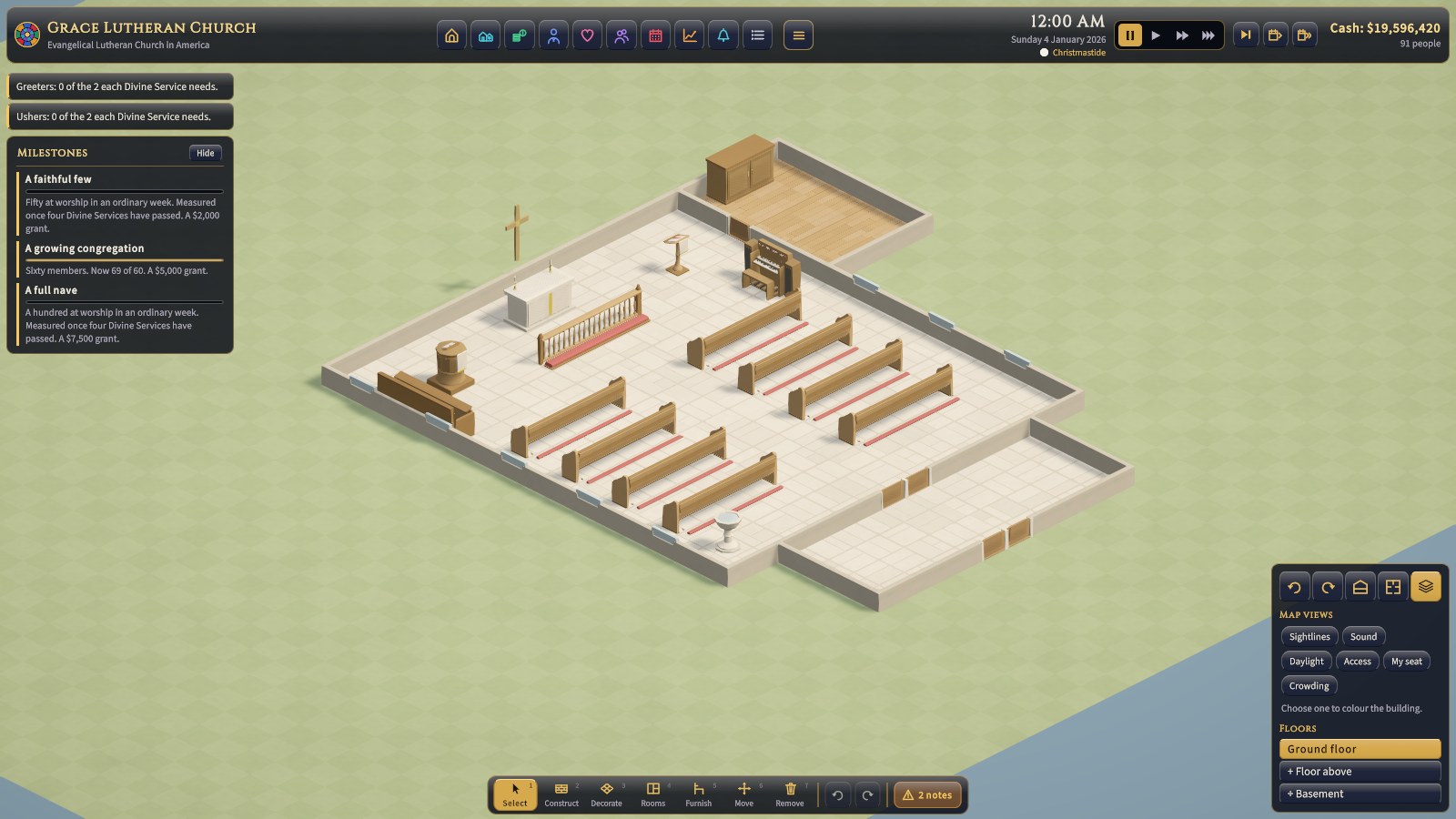
| Style | What it is | Ceiling | Wall cost | Heat loss | Wall absorption | Window light | Formality | Looks |
|---|---|---|---|---|---|---|---|---|
| Colonial brick | Red brick, white trim, clear windows, and a plaster ceiling at an ordinary height: the American meeting house. Cheap to build and to heat, and acoustically plain. | 3.2 m | ×1 | ×1 | 0.06 | 1.0 | 0.4 | 5 |
| Modern synagogue | Pale stone and warm timber, after the synagogues American architects built in the fifties and sixties: tall rooms lit by clerestories and broad windows, and wood that softens the sound so the spoken word comes through. Well insulated. | 5 m | ×1.3 | ×0.95 | 0.12 | 1.2 | 0.55 | 7 |
| Japanese temple | Stained timber posts and beams, plaster between them, and paper screens that soften the daylight. Wood keeps the sound warm and close; draughty in winter. | 4.2 m | ×1.6 | ×1.25 | 0.10 | 0.85 | 0.7 | 8 |
| Islamic | Pale stone and plaster, pointed and horseshoe arches, geometric tilework and calligraphy, and windows behind carved screens. Tall and hard, so a voice reciting carries and rings. | 5.5 m | ×1.8 | ×1.1 | 0.03 | 0.75 | 0.75 | 8 |
| Thai temple | Whitewashed walls, gilded and lacquered doors and shutters, tall narrow windows, and a high hall glittering with glass mosaic. Grand, bright, and costly; its hard walls ring with chanting. | 6 m | ×2.2 | ×1.15 | 0.03 | 0.7 | 0.85 | 9 |
| Gurdwara | White marble and white stucco, scalloped arches, little domed kiosks at the corners, and broad doors on every side. Bright and tall; its hard floors carry kirtan to the back. | 5 m | ×1.6 | ×1.05 | 0.03 | 1.0 | 0.6 | 8 |
| Shinto shrine | Cypress posts and beams painted vermilion, white plaster between them, and deep eaves. Wood keeps the sound soft; draughty in winter. | 4 m | ×1.7 | ×1.3 | 0.10 | 0.9 | 0.75 | 8 |
| Chinese temple | Red lacquered columns, beams painted blue, green, and gold, dragons twined round the pillars at the door, and lattice windows. Smoky with incense; its painted wood keeps the sound warm. | 5 m | ×1.9 | ×1.2 | 0.06 | 0.75 | 0.8 | 9 |
| Nagara temple | Carved sandstone in the North Indian way: walls stepped out in carved projections, columned porches, and a sanctum that grows darker the deeper it lies. Among the dearest to build. | 6 m | ×2.4 | ×1.15 | 0.02 | 0.6 | 0.85 | 9 |
| Dravidian temple | Carved granite in the South Indian way: halls of carved pillars under flat stone ceilings, and few windows, so the lamps do the lighting. Among the dearest to build. | 5 m | ×2.5 | ×1.2 | 0.02 | 0.55 | 0.85 | 9 |
| Jain marble | White marble carved as fine as lace, ceilings of concentric rings and pendants, every column a sculpture, carved in Rajasthan and shipped over. Cool, pale, and ringing; nearly as dear as Gothic. | 5.5 m | ×2.8 | ×1.1 | 0.02 | 0.8 | 0.9 | 10 |
| Gothic | Stone, pointed arches, and a vault high overhead. Expensive to build and to heat, and it rings: an organ and a choir sound glorious, a band turns to mud. | 9 m | ×3 | ×1.3 | 0.02 | 0.8 | 0.95 | 9 |
The roof is chosen apart from the style, in Construct → Roof, and includes three temple roofs with upturned eaves, the Chinese one with its swallowtail ridge, and a Shinto shrine's cypress bark (see Keeping the building standing); domes, minarets, stupas, pagodas, and the Hindu temple towers are items set on the roof or the grounds (The item catalogue).
After each service, a style moves everyone by up to 0.06, by how close its formality is to the tradition's: 1 − 2 × |style formality − tradition formality|, scaled to ±0.06. A tradition's formality is 0 (minimal: Friends, Churches of Christ), 0.33 (low), 0.67 (moderate), or 1 (high).
- High (1): a Conservative or Orthodox synagogue, the Ahmadis, a Zen center, a Chinese Buddhist temple, a South Indian Hindu temple, Tenrikyo, a Catholic or Orthodox parish. Gothic (0.95) and Jain marble (0.9) are nearly perfect; the Nagara and Dravidian temples and the Thai temple (0.85) and the Chinese temple (0.8) close behind.
- Moderate (0.67): a Reform synagogue, a Sunni or Shia Islamic center, the gurdwara, BAPS and ISSO, ISKCON, a Jain center, most Buddhist temples, a shrine and Konko, a folk temple and Yiguandao, a United Methodist church. Japanese temple (0.7), Islamic and Shinto shrine (0.75), and Gurdwara (0.6) suit them best.
- Low (0.33): a Reconstructionist synagogue and Chabad, the W. Deen Mohammed community, SGI, the Indo-Caribbean mandir, the Arya Samaj, Chinmaya Mission, SRF, a Sathya Sai center, Jain Vishva Bharati, a Daoist temple, a Baptist church. Colonial brick (0.4) is closest.
Each tradition's page in Every tradition: services and what they need gives every style's score for it. A Gothic worship room also has nearly three times the volume to heat, and loses 30% more heat. Refacing an existing building costs half of building its walls new in the style. Wedding couples from outside book formal, handsome buildings, so Gothic draws more of the $2,500 weddings.
Lots
Every house of worship stands on a kind of lot, which sets its size, how many neighbours it has, and how many people walk in.
| Lot | Size | Land price | Neighbours | Walk-ins | Description |
|---|---|---|---|---|---|
| Urban | 40 × 32 m | $900,000 | 1.6 | ×1.3 | A corner lot in the city: dear and tight, with transit at the door. Many neighbours, many passers-by. |
| Suburban | 64 × 48 m | $250,000 | 1.0 | ×1.0 | A lot on a residential street: room for a church and its grounds, with neighbours on every side. |
| Rural | 96 × 72 m | $60,000 | 0.3 | ×0.7 | A country lot on a two-lane road: plenty of land, cheap, and few neighbours to hear the bells. Few people pass by to walk in. |
Neighbours scales how much noise costs you with the people next door (see The congregation in its community). With a steeple's peal of bells, the loudest thing in the game (1.0), relations settle near 0.22 in town, 0.4 in a suburb, and 0.61 in the country. Quieter things count less: a Buddhist temple bell (0.6), a sound system or a drum kit, a folk temple's joss paper furnace (0.3, its smoke) and censer (0.1), Tenrikyo's kagura instruments (0.1); a minaret makes none, since most American mosques give the call to prayer inside. Below 0.4 the neighbours complain and new construction is refused planning permission. Extra land to the east or south costs the lot's price per square metre.
Climates
The climate is where the building is: fourteen regions of the United States, each modelled on a city's weather. Choose it when you set up a sandbox (Region), or move the congregation in Church → Church, where each region shows its typical January and July, its sunshine, and how often rain keeps people home. It sets:
- Heating and cooling bills, by the month's degree-days (how far below or above 18 °C the days are, added up).
- Snow and heat waves: snow in cold months (up to one day in five, a tenth of them blizzards), heat waves in hot ones (up to three in ten). Both keep people home; snow most.
- Rain, month by month: a wet day keeps a few people home, whichever day the service falls on.
- The sun's times and the qibla: each region has a place (a latitude, a longitude, its time zone and daylight saving), so sunrise, sunset, nightfall, candle-lighting, and the five prayer times are worked out for every day there, and with them the bearing to Mecca. A mosque in Seattle prays Maghrib at a different hour from one in Miami, and turns a little differently to face the qibla; a synagogue's Shabbat begins at its own candle-lighting; a gurdwara's Rehras follows its own sunset; and a Hindu temple's festivals fall on the lunar day as it stands at sunrise, noon, or midnight there.
- Sunshine: sunnier places' windows are brighter (up to about a sixth brighter in the desert, a little dimmer in the grey Northwest), and their solar panels make more: each panel's 5% is for an ordinary place's sun, so it's ×1.55 in the Desert Southwest and ×0.84 in the Pacific Northwest, up to 30% in all.
| Region | Like | January | July | Heating degree-days a year | Cooling degree-days a year | Sunshine | Rain, weeks | Solar |
|---|---|---|---|---|---|---|---|---|
| Alaska | Anchorage | 17 °F (-8 °C) | 59 °F (15 °C) | 5,605 | 20 | 43% | 1 in 7 | ×0.78 |
| Desert Southwest | Phoenix | 56 °F (13 °C) | 95 °F (35 °C) | 500 | 2,680 | 85% | 1 in 22 | ×1.55 |
| Gulf Coast | Houston | 55 °F (13 °C) | 85 °F (29 °C) | 555 | 1,865 | 56% | 1 in 8 | ×1.01 |
| Hawaii | Honolulu | 74 °F (23 °C) | 81 °F (27 °C) | 15 | 2,715 | 64% | 1 in 9 | ×1.17 |
| Mid-Atlantic | Philadelphia | 33 °F (1 °C) | 79 °F (26 °C) | 2,405 | 775 | 56% | 1 in 7 | ×1.03 |
| Midwest (the default) | Chicago | 25 °F (-4 °C) | 72 °F (22 °C) | 3,525 | 420 | 54% | 1 in 7 | ×0.99 |
| Mountain West | Denver | 30 °F (-1 °C) | 74 °F (23 °C) | 3,280 | 410 | 68% | 1 in 9 | ×1.23 |
| Northeast | Boston | 29 °F (-2 °C) | 73 °F (23 °C) | 3,040 | 440 | 58% | 1 in 6 | ×1.05 |
| Pacific Northwest | Seattle | 42 °F (6 °C) | 67 °F (19 °C) | 2,455 | 190 | 46% | 1 in 5 | ×0.84 |
| South Florida | Miami | 68 °F (20 °C) | 84 °F (29 °C) | 45 | 2,615 | 66% | 1 in 6 | ×1.20 |
| Southeast | Atlanta | 42 °F (6 °C) | 79 °F (26 °C) | 1,520 | 1,030 | 61% | 1 in 7 | ×1.11 |
| Southern California | Los Angeles | 58 °F (14 °C) | 72 °F (22 °C) | 675 | 695 | 73% | 1 in 26 | ×1.33 |
| Southern Plains | Dallas | 47 °F (8 °C) | 86 °F (30 °C) | 1,105 | 1,615 | 64% | 1 in 10 | ×1.16 |
| Upper Midwest | Minneapolis | 15 °F (-9 °C) | 73 °F (23 °C) | 4,095 | 415 | 58% | 1 in 7 | ×1.05 |
Heating costs the volume × the month's heating degree-days × $0.0018; cooling, the volume × cooling degree-days × $0.003; electricity and water, $0.90 per m² of enclosed floor a month. In the Midwest a small 114 m² building pays about $447 to heat in January and $3 in July. Only floored space inside walls is heated.