Chapter 14
Scenario walkthroughs
Each scenario hands you a congregation (a church, a synagogue, a mosque, a temple, a gurdwara, a shrine) in trouble or in transition, with goals to reach and failures to avoid. These walkthroughs follow the plans the game's own scripted player, "the steward", uses to win: a sensible leader with no cleverness. You should do better.
Each scenario is played as one of its traditions, chosen with its Play as buttons. The dying congregation can be a Baptist church, a Catholic parish, a Conservative synagogue, or a Shin Buddhist temple; the suburban plant a Baptist, Pentecostal, Adventist, Sunni, or Zen one. Six scenarios belong to the other faiths: a storefront mosque, a temple in a house, a synagogue turning a hundred, two synagogues merged under one roof, a church become a mosque, and a dharma center after its teacher's fall. Two more are American churches' own: a country church sharing its pastor, and a historic Black church in a neighbourhood that has changed around it. Five more belong to the faiths added since: a church become a Hindu temple, a gurdwara born of a split, a Hawaii shrine whose priest has retired, a Chinatown temple upstairs, and a Jain center raising its shikhara; some of these are played in two variants of one tradition (a South or North Indian temple, a Shvetambara or Digambara center). The scenario's words are its tradition's: a rabbi and Shabbat, an imam and Jumu'ah, a sangha and its Sunday service (Faiths and traditions says what else changes).
How scenarios work
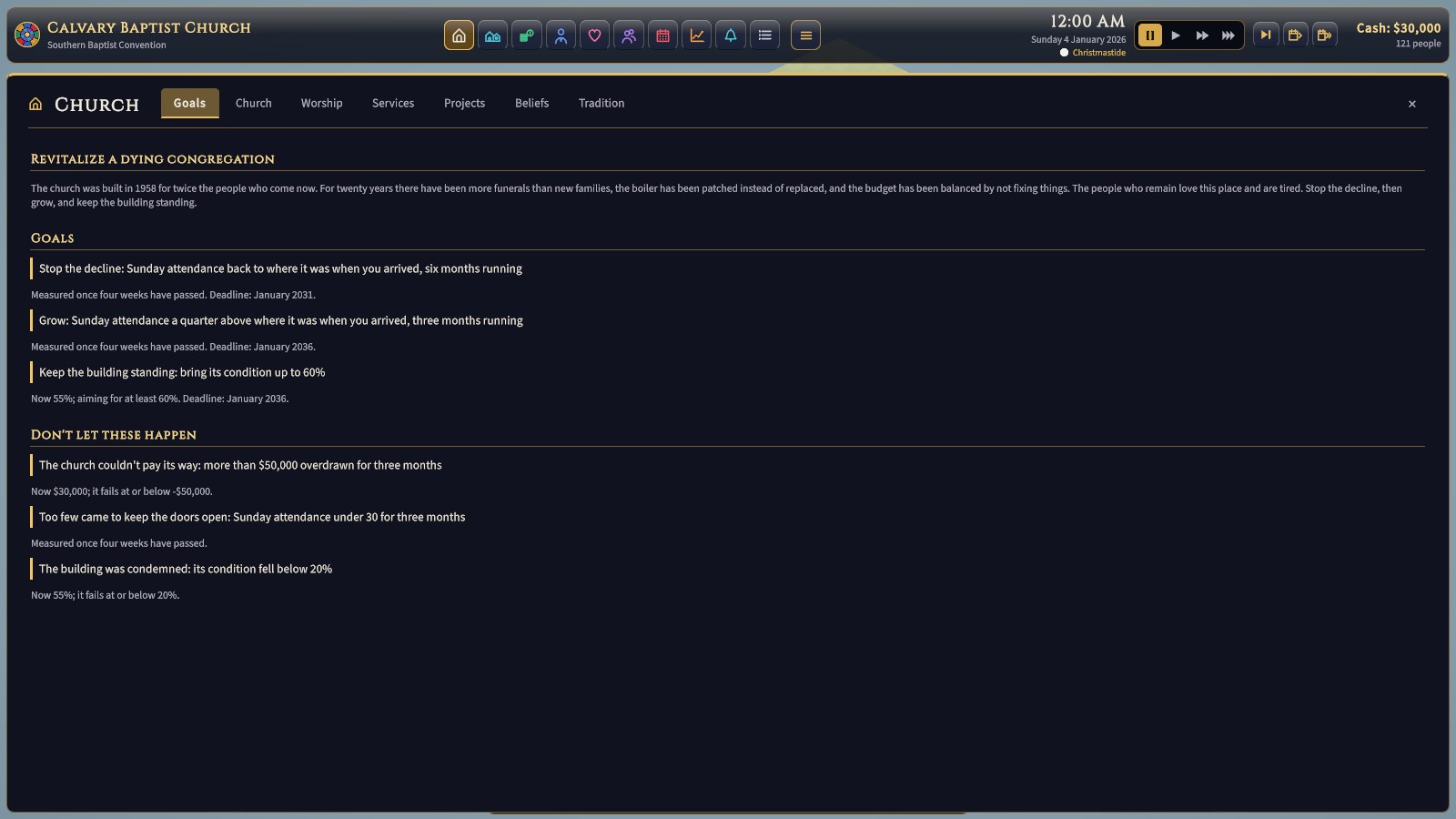
- Church → Goals shows the briefing, each goal with its deadline and where you stand, and the failures to avoid.
- Goals and failures are checked once a month, an hour after the monthly business. Many must hold for several months in a row.
- A goal is achieved once it holds for its months. It's missed if its deadline passes first, and a missed goal loses the game.
- A failure ends the game once it holds for its months. Some scenarios give you a few months' grace at the start.
- When every goal is achieved, you've won. After a win or a loss, the game carries on, but nothing more is checked.
Revitalize a dying congregation
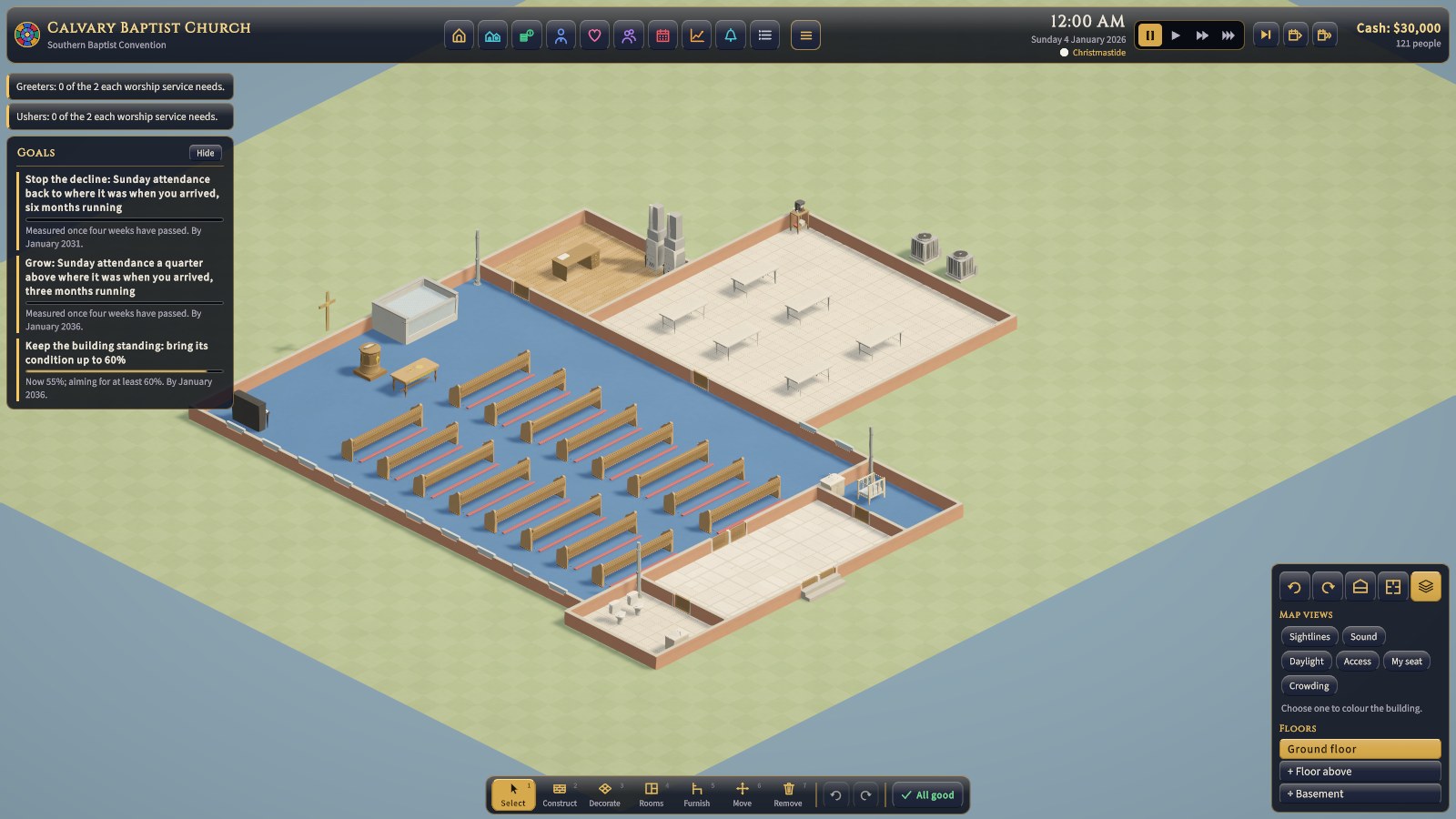
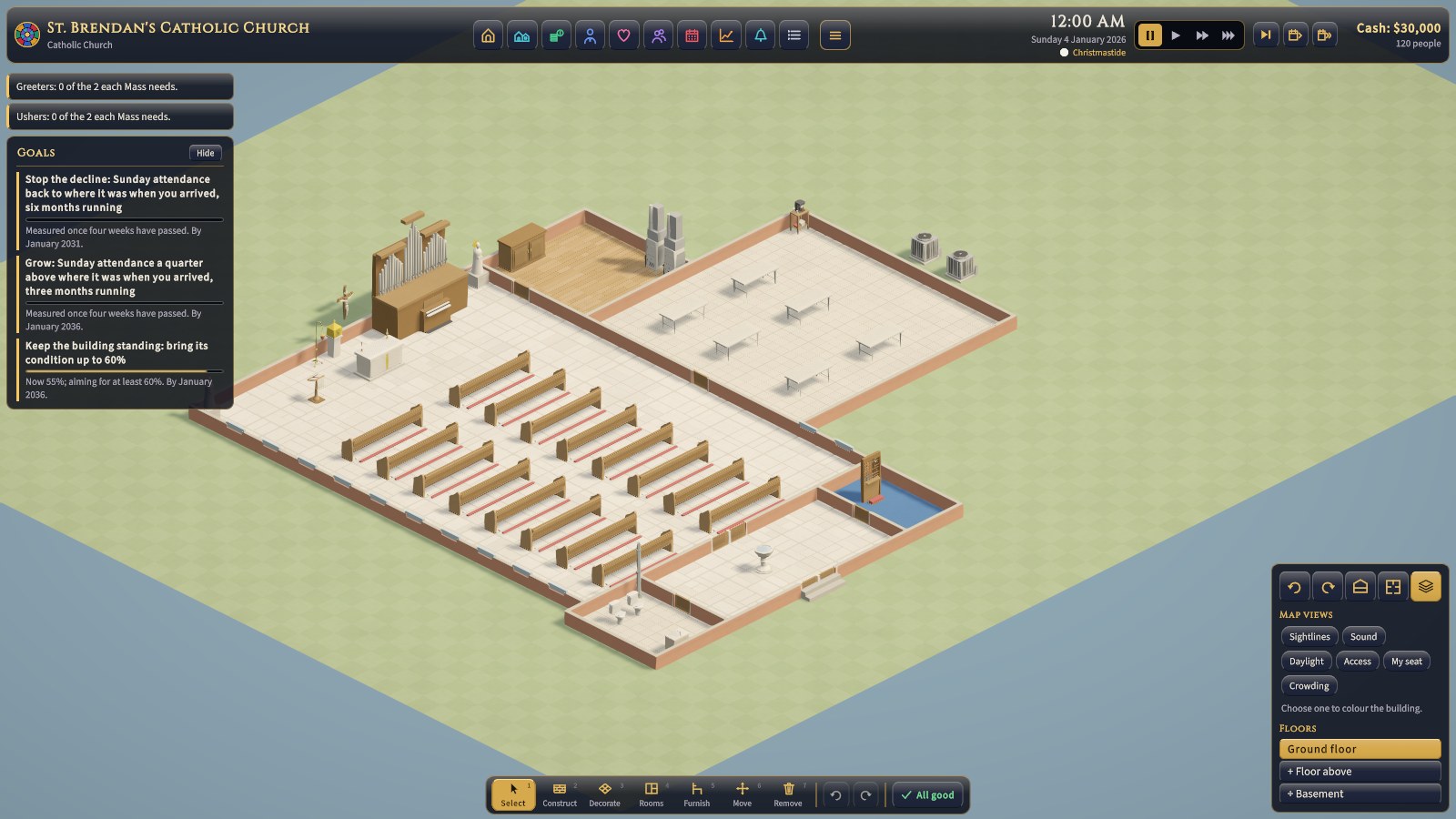
"The church was built in 1958 for twice the people who come now. For twenty years funerals have outnumbered baptisms, the boiler has been patched instead of replaced, and the budget has been balanced by not fixing things. The people who remain love this place and are tired."
| You start with | About 120 people, mostly over 55, satisfaction between 0.37 and 0.67. $30,000 cash and a $250,000 endowment. A full-time pastor (you) and no other staff: at St. Brendan's, a priest the diocese has sent; at Beth Shalom, a rabbi; at the Prairie Buddhist Temple, a minister. Every building system at 0.55, and no maintenance budget. 128 seats, steps at the front doors, no hearing loop. Baptists give more per adult ($3,900 against $3,100 at the parish and the temple, and $2,800 at the synagogue). The synagogue and the temple give as dues: 70% of it assessed, paid by the households engaged enough to keep up their membership. |
|---|---|
| To win | Attendance on the day of worship (Sunday, or Shabbat) back to where it started, six months running, within five years. Attendance a quarter above where it started, three months running, within ten years. Building condition up to 60% for three months. |
| You lose if | More than $50,000 overdrawn for three months; under 30 on the day of worship for three months; condition below 20%. |
Walkthrough
- Stop the bleeding (month 1). Draw 5% from the endowment. Set a maintenance budget. Recruit greeters, ushers, a nursery team, and singers. Left alone, the building never recovers, and the Baptist church often runs out of money too: the untouched parish loses every time.
- Fix access (year 1). A Ramp at the stepped front doors, and a Hearing loop. This congregation is old, and both cost it something every week until fixed.
- Repair the building (years 1 to 3). Run a two-year repairs campaign while the building is poor, and replace any system whose monthly risk passes 3%. Get condition to 0.6 for three months to tick off that goal.
- Then grow (years 2 to 5). With money steadier, hire someone to lead the music once you average a $2,500 monthly surplus: a choir director or organist at the church or the synagogue, the organist at the Shin temple. Make sure every visitor is greeted. The church was built for twice as many, so you have seats.
- Baptist only: Southern Baptists don't pledge. People give in the plate and the boxes each week they come, so the money follows Sunday attendance: every family you keep coming is income.
- Synagogue only: the week has two main services, Friday evening and Shabbat morning, and the week's newcomers are shared between them. Keep a minyan at both: under ten adults, everyone there feels it (−0.08). Dues carry the budget, so a family that drifts stops paying: hold on to the members you have. Sell seats for the High Holy Days, when the room fills, and greet the visitors they bring. A sanctuary that faces east earns its small bonus.
- Temple only: the Buddhist Churches of America keep a Sunday service before the onaijin, with Dharma School, a monthly memorial, and Obon in summer, the year's great day. Dues and the memorial offerings carry the money, as at the synagogue. Untended it runs out of money in about four years.
- Catholic only: pay the diocesan assessment. If money is tight, pay half in the worst months; don't stop. The diocese sends the priest, and you can't let him go; if he's weak, ask for a move once he's been there two years (Staff screen). Renovations are the priest's to decide, on the finance council's advice: they take a week, not the Baptists' four, and he turns down what the parish can't pay for or most of the council is against. Propose when the council is content.
Don't rip out pews to modernize. This congregation has been here for decades, and long-standing members oppose it most (see Projects, approvals and conflict).
The steward's record: it wins every run in every tradition: the Baptists in about a year and a quarter, the Catholics in about three years, the synagogue in about five and a half, and the temple in about six (membership comes slowly where it's paid for). Doing nothing never wins: the parish, the temple, and most often the synagogue run out of money.
Plant in a new suburb
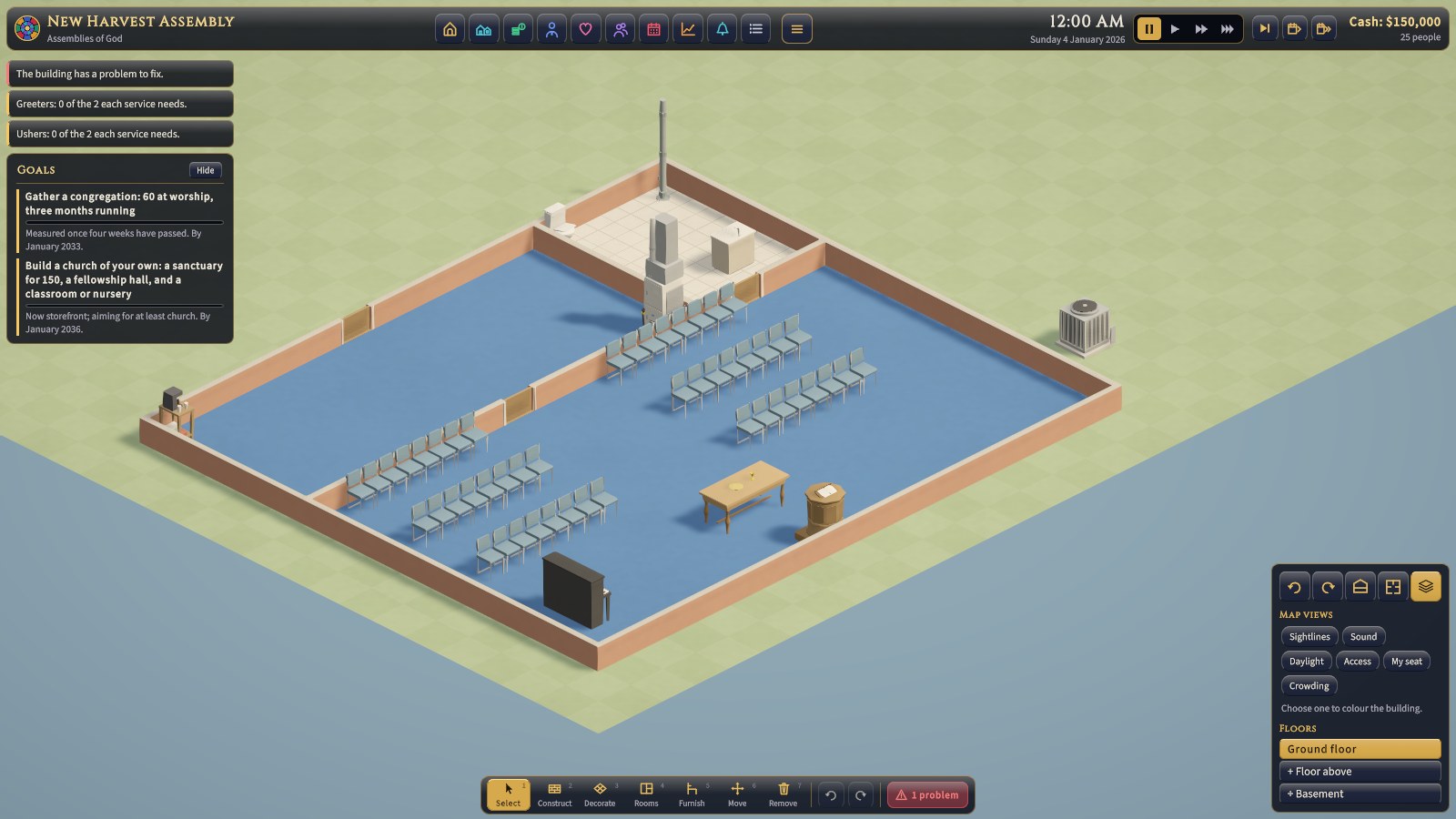
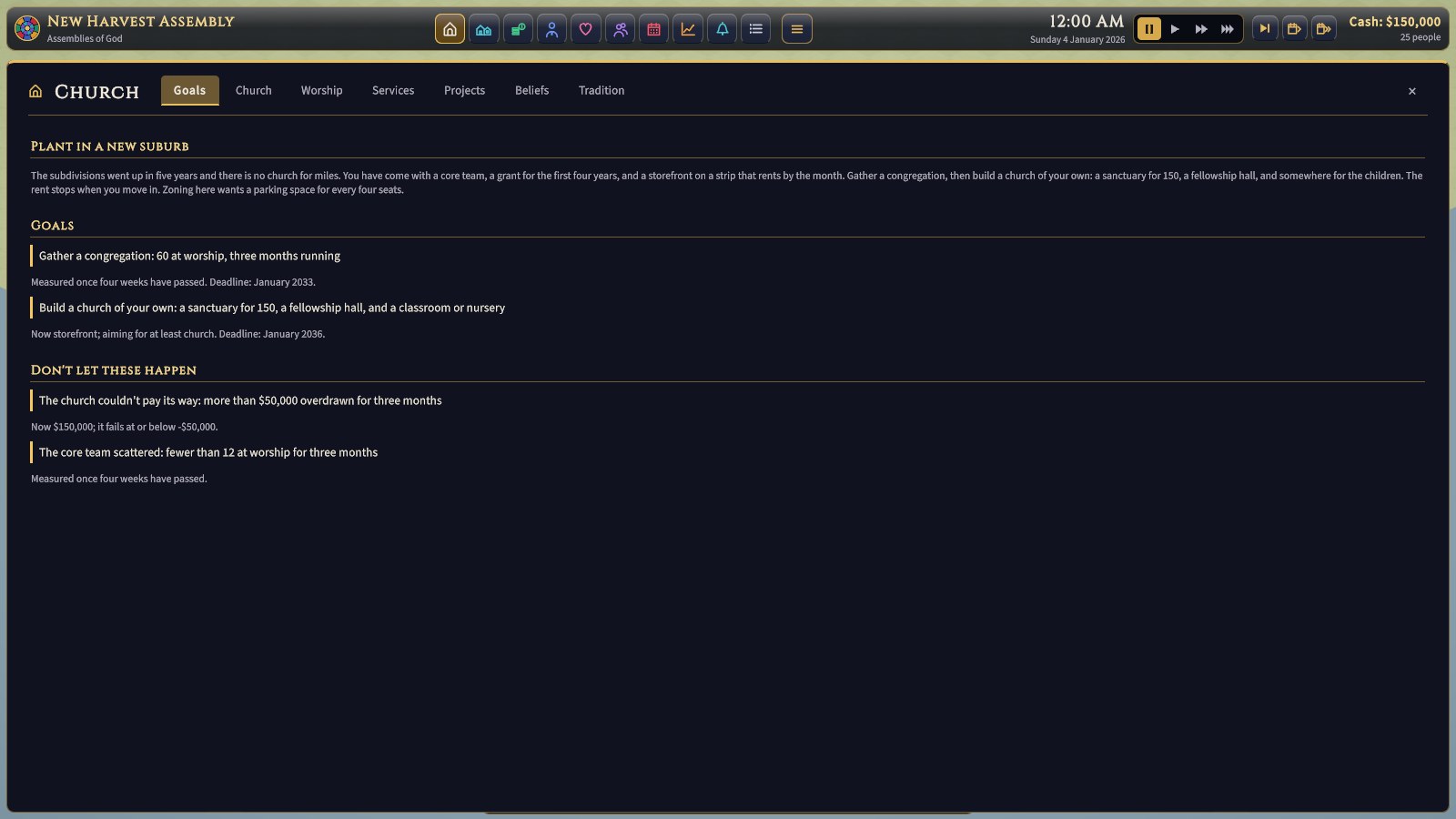
"The subdivisions went up in five years and there is no church for miles. You have come with a core team, a grant for the first four years, and a storefront on a strip that rents by the month." Al-Noor Islamic Center and Clear Creek Zen Center start the same way, in a storefront fitted as a musalla or a zendo, with a start-up grant rather than a denomination's.
| You start with | A core team of about 25 in a rented storefront on a suburban lot. A bivocational pastor (or imam, or teacher). $150,000, and a grant of $4,000 a month for four years. Rent of $2,500 a month until the church has a building of its own. Twice the usual newcomers: the suburb is new and filling up. |
|---|---|
| To win | 60 at worship within seven years. A building of its own, the third growth stage, which the game names for the tradition's building ("A church", "A mosque", "A Zen center": 150 seats, a hall, and a classroom or nursery), within ten. |
| You lose if | $50,000 overdrawn for three months; fewer than 12 at worship for three months. |
Walkthrough
- Fit out the storefront with what your tradition requires: a Baptistry with a Plumbing stack for Baptists, Pentecostals, and Adventists, plus a Drum kit and Sound system for Pentecostals, and Foot-washing basins for Adventists. The newcomers are there; welcome them.
- Gather people first. Greeters from day one, a nursery, and a restroom.
- Plan the move before the grant ends (month 48). Run an expansion campaign (the most popular cause), take a building loan, and build a sanctuary of about 150 seats beside the storefront, with a nursery or classroom.
- Turn the storefront into the hall. Reaching that stage ends the lease, and with it the rent.
- Keep the overdraft away. The plant runs close to the line. Take the loan before you need it.
- Sunni only: the new building must face the qibla (north-east from the Midwest), with prayer carpet across the room, a wudu room, a mihrab, and a minbar. Jumu'ah at midday on Friday is the main prayer; Ramadan and the Eids bring the crowds and the giving. Interest is forbidden, so the loan is Islamic financing: dearer, and most of the money raised first.
- Zen only: cushions on the floor, an altar with the Buddha image, a bell. The Sunday sitting and talk are the main service; the dawn and dusk sittings through the week draw the devoted few. Zen centers are independent and lean: little to furnish, and nothing owed upward.
The steward's record: 90% of runs as Baptists, every run as Pentecostals, about half as Seventh-day Adventists. Pentecostal worship is cheaper to furnish and owes nothing it must pay. The Baptists no longer pledge: they give in the plate and the boxes as they come, so the plant's income grows with its attendance, and gathering people first pays twice. The Adventist plant is the hardest: it worships on Saturday and keeps only Christmas and Easter of the church year, so there are few feast crowds to grow on. It sends a 15% tithe to its conference, but the conference pays its pastor. Its people give more; lean on outreach (mailings, Vacation Bible School, and the evangelistic series on Community → Evangelism) to reach 60. The steward has no plan of its own for the Islamic and Zen centers yet, so there's no record to give for them: follow the Sunni and Zen steps above, and lean on the invitation day, the open mosque and new Muslims' circle, or the meditation class for beginners.
Restore a fire-damaged historic church
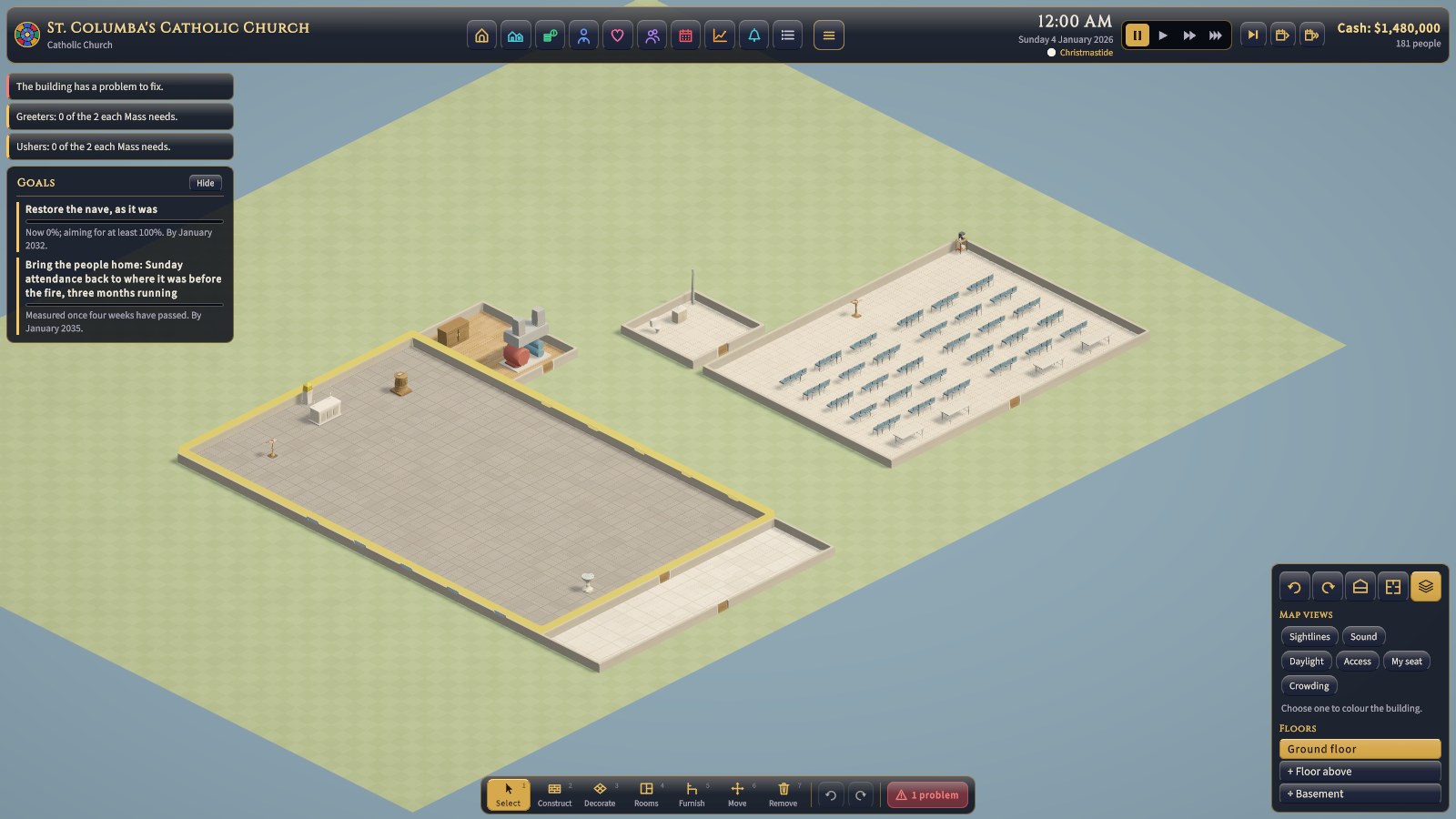
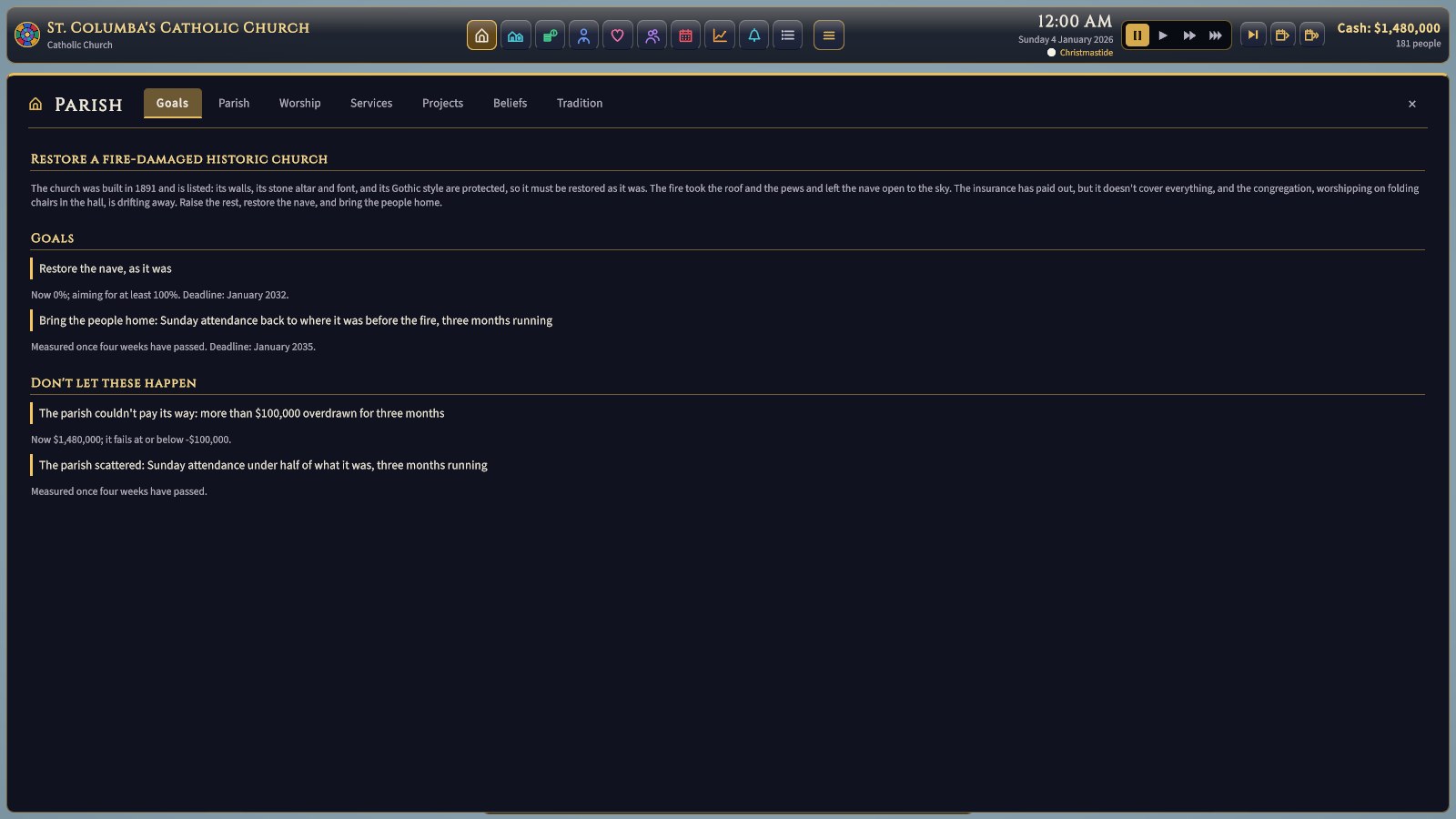
"The church was built in 1891 and is listed: its walls, its stone altar and font, and its Gothic style are protected, so it must be restored as it was. The fire took the roof and the pews and left the nave open to the sky."
| You start with | About 180 people worshipping on folding chairs in the hall. $1.4 million of insurance, paid at the start. Restoring the nave costs $1.6 million and a year's work. The walls, altar, font, and style are protected: they can't come down, be taken out, or change. |
|---|---|
| To win | Restore the nave within six years. Then bring Sunday attendance back to where it was before the fire, three months running, within nine. |
| You lose if | $100,000 overdrawn for three months; attendance under half for three months. |
Walkthrough
- Close the gap. Insurance covers most of it. A restoration loan and a repairs campaign cover the rest. Lean on the endowment while cash is low.
- Propose the restoration with the Restore button on Church → Church (it shows the price and who must approve it) as soon as the parish can carry it. Members back restoring their own church readily; a bishop wants it affordable.
- Keep the hall welcoming meanwhile. It's where visitors meet you for a year or more: greeters, a nursery, a restroom.
- Put the furnishings back when the nave is done: pews and the tradition's furniture. The building check lists what's missing.
- Don't fight the listing. Build around the protected walls and pieces.
The steward's record: every run as Catholics, 80% as Lutherans.
Build a cathedral across generations
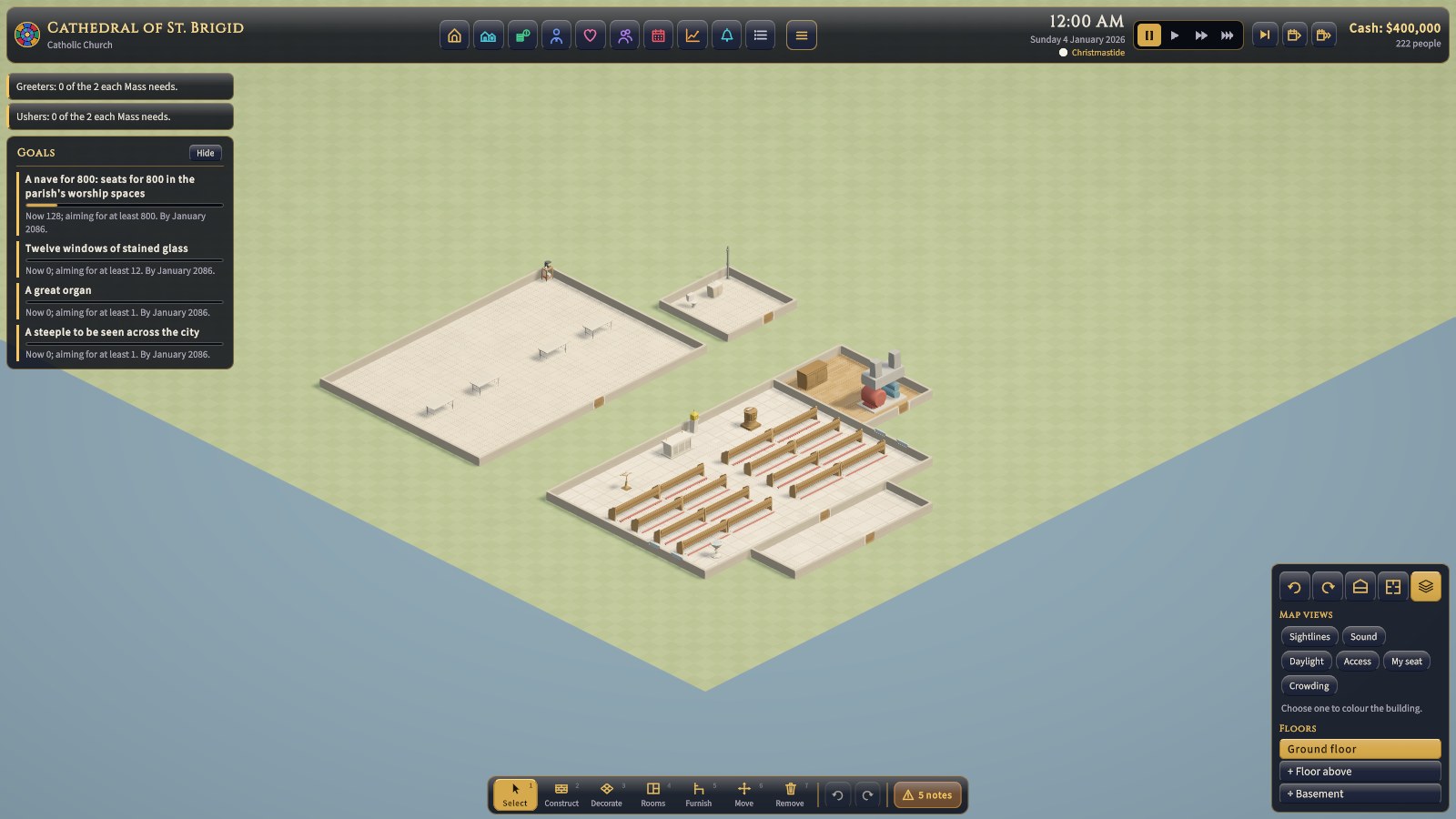
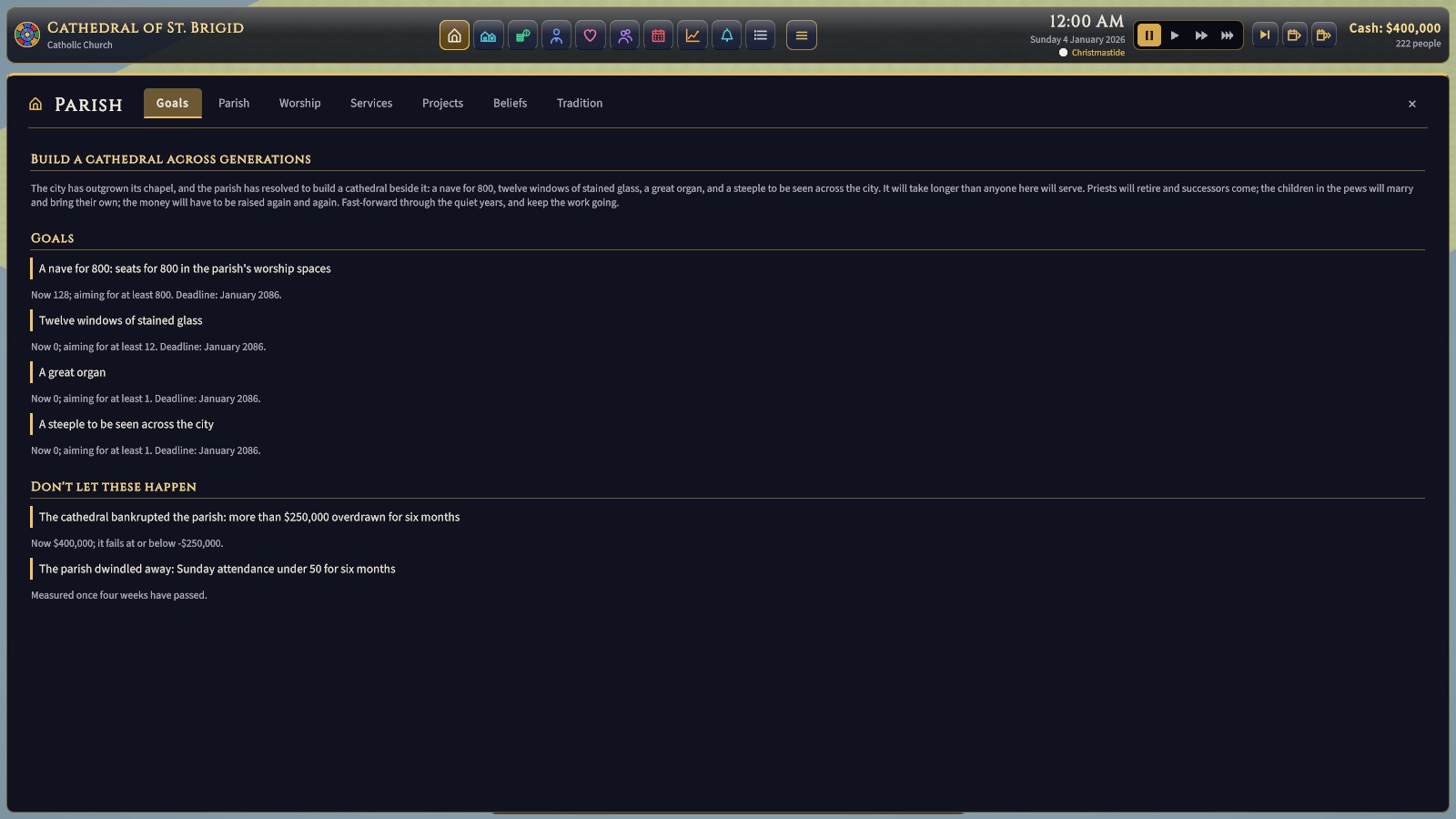
"It will take longer than anyone here will serve. Pastors will retire and successors come; the children in the pews will marry and bring their own; the money will have to be raised again and again."
| You start with | A Gothic chapel for 160, room for a nave forty metres by sixty, $400,000, and a $4 million foundation. A growing city: 1.5 times the usual newcomers. Sixty years. |
|---|---|
| To win | Seats for 800, twelve stained-glass windows, a Pipe organ, and a Steeple and bells. |
| You lose if | $250,000 overdrawn for six months; fewer than 50 on Sunday for six months. |
Walkthrough
- Keep a building campaign going the whole time. It's how a parish this size funds stone.
- Raise the nave's walls when cash and the campaign cover them. Don't lay the whole floor at once: an unfloored shell costs nothing to heat, so floor it in sections as you can use them.
- Add pews as the floor goes in, then a window of stained glass every six months, then the organ (30 months to build), then the steeple. Each is a renovation: at St. Brigid's the priest decides it within a week, on the finance council's advice.
- Lean on the foundation once the nave stands, at a sustainable rate.
- Ask only for what the bishop will grant, and ask again for what was turned down once you can afford it.
- Use Skip a year beside the clock (the calendar page with two arrows). Decades pass event by event: pastors retire and are replaced, generations are born, marry, and grow up.
The steward's record: 95% of runs as Catholics and every run as Lutherans, in twelve to sixteen years.
A storefront mosque
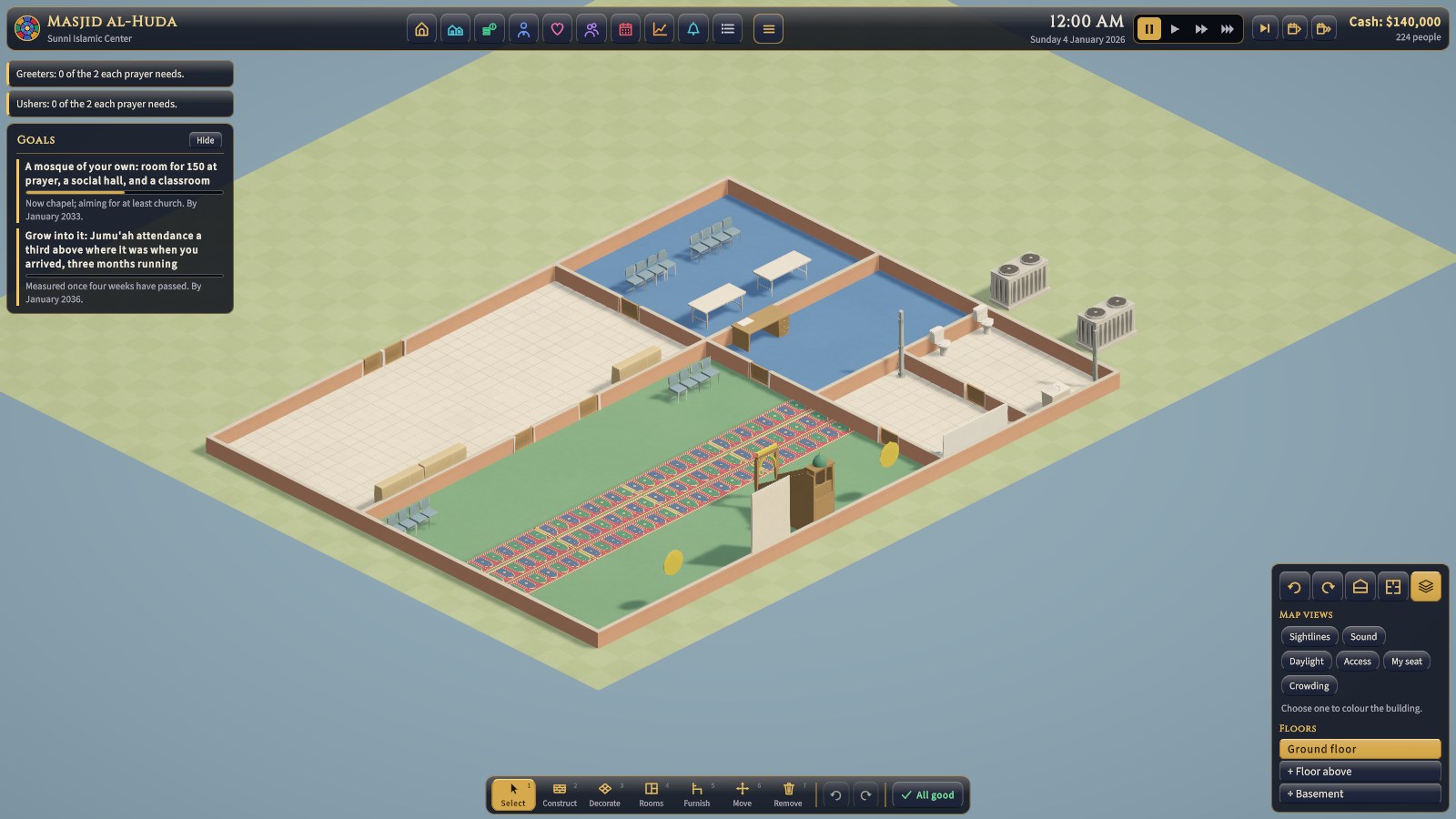
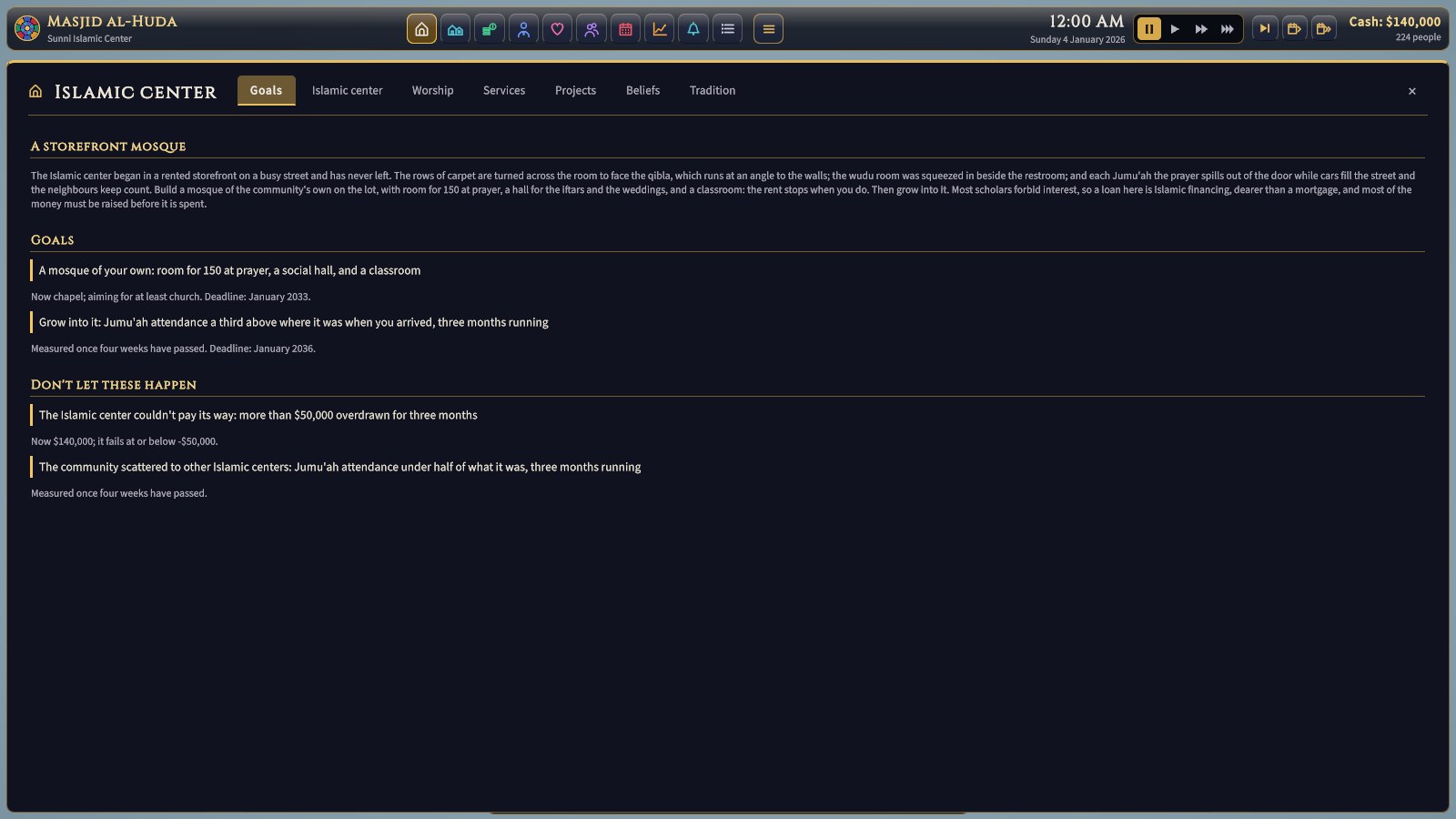
"The community began in a rented storefront on a busy street and has never left. The rows of carpet are turned across the room to face the qibla, which runs at an angle to the walls; the wudu room was squeezed in beside the restroom; and each Friday the prayer spills out of the door while cars fill the street and the neighbours keep count." Played as a Sunni Islamic center (Masjid al-Huda) or a W. Deen Mohammed community (Masjid Ash-Shura).
| You start with | About 220 people, younger than most congregations, in a rented storefront on an urban lot in the mid-Atlantic. $140,000, no endowment. Rent of $3,200 a month until the community has a building of its own. Masjid al-Huda has a part-time imam; Ash-Shura's imam is elected and unpaid, with a lay leader. |
|---|---|
| To win | A building of your own, the third growth stage ("A mosque": room for 150 at prayer, a social hall, and a classroom), within seven years. Then Friday attendance a third above where it started, three months running. |
| You lose if | $50,000 overdrawn for three months; Friday attendance under half of what it was for three months (after six months' grace); or the building goal missed. |
Walkthrough
- Save first. Left alone, the community gives well and the money piles up, but the rent never stops and nothing gets built: the seven-year goal is missed. Most scholars forbid interest, so the loan here is Islamic financing, dearer than a mortgage, and most of the money must be raised before it's spent. Run an expansion campaign early; Ramadan and the Eids bring the year's best giving.
- Build to the qibla. A prayer hall turned toward Mecca (use Face the qibla, Faiths and traditions), with rows of prayer carpet, a Mihrab, a Minbar, a wudu room, and a shoe rack. A hall for the iftars and weddings, and a classroom for the weekend school.
- Move in, then grow. The rent stops at that stage. Greet every visitor at Jumu'ah, keep the imam, and give the weekend school teachers.
- Open the doors. Once you're in, an open mosque day for the neighbours, a class for new Muslims, and a Qur'an class bring newcomers (Community → Ministries).
The steward's record: every run in both traditions, in about three years. It builds a second prayer hall (the women's, as many mosques have) and a social hall on the car park, which with the unit's hall makes 200 places. Doing nothing never wins: the money piles up, but nothing is built.
The temple in a house
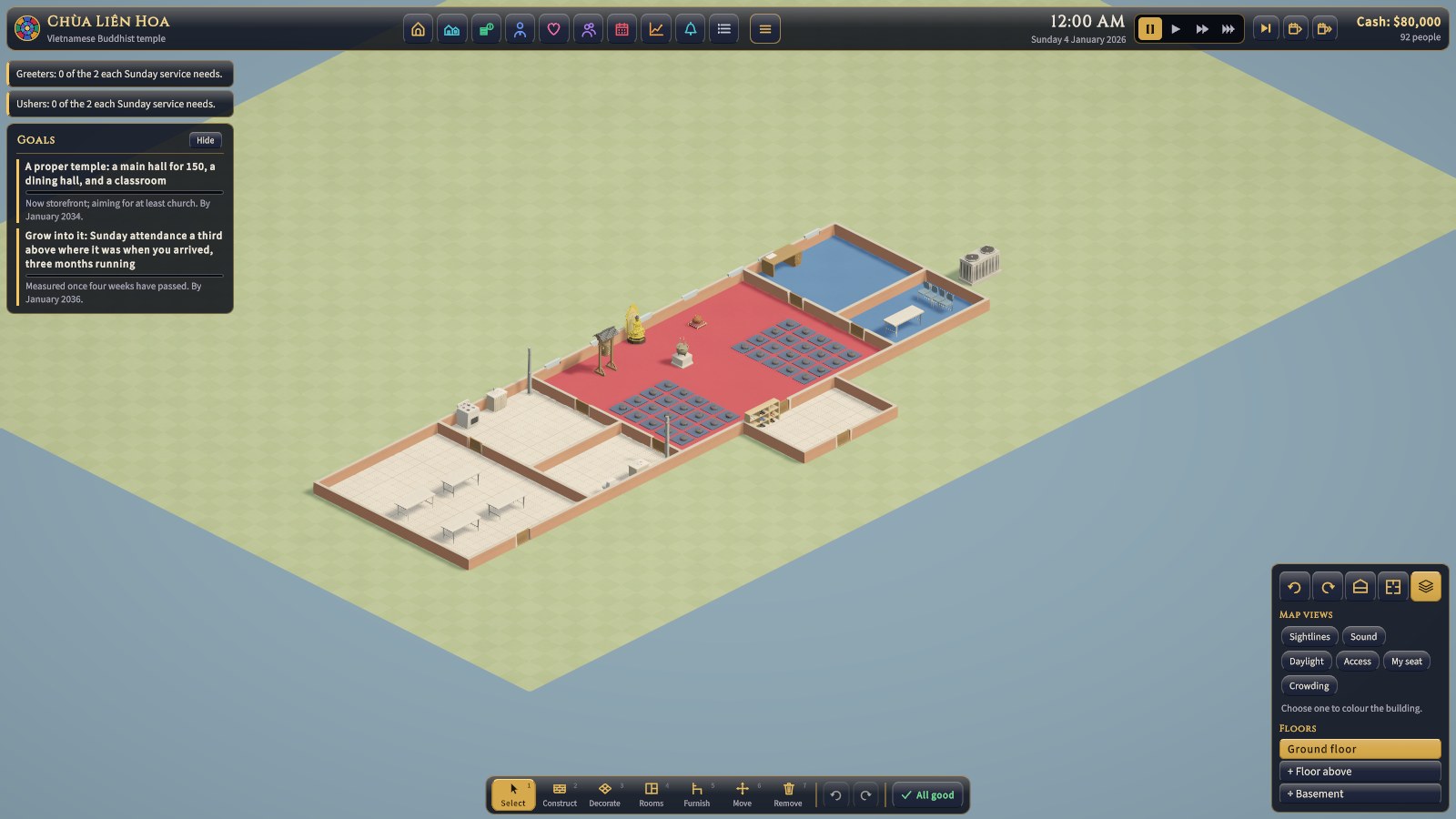
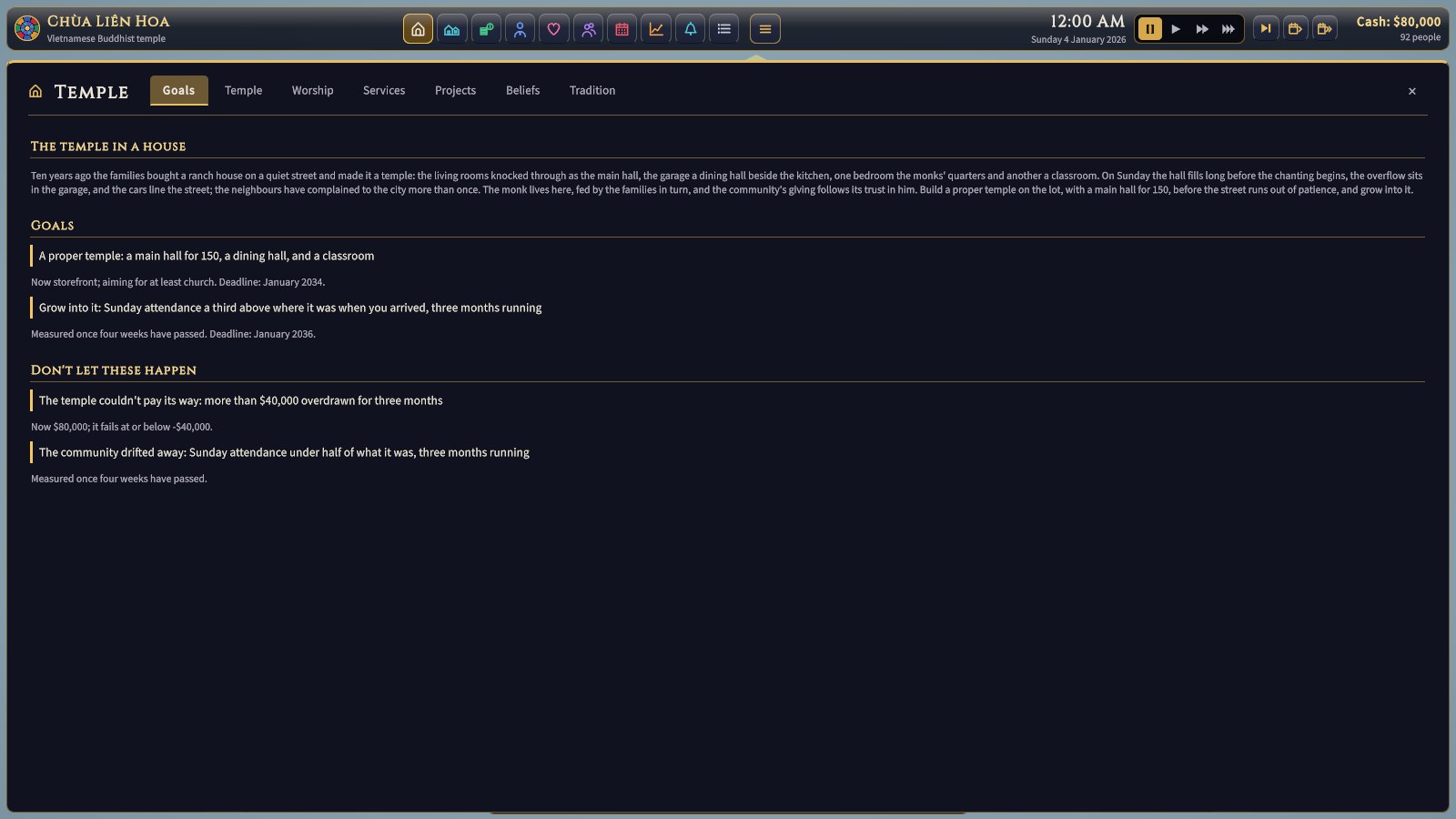
"Ten years ago the families bought a ranch house on a quiet street and made it a temple: the living rooms knocked through as the main hall, the garage a dining hall beside the kitchen, one bedroom the monks' quarters and another a classroom." Played as a Vietnamese temple (Chùa Liên Hoa) or a Theravada one (Wat Santidhamma).
| You start with | About 90 people in a converted house on a suburban lot on the Gulf Coast. $80,000, no endowment, an abbot (a monk the temple keeps: unpaid, but leading and caring for people as a full-time leader does), and a resident monk, both fed by the families in turn: the community's giving follows its trust in him. |
|---|---|
| To win | A proper temple, the third growth stage ("A temple": a hall for 150, a dining hall, and a classroom), within eight years. Then Sunday attendance a third above where it started, three months running. |
| You lose if | $40,000 overdrawn for three months; Sunday attendance under half of what it was for three months (after six months' grace); or the temple goal missed. |
Walkthrough
- Keep the monk. Monks' quarters and a kitchen are required; the dana meal is served before noon. A community that loses its monk loses its heart, and its giving.
- Raise the money for the hall. Vesak, the Lunar New Year (Tết at the Vietnamese temple), and the Ullambana or Vu Lan festival bring the year's crowds; run a campaign around them.
- Build the hall on the lot: floor seating before the Buddha image, a dining hall by the kitchen, and a classroom. Shoes come off at the door. The Vietnamese temple seats women to the left; a Stupa or a bell honours the place.
The steward's record: every run of both, in about four years. It builds a main hall behind the house with the Buddha, incense, and thirty rows of cushions; the house keeps its dining hall and classroom. Doing nothing never wins.
The centennial synagogue
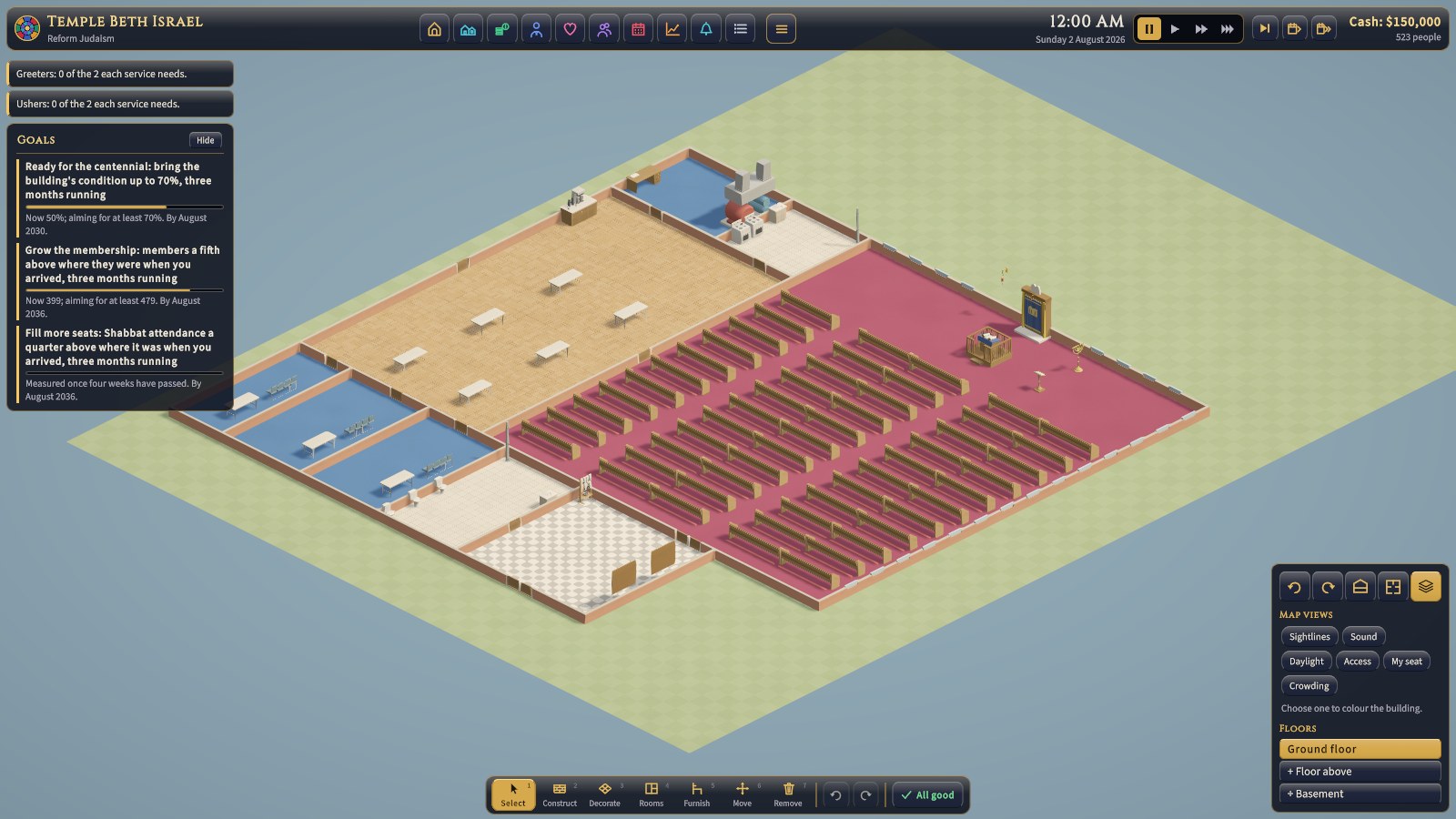
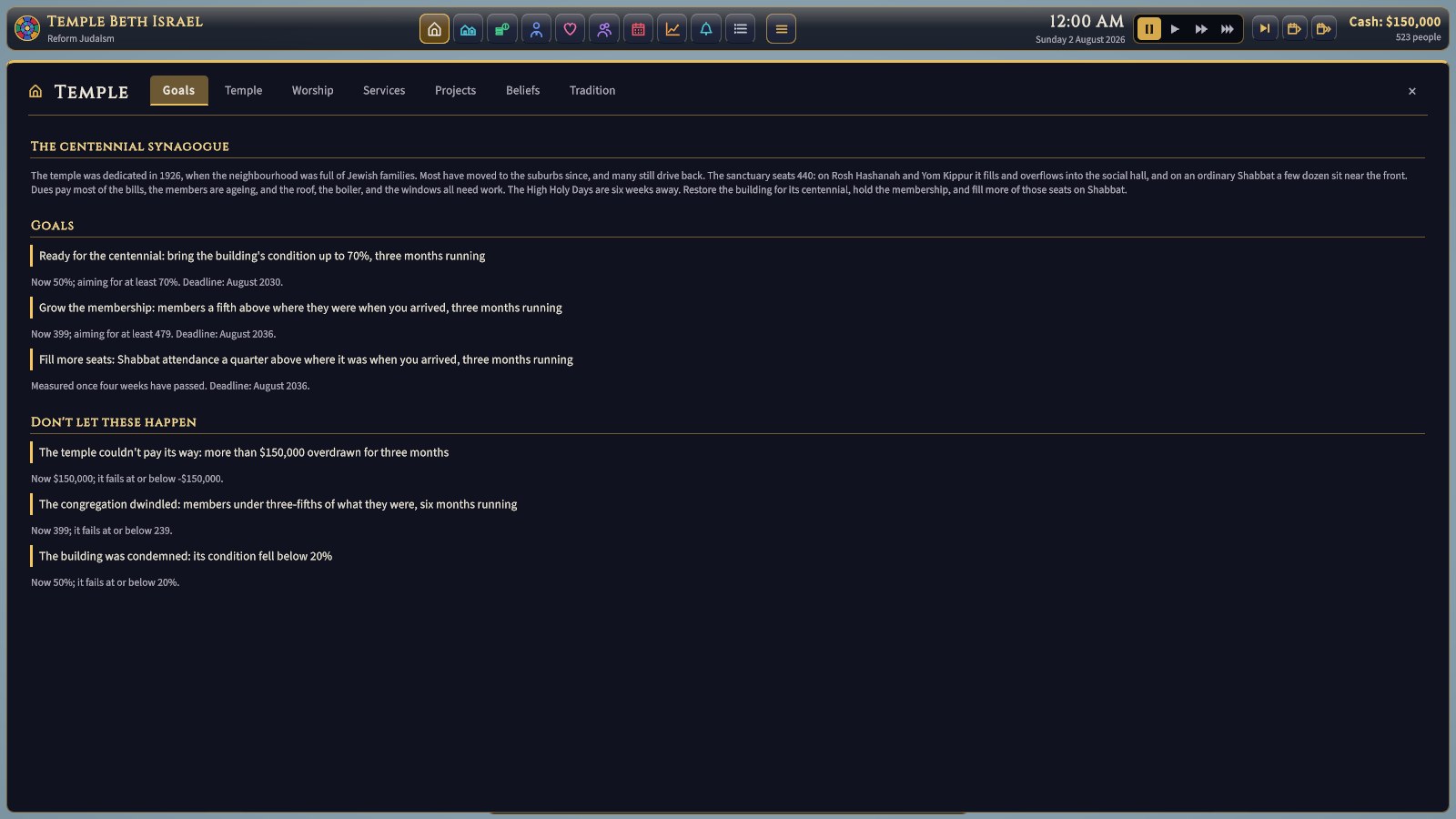
"The synagogue was dedicated in 1926, when the neighbourhood was full of Jewish families. Most have moved to the suburbs since, and many still drive back. The sanctuary seats 440: on Rosh Hashanah and Yom Kippur it fills and overflows into the social hall, and on an ordinary Shabbat a few dozen sit near the front." Played as Reform (Temple Beth Israel) or Conservative (Congregation Ohev Shalom). It begins on 2 August 2026, six weeks before the High Holy Days.
| You start with | About 520 people, most of them over 55, and dues of $1,800 a family on average. A rabbi, a cantor, and a caretaker. $150,000 and a $1.5 million endowment. A brick building in the Northeast at half its condition: the roof, the boiler, and the windows all need work. |
|---|---|
| To win | The building at 70% condition, three months running, within four years (by the centennial). Members a fifth above where they started, three months running. Shabbat attendance a quarter above where it started, three months running. |
| You lose if | $150,000 overdrawn for three months; members under three-fifths of what they were, six months running; condition below 20%. |
Walkthrough
- The High Holy Days first. Sell seats, set out every chair, and have greeters and ushers on duty: Rosh Hashanah and Kol Nidre bring the visitors who might join.
- Restore the building. Run a repairs campaign, draw on the endowment at a sustainable rate, and replace the worst systems first. Four years is enough, but not if you wait.
- Fill the seats on Shabbat. A minyan at every service, a meal after Shabbat morning, the Hebrew school, and small groups bring the members who come at the High Holy Days back during the year.
The steward's record: every run in both traditions, in about two and a half years, replacing the building system in the worst condition whenever it can keep $60,000 in hand. Doing nothing never wins: the building isn't ready for the centennial. Waiting to replace each system until it's about to fail isn't enough.
Two congregations, one roof
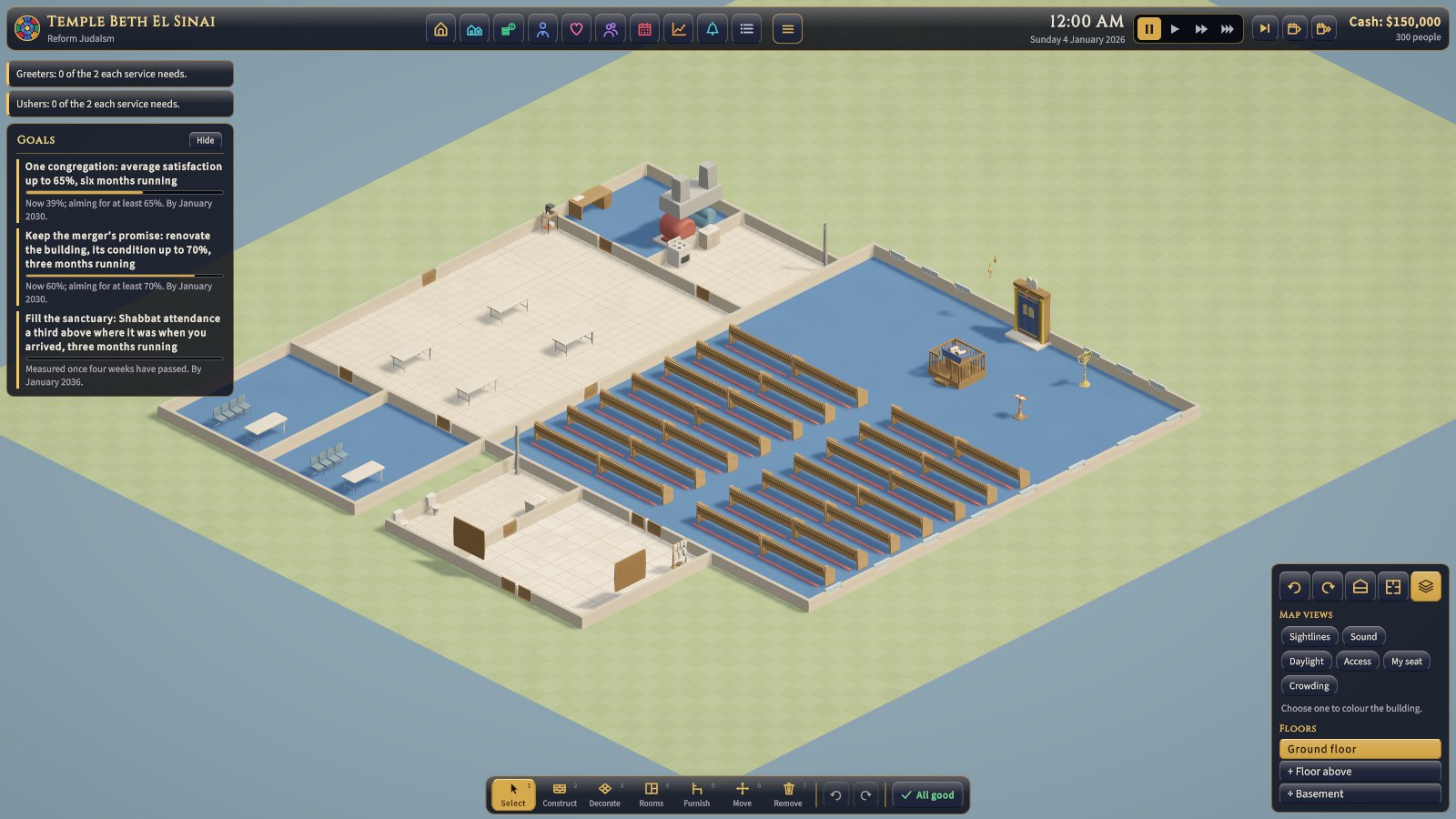
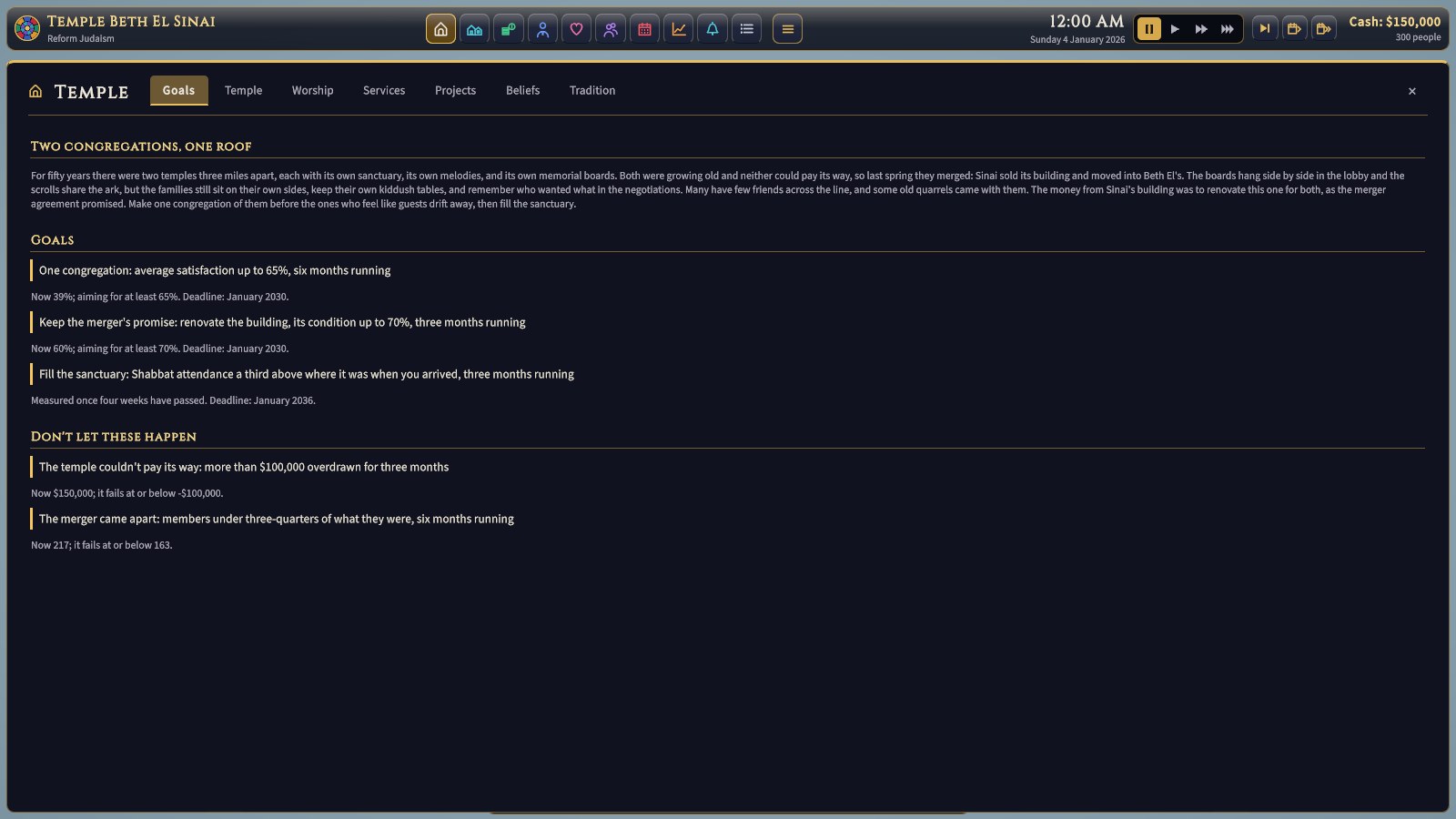
"For fifty years there were two synagogues three miles apart, each with its own sanctuary, its own melodies, and its own memorial boards. Both were growing old and neither could pay its way, so last spring they merged: Sinai sold its building and moved into Beth El's. The boards hang side by side in the lobby and the scrolls share the ark, but the families still sit on their own sides." Played as Reform (Temple Beth El Sinai) or Conservative (Congregation Shaarei Shalom, the new name the two chose).
| You start with | About 300 people, most over 55 and nearly all members, satisfaction between 0.25 and 0.55. They have few friends across the old line (1.2 each, where a congregation that grew up together has about 3), and many long-standing members hold a grudge against someone from the other side. Two rabbis and a cantor, as both congregations' clergy stayed on. $150,000 set aside from the sale of Sinai's building for the renovation the merger promised, and a $500,000 endowment. The building at 0.6, in the Upper Midwest. |
|---|---|
| To win | Average satisfaction up to 65%, six months running, within four years. The building's condition up to 70%, three months running, within four years. Shabbat attendance a third above where it started, three months running. |
| You lose if | $100,000 overdrawn for three months; members under three-quarters of what they were, six months running (the merger came apart). |
Walkthrough
- Make friends of strangers. Small groups, a membership class, greeters at every service: friendships are what a merged congregation lacks, and each one makes the services warmer. Grudges cost everyone who sees across the room someone they resent; new friendships slowly outweigh them.
- Keep the promise. Replace the worst of the building's systems first, while Sinai's money is still in hand. Draw on the endowment at a sustainable rate.
- Watch the payroll. Two rabbis and a cantor are a big congregation's staff. The money holds for a few years; if it doesn't, the second rabbi is the hard decision.
- Then fill the seats. Shabbat and the High Holy Days bring visitors; greet them.
The steward's record: every Reform run and three in four Conservative ones, in about three years; the losses never reached 65% satisfaction. Doing nothing never wins: the building isn't renovated, and the Conservative congregation never becomes one.
A church becomes a mosque
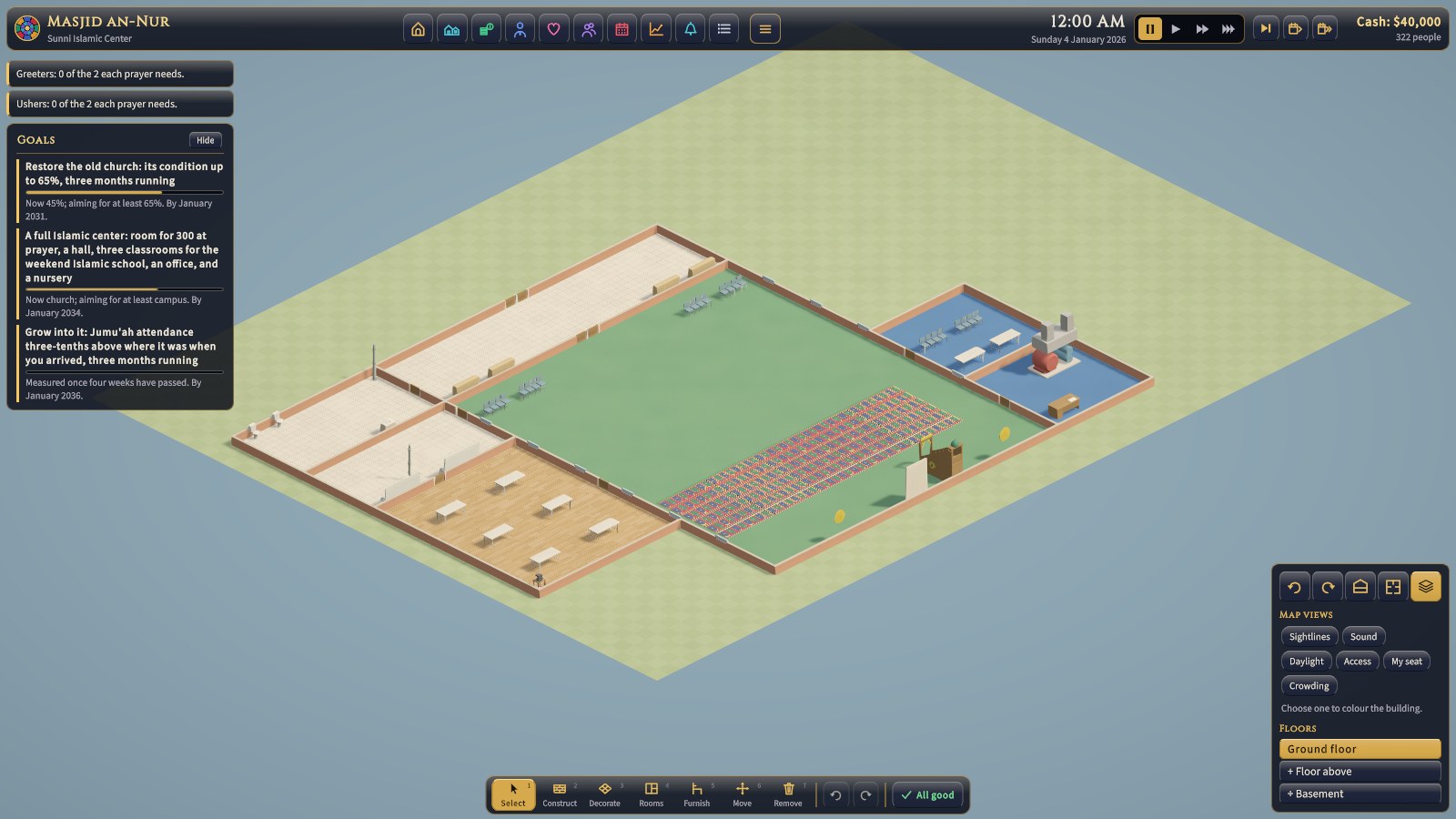
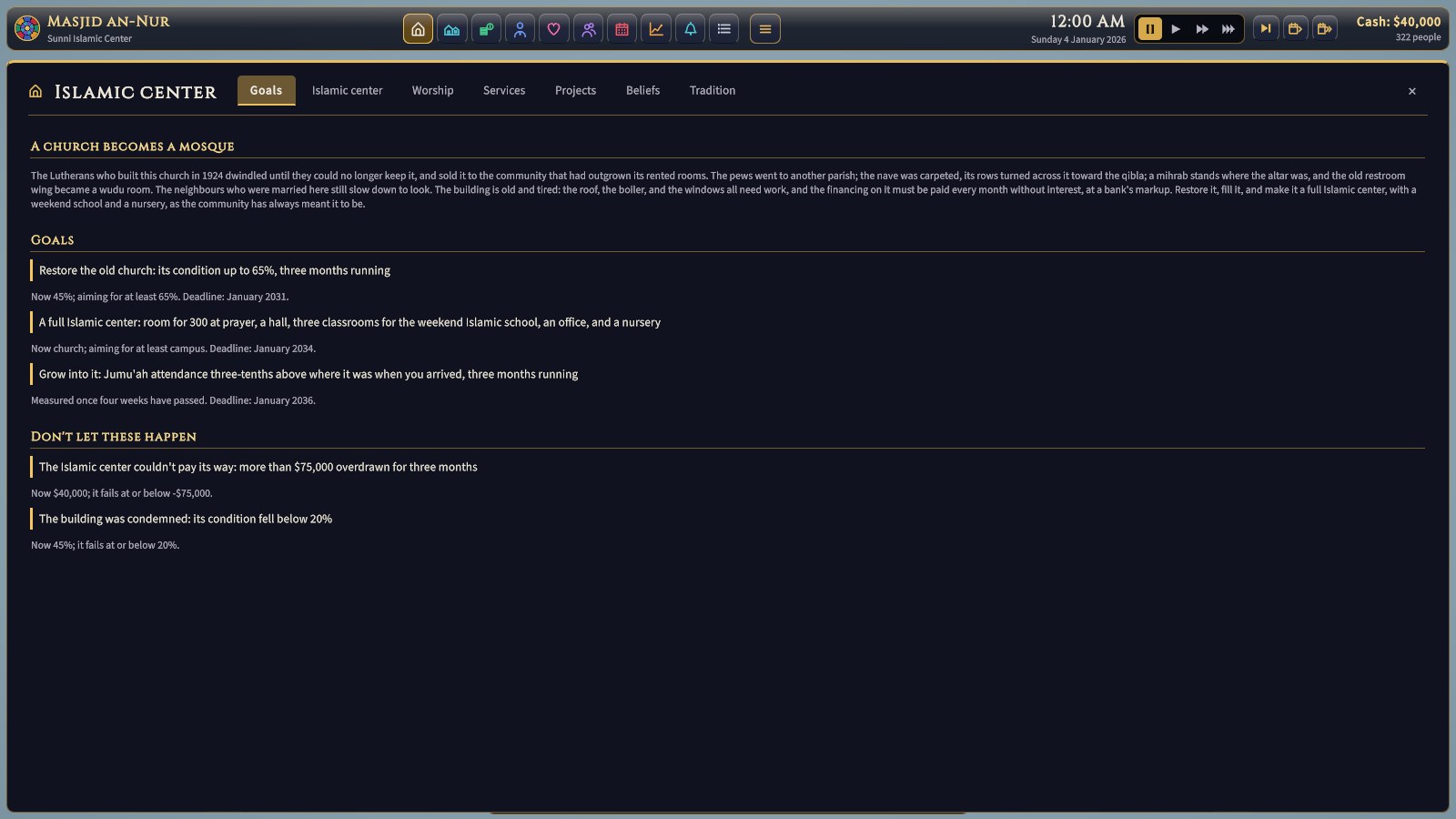
"The Lutherans who built this church in 1924 dwindled until they could no longer keep it, and sold it to the community that had outgrown its rented rooms. The pews went to another parish; the nave was carpeted, its rows turned across it toward the qibla; a mihrab stands where the altar was, and the old restroom wing became a wudu room." Played as a Sunni Islamic center (Masjid an-Nur) or a Shia one (Al-Zahra Islamic Center), whose old chapel is its imambargah.
| You start with | About 320 people, young (a third under 35), half of them members, in a brick church in the Midwest. 240 places on the carpet, a social hall, a wudu room, an office, and one classroom. $40,000, no endowment, and $850,000 still owed on the building: Islamic financing at the bank's markup, about $7,900 a month for fifteen years. The building at 0.45: the roof, the boiler, and the windows all need work. |
|---|---|
| To win | The building's condition up to 65%, three months running, within five years. A full Islamic center, the campus growth stage (room for 300 at prayer, a hall, three classrooms, an office, and a nursery), within eight. Attendance at the main prayer (Jumu'ah; for the Shia, Thursday night's Du'a Kumayl) three-tenths above where it started, three months running. |
| You lose if | $75,000 overdrawn for three months; condition below 20%. |
Walkthrough
- Fix the worst first. Replace the systems in the worst condition as the money comes, keeping something in hand for the financing. A repairs campaign helps; Ramadan and the Eids bring the year's best giving.
- Lay more carpet. A few more rows across the nave take it past 300 places, for very little.
- Build the school wing once the building is sound: two classrooms and a nursery beside the office make the weekend school, and with the rest, a full Islamic center.
- Shia only: keep the imambargah for the majalis of Muharram, the year's great gathering and its biggest sponsorship. A tenth of the giving goes to the marja's office as khums, so the Shia center's people give a little more.
The steward's record: every run in both traditions, the Shia center in about five years and the Sunni in about six. Doing nothing never wins: the Sunni center runs out of money or lets the building go, and the Shia center runs out of money in under four years.
After the teacher
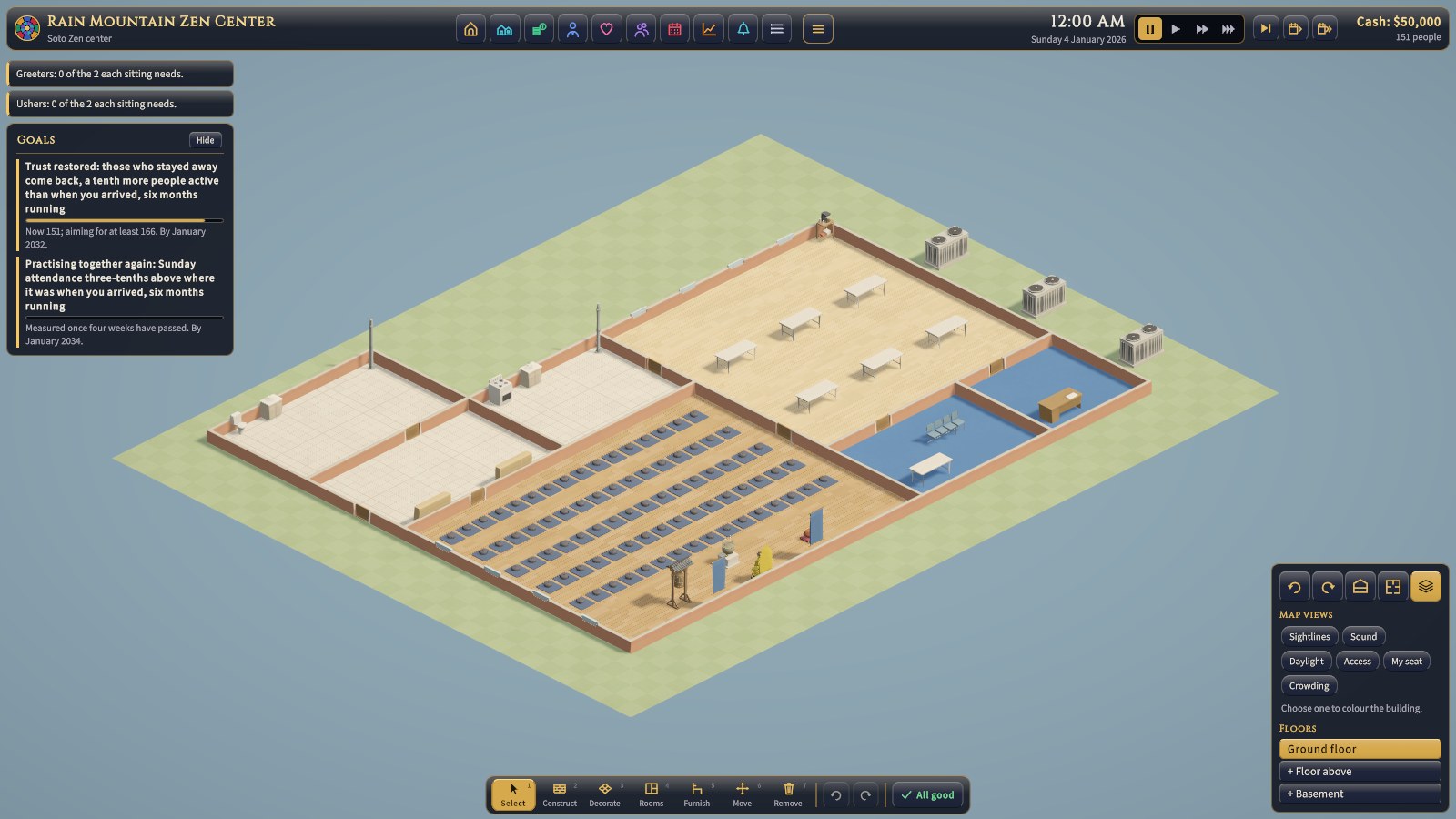
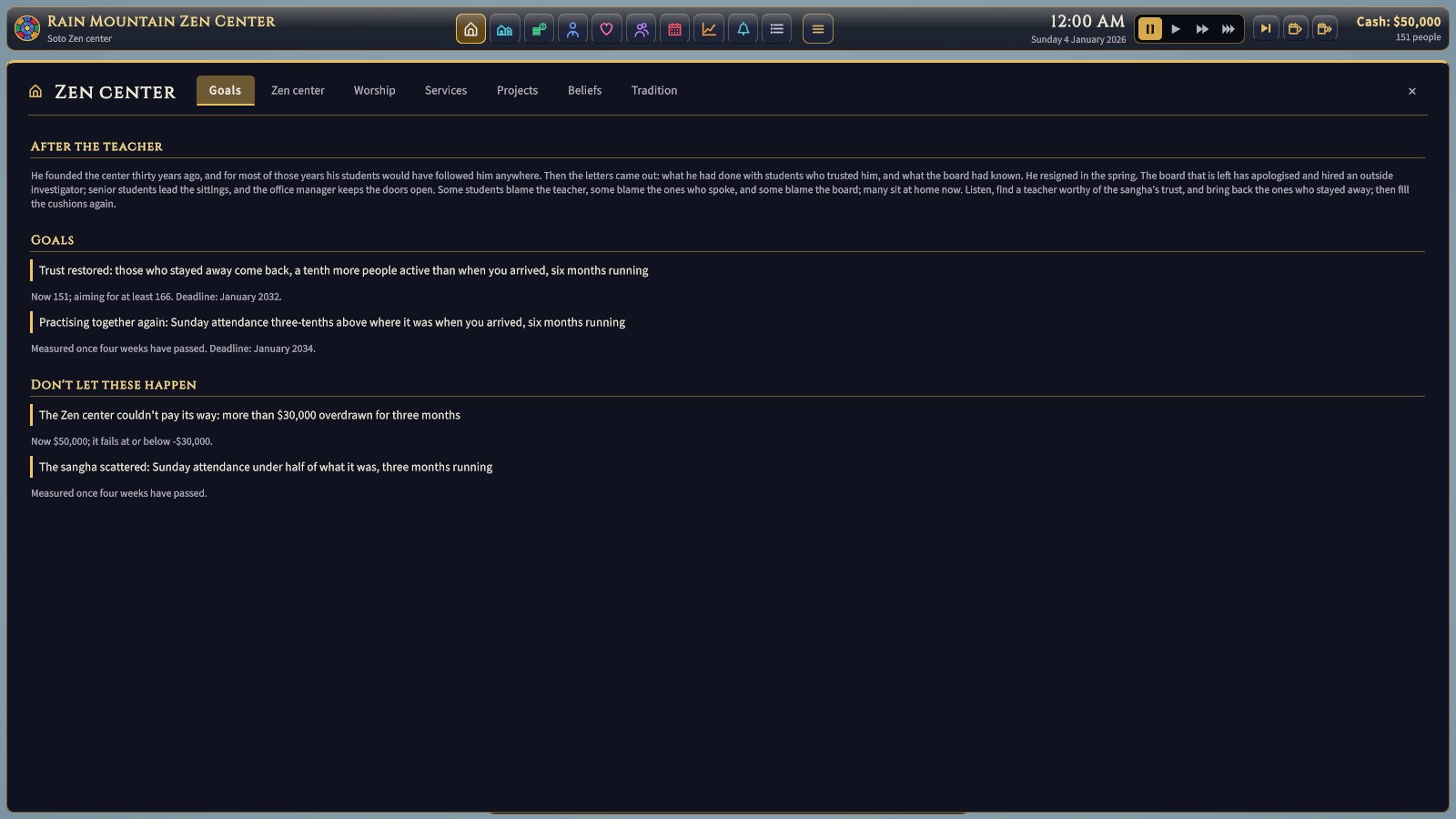
"He founded the center thirty years ago, and for most of those years his students would have followed him anywhere. Then the letters came out: what he had done with students who trusted him, and what the board had known. He resigned in the spring." Played as a Soto Zen center (Rain Mountain Zen Center) or a Tibetan one (Jewel Lotus Dharma Center). American sanghas have been through this many times; the ones that recovered did it slowly.
| You start with | About 150 people, satisfaction between 0.2 and 0.5, in a converted building on a city lot in the Pacific Northwest. Students who have sat together for years know each other well, and many of the long-standing ones now hold a grudge: over what happened, and who knew. No teacher: senior students lead the sittings, and the office manager keeps the doors open. 80 places on the cushions. $50,000 and no endowment. |
|---|---|
| To win | A tenth more people active in the sangha than when you arrived, six months running, within six years. Attendance three-tenths above where it started, six months running. |
| You lose if | $30,000 overdrawn for three months; attendance under half of what it was for three months (after six months' grace). |
Walkthrough
- Don't hurry. Keep the sittings going, and the welcome: greeters, small groups, the meal after practice.
- Call a new teacher after a few months (Staff screen). Choose experience over a bargain: the board votes on the call, and a sangha that has been hurt needs someone it can trust. The Zen center's teacher is part-time; the Tibetan center's full-time.
- Open the doors again. Once there's a teacher, a meditation class for newcomers brings in people who never knew the old teacher.
The steward's record: seven in eight Zen runs, in about four years, and every Tibetan run, in about two. Doing nothing never wins: the sangha shrinks, and its money piles up with no teacher to pay.
Two churches, one pastor
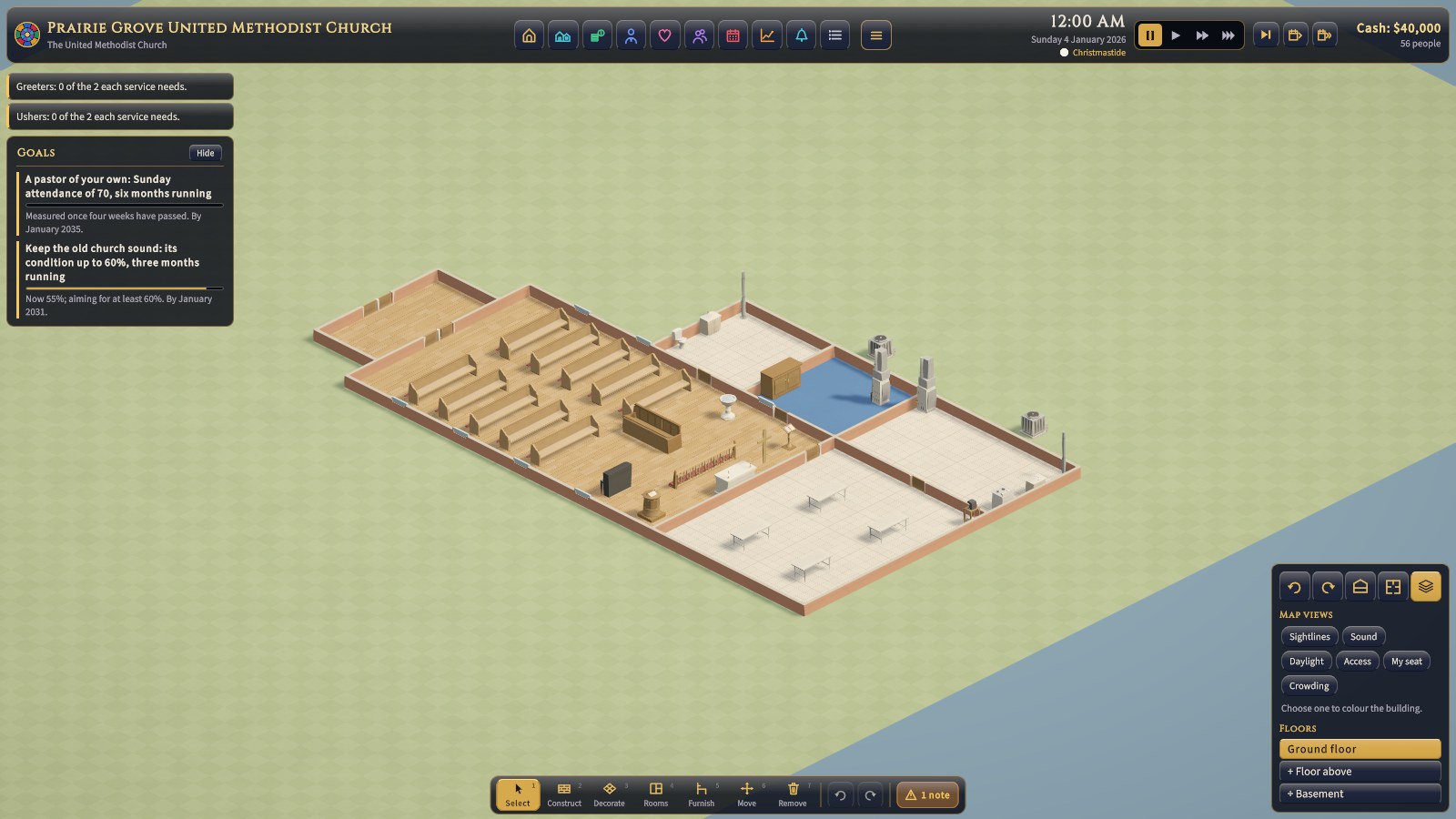
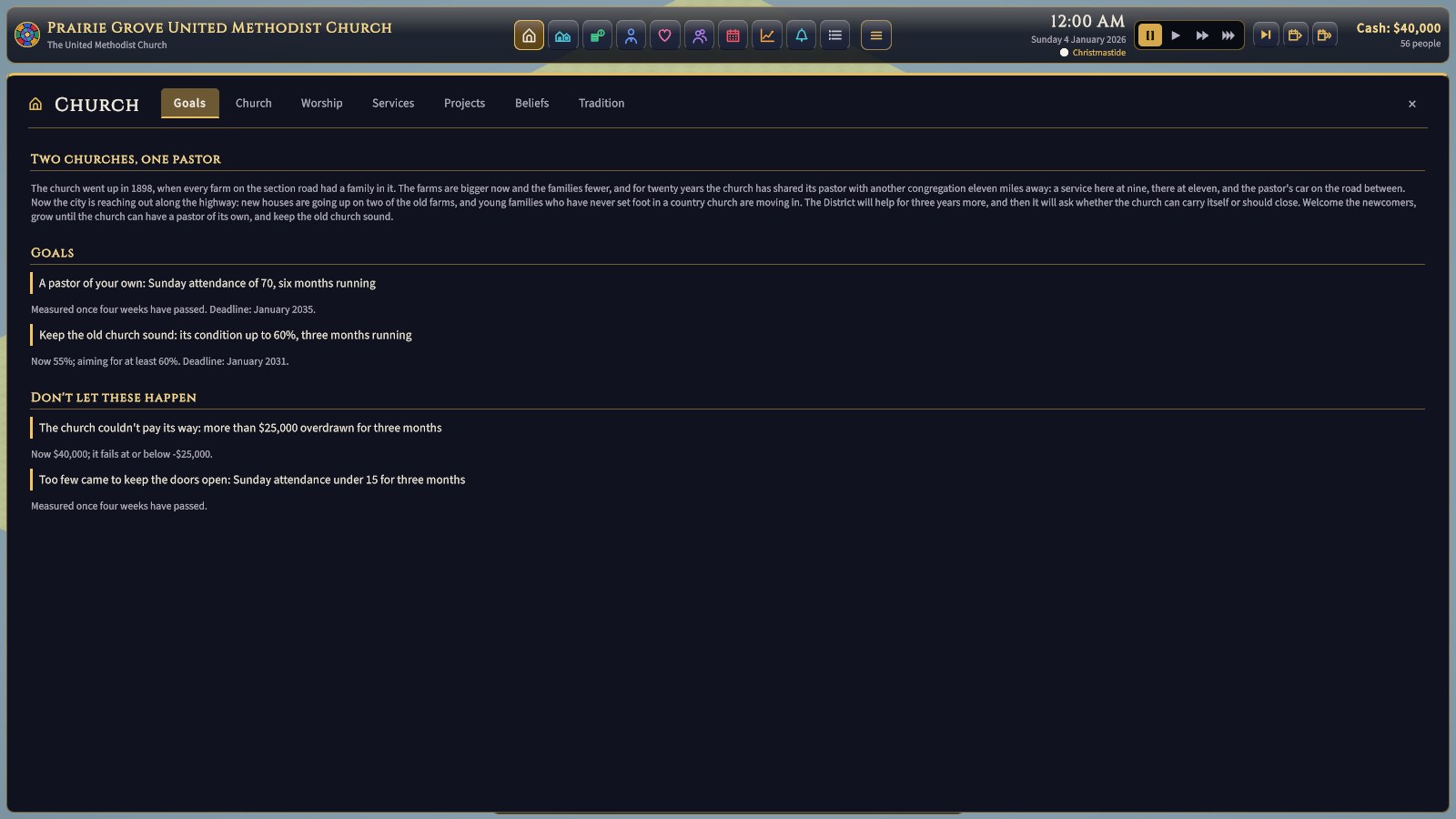
"The church went up in 1898, when every farm on the section road had a family in it. The farms are bigger now and the families fewer, and for twenty years the church has shared its pastor with another congregation eleven miles away. Now the city is reaching out along the highway: new houses are going up on two of the old farms." Played as United Methodist (Prairie Grove) or Lutheran Church–Missouri Synod (St. John's).
| You start with | About 55 people, mostly older, who all know each other, on a rural lot in the Midwest. A full-time pastor shared with another church while attendance is under 70: you pay half. $40,000, a $250,000 endowment (a farm left to the church), and help from the wider body of $1,500 a month for three years. Newcomers more than most country churches see, from the new houses. The building at 0.55. |
|---|---|
| To win | Sunday attendance of 70, six months running, within nine years: enough for a pastor of your own. The building's condition up to 60%, three months running, within five years. |
| You lose if | $25,000 overdrawn for three months; under 15 at worship for three months; or the wider body closes the church. |
Walkthrough
- Welcome the new families. Greeters, a nursery, small groups: the newcomers are the church's future, and the old members already have their friends.
- Mend the building with the wider body's help while it lasts, the worst system first.
- Plan for success. At 70 the pastor is no longer shared (decided each July), and the church pays the whole salary. Have the money ready before you get there.
The steward's record: seven in eight runs in each tradition, the Methodists in about five years and the Lutherans in about six; each one loss ran out of money. Doing nothing never wins: the church runs out of money in about four years.
The church on the corner
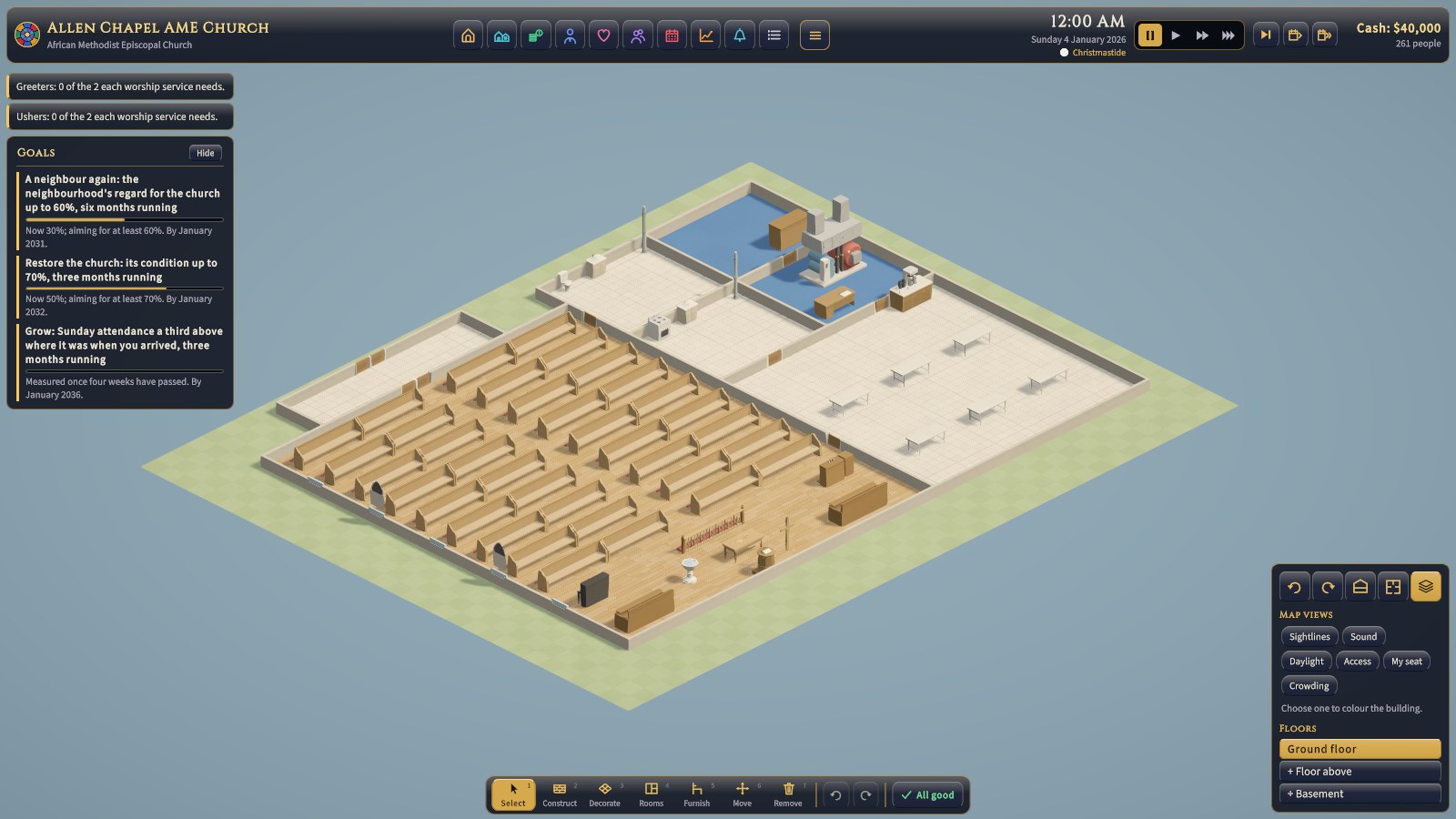
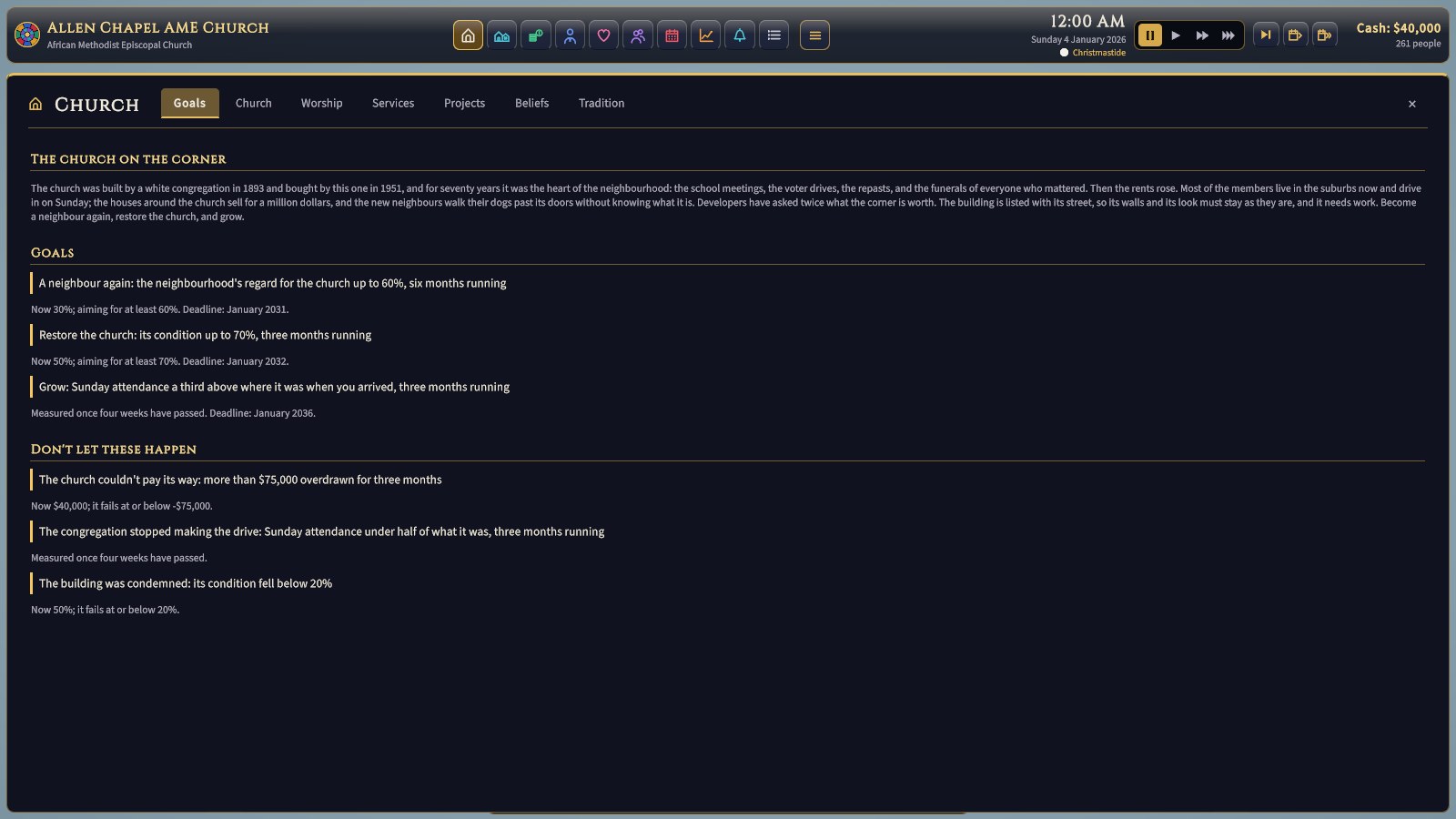
"The church was built by a white congregation in 1893 and bought by this one in 1951, and for seventy years it was the heart of the neighbourhood. Then the rents rose. Most of the members live in the suburbs now and drive in on Sunday; the houses around the church sell for a million dollars, and the new neighbours walk their dogs past its doors without knowing what it is." Played as African Methodist Episcopal (Allen Chapel) or National Baptist (Greater Mount Zion).
| You start with | About 260 people, most over 55, who know each other well, on a city lot in the mid-Atlantic. A full-time pastor. 288 seats, a choir, a piano and a Hammond organ; the AME church has its communion rail and font, the Baptist church its baptistry. Listed with its street: the walls and the Gothic style can't change. $40,000, a $200,000 endowment, the building at 0.5. Fewer newcomers than most city churches: the new neighbours seldom come in. |
|---|---|
| To win | The neighbourhood's regard for the church (its standing in the community) up to 60%, six months running, within five years. The building's condition up to 70%, three months running, within six. Sunday attendance a third above where it started, three months running. |
| You lose if | $75,000 overdrawn for three months; attendance under half of what it was for three months (after six months' grace); condition below 20%. |
Walkthrough
- Open the hall. A food pantry in the first month (Community → Ministries); rent the hall to a twelve-step group and offer it as a polling place (Community → Rentals). A church that does nothing is regarded at 30% and drifts back there; each ministry and rental lifts it month by month, as far as its volunteers keep it going.
- More as the volunteers allow: a youth group, a health clinic.
- Restore what you can. The listing protects the walls and the look, not the roof or the boiler: replace the worst systems first.
- Grow. The members still make the drive; welcome everyone who comes through the door, old neighbours and new.
The steward's record: every run, the AME church in about a year and a half and the Baptist in about two and a half. Doing nothing never wins: the neighbourhood never comes to know the church, the building declines, and the Baptist church's attendance falls by a quarter.
A church becomes a temple
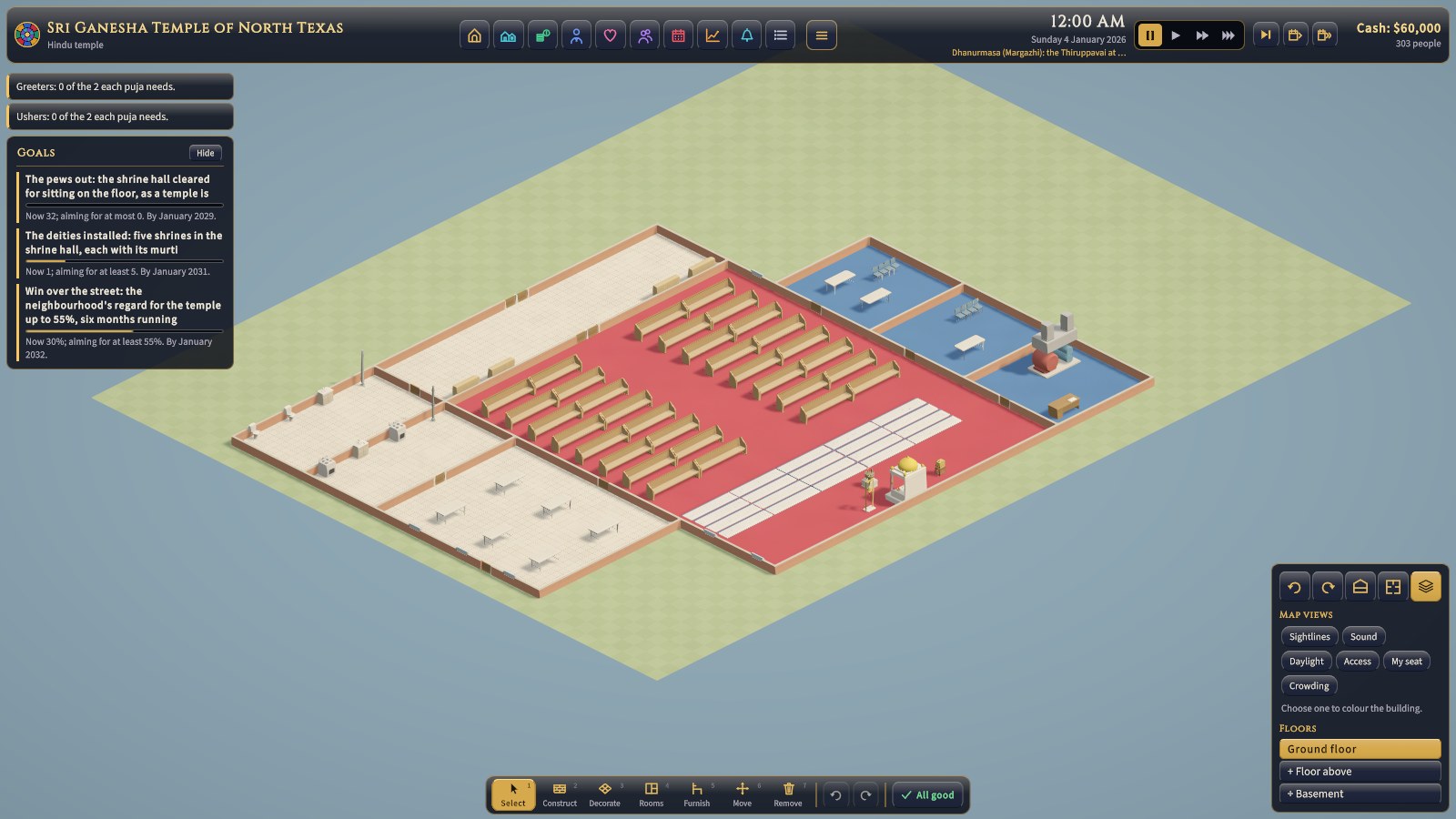
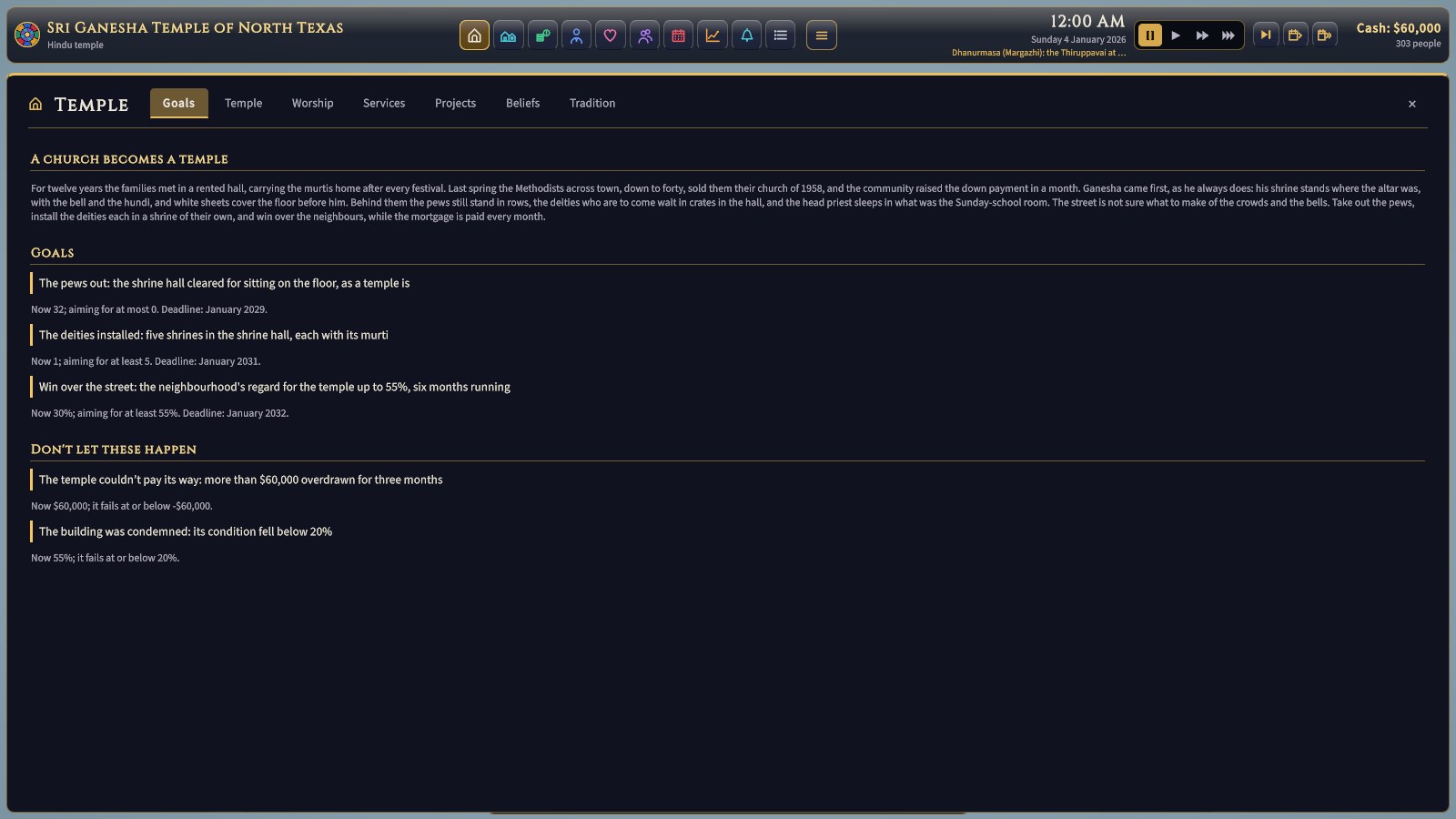
"For twelve years the families met in a rented hall, carrying the murtis home after every festival. Last spring the Methodists across town, down to forty, sold them their church of 1958, and the community raised the down payment in a month. Ganesha came first, as he always does." Played as a South Indian community temple (Sri Ganesha Temple of North Texas), with its head priest and its Sunday abhishekam, or the North Indian variant (Shri Radha Krishna Mandir), a mandir with its pandit and a Sunday satsang followed by the Bhandara.
| You start with | About 300 people, mostly of working age, half of them life members, on a suburban lot in the Southern Plains. In the nave, Ganesha's shrine with the bell, the hundi and incense, twenty rows of white sheets, and 32 pews behind them; the old narthex, now the entrance hall, with the shoe racks; a community hall and kitchen; an office; a Sunday-school room that is now the priest's quarters, and a classroom. The head priest. $60,000, no endowment, and $700,000 still owed on the building over twenty years. The building at 0.55. |
|---|---|
| To win | The pews out of the shrine hall within three years. Five murti shrines, each deity in its own, within five years. The neighbourhood's regard for the temple (its standing in the community) up to 55%, six months running, within six. |
| You lose if | $60,000 overdrawn for three months; condition below 20%. |
Walkthrough
- Serve the town from the start. Seva meals in the second month, a yoga class soon after, a food pantry within the year (Community → Ministries). The street doesn't know what to make of the crowds and the bells; a temple that cooks for the shelter and teaches yoga in its hall soon has friends.
- Take out the pews after a few months, and lay white sheets in their place: a Hindu temple sits on the floor. Pews are cherished things, so some may object; it passes.
- Install the deities one at a time along the front of the hall as the money comes, keeping about $25,000 in hand for the mortgage. Each murti shrine is $22,000.
- Mind the head priest. A temple's day is a timetable of rites from dawn to the evening arati. Each daily rite weighs on the priest only a little, and less with a second priest to share them, but over the years it tells: give a sabbatical when it's due, and a pujari besides once the temple can pay one.
The steward's record: every run in both variants, the South Indian temple in about 22 months and the North Indian mandir in about 18. Doing nothing never wins: the pews stay in.
The new gurdwara
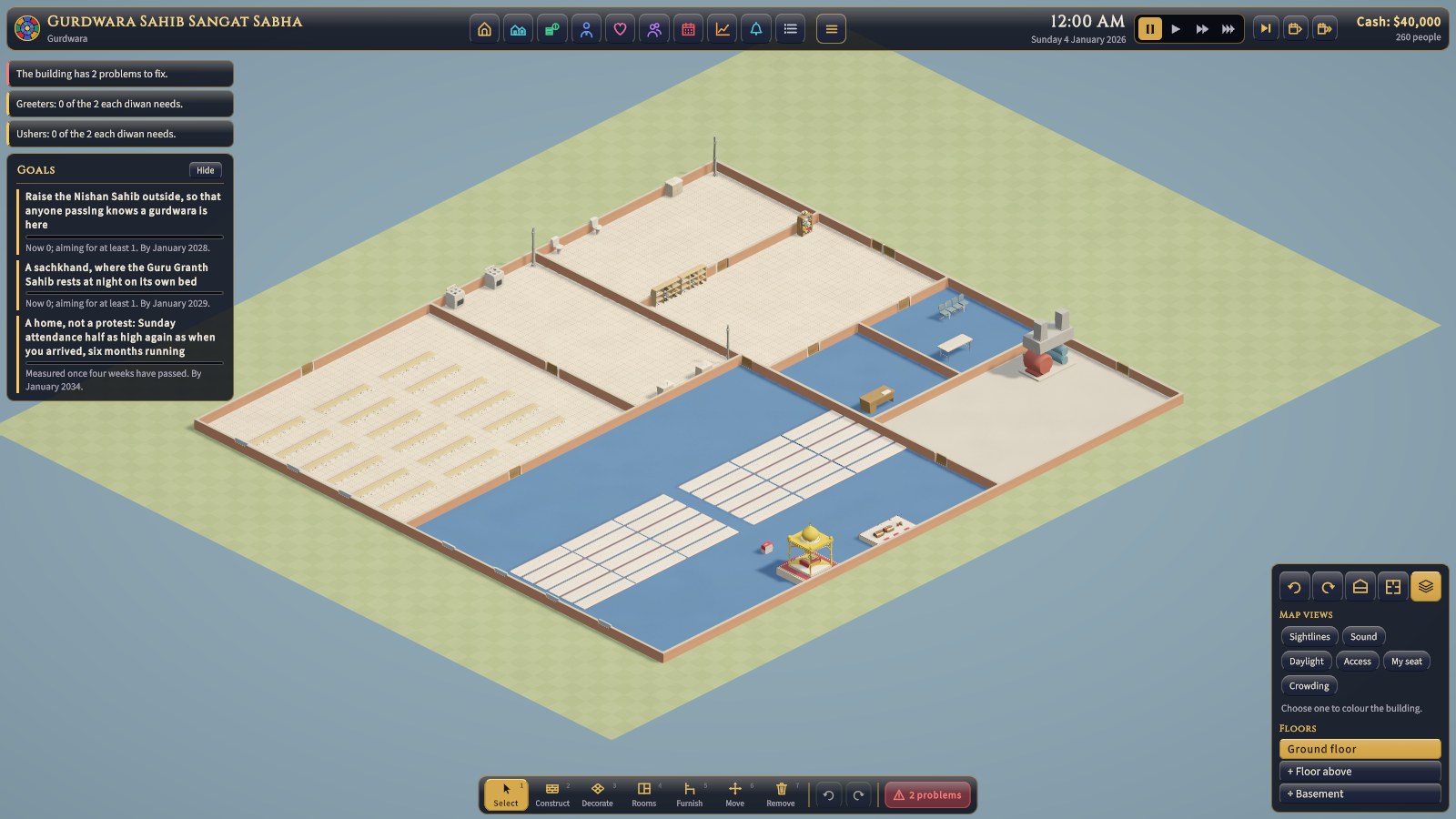
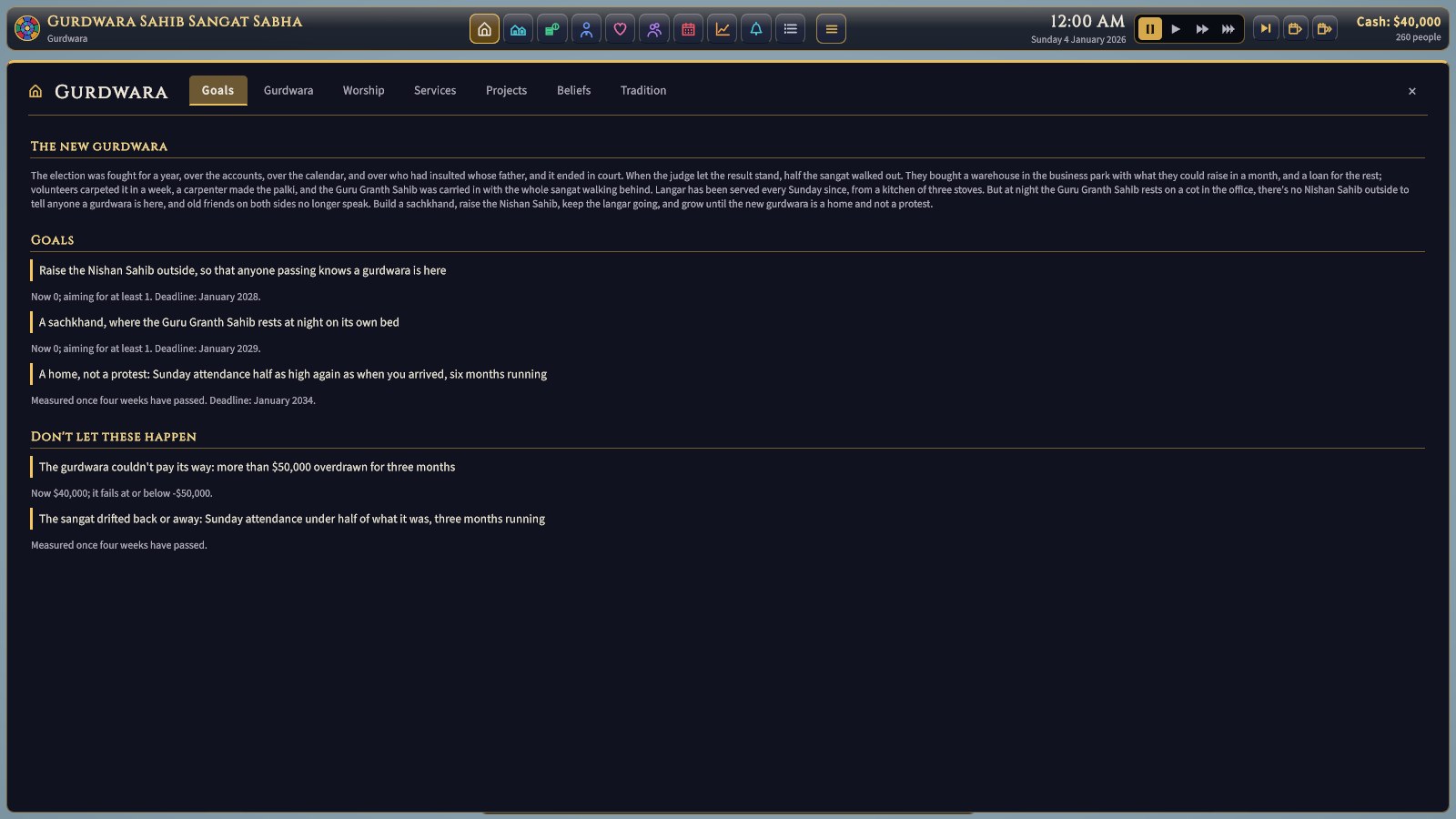
"The election was fought for a year, over the accounts, over the calendar, and over who had insulted whose father, and it ended in court. When the judge let the result stand, half the sangat walked out." Played as a gurdwara keeping the original Nanakshahi calendar (Gurdwara Sahib Sangat Sabha) or the SGPC's (Gurdwara Singh Sabha of the Valley): which calendar to keep is one of the things such elections are fought over.
| You start with | About 260 people in Southern California, unhappy and divided: fewer friendships than a settled sangat, and old quarrels among the long-standing families. A warehouse in a business park: the darbar hall with the palki, the ragis' stage, the golak and sheets for 288; the langar hall with its runners and a kitchen of three stoves; an entry with shoe racks and head scarves; an office, a classroom for the Punjabi school, and the empty loading bay. No sachkhand (the Guru Granth Sahib rests on a cot in the office) and no Nishan Sahib: the gurdwara needs both, and the sangat feels their lack every week. The granthi. $40,000, no endowment, and $550,000 owed on the warehouse over fifteen years. |
|---|---|
| To win | The Nishan Sahib raised within two years. A sachkhand, with the bed where the Guru Granth Sahib rests at night, within three. Sunday attendance half as high again as where it started, six months running. |
| You lose if | $50,000 overdrawn for three months; attendance under half of what it was for three months (after six months' grace). |
Walkthrough
- Keep the langar going. Recruit cooks on the Volunteers screen and keep the rota full: langar is served every Sunday whoever comes, and a missed or short langar costs the sangat's goodwill. Families sponsor it in turn.
- Raise the Nishan Sahib outside as soon as the money allows, about $12,000: it tells anyone passing that there is food and shelter here.
- Build the sachkhand. Wall off a corner of the loading bay behind the darbar hall's side door, zone it as the sachkhand, and put the sukhasan bed in it.
- Reach out. A youth group, street langar, Sikh awareness work and a kirtan class bring the neighbourhood and the sangat's children in; a gurdwara looked after well grows fast.
- The granthi keeps the Guru's day from Prakash at dawn to Kirtan Sohila at night. The daily rites weigh on a granthi alone a little more each year; an assistant granthi shares them, and a sabbatical clears the strain when it's due.
The steward's record: every run in both variants, in about two years and three months, with the sangat nearly doubled. Doing nothing never wins: most runs run out of money within two years, and the rest never raise the Nishan Sahib.
The last priest
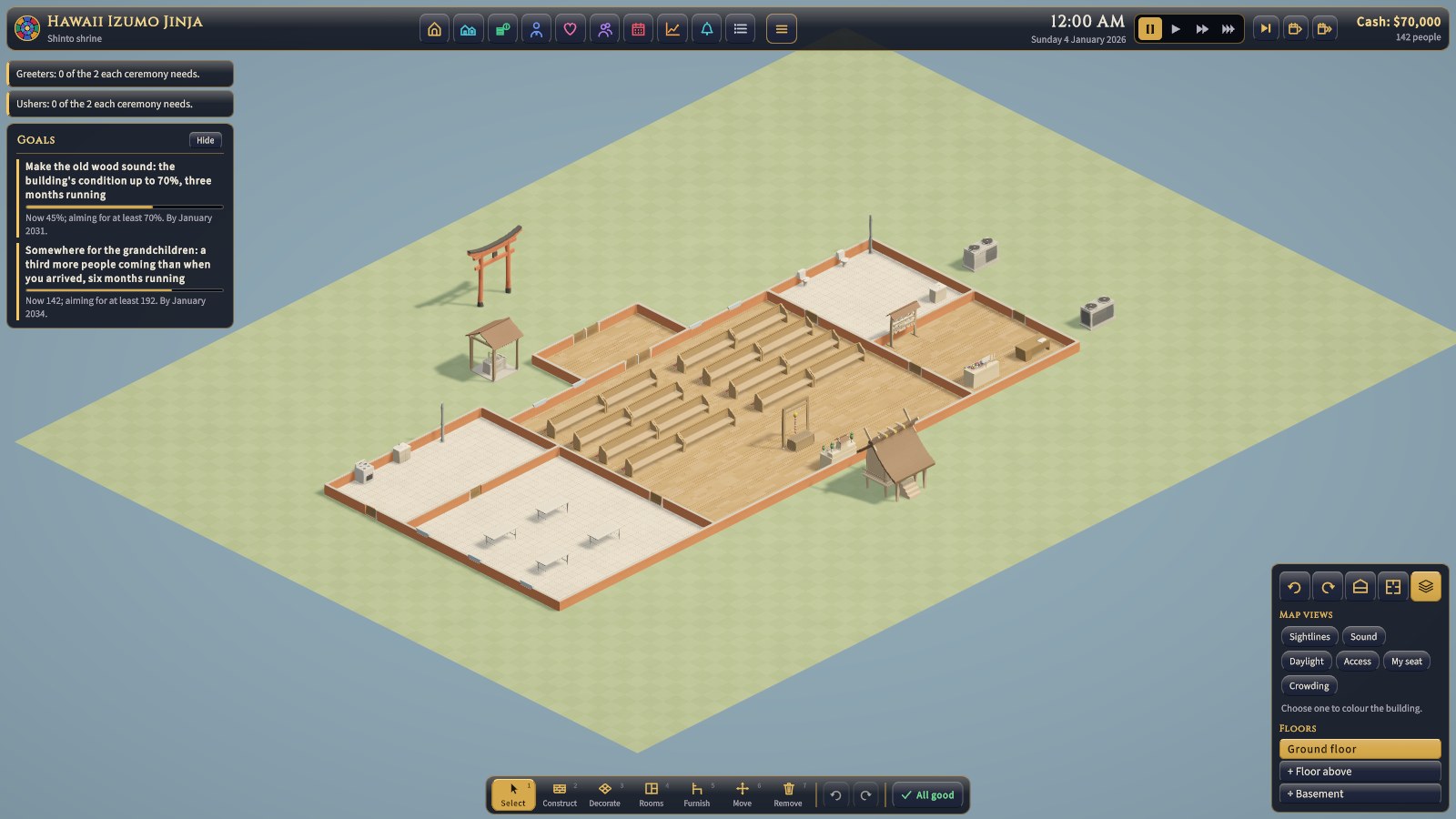
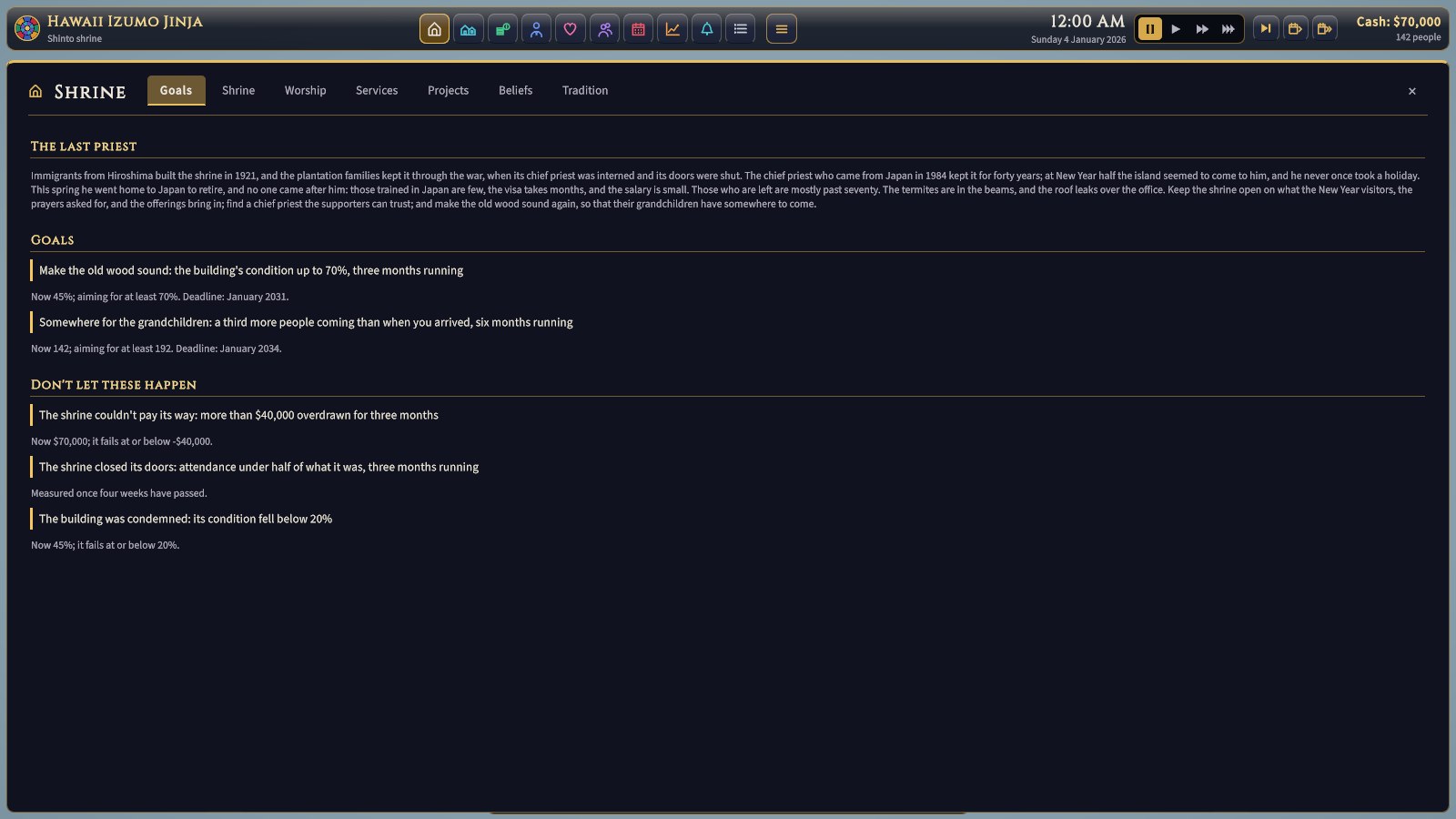
"Immigrants from Hiroshima built the shrine in 1921, and the plantation families kept it through the war, when its chief priest was interned and its doors were shut. The chief priest who came from Japan in 1984 kept it for forty years. This spring he went home to Japan to retire, and no one came after him." Played as a Shinto shrine (Hawaii Izumo Jinja) or a Konko church (Konko Church of Wahiawa), whose minister sits at the mediation seat beside the altar through the day.
| You start with | About 140 people on Oahu, mostly past 55 and many past 75. The shrine's haiden with pews before the kamidana and the offertory box, the honden behind it, the torii and the chozuya, the shrine office with its amulets and ema; the Konko church's hall with the altar to the Kami, the mediation seat and the altar to the spirits. Both have a social hall and kitchen. No chief priest or minister: the shrine has its miko in the office, the Konko church a secretary. (Konko's headquarters sends a part-time minister within a couple of months, though not one the church chose.) $70,000 and a $150,000 endowment. The building at 0.45: termites in the beams, and the roof leaking over the office. |
|---|---|
| To win | The building's condition up to 70%, three months running, within five years. A third more people active than when you arrived, six months running. |
| You lose if | $40,000 overdrawn for three months; attendance under half of what it was for three months (after six months' grace; at the shrine, which holds no weekly service, an ordinary day's visits at its open hours); condition below 20%. |
Walkthrough
- Call a successor at once (Staff screen): post the position and take the most experienced who applies. Priests trained in Japan are few and the search is long, so start it in the first month. Without one there are no prayers asked for, no blessings, and little reason for the young to come.
- Make the old wood sound. Replace the systems in the worst condition whenever you can keep about $15,000 in hand. New Year's crowds and the amulet counter carry the shrine's budget; the Konko church lives on what its believers give.
- Give the young a reason to come. At the shrine, the children's festivals and a taiko group (Community → Ministries); at the Konko church, a faith study group and the care of the cemetery.
The steward's record: every run in both, each in about two and a quarter years. Doing nothing never wins: the building is never made sound, and while the shrine piles up money with no priest to pay, the Konko church usually runs out.
The temple upstairs
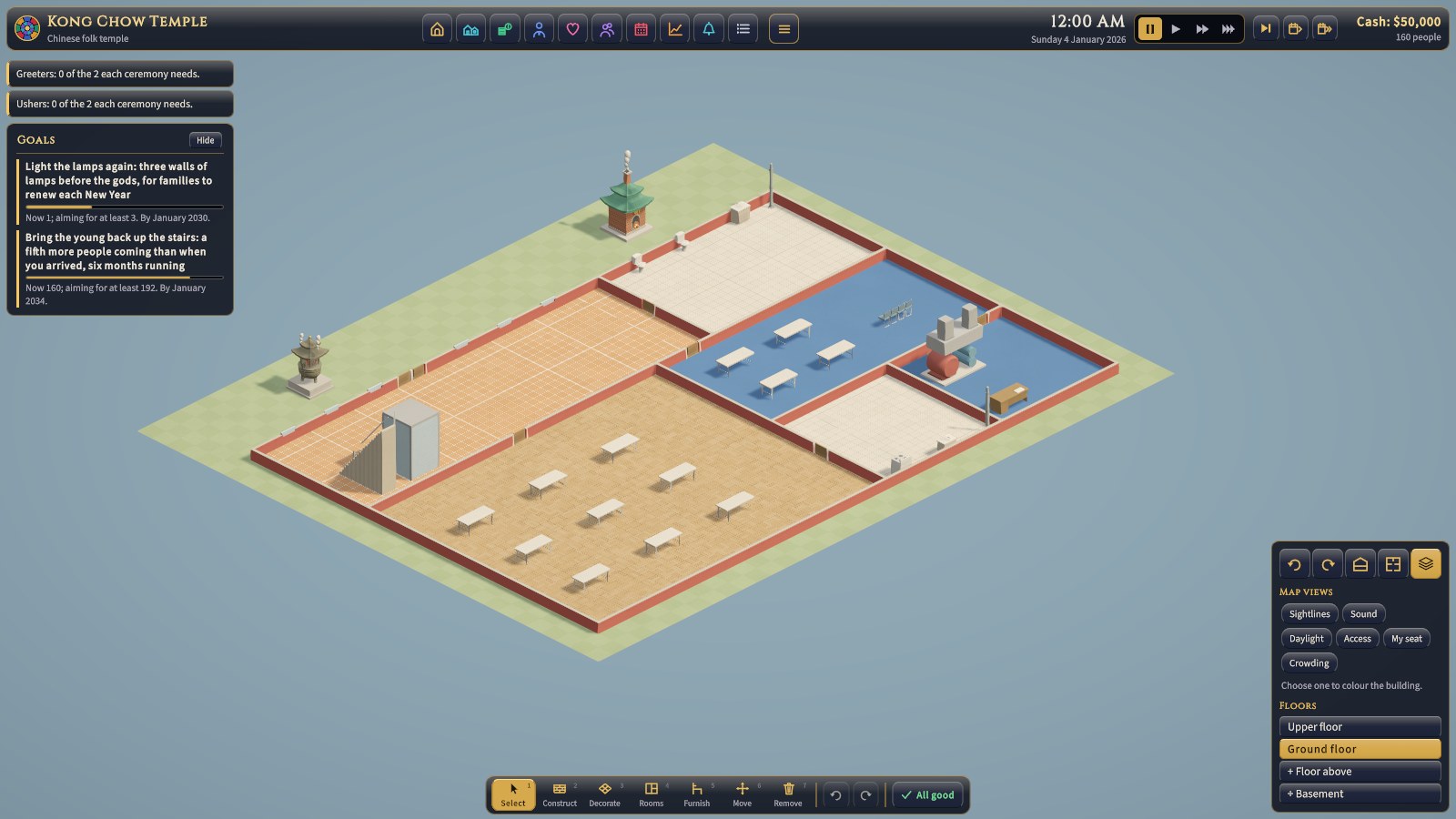
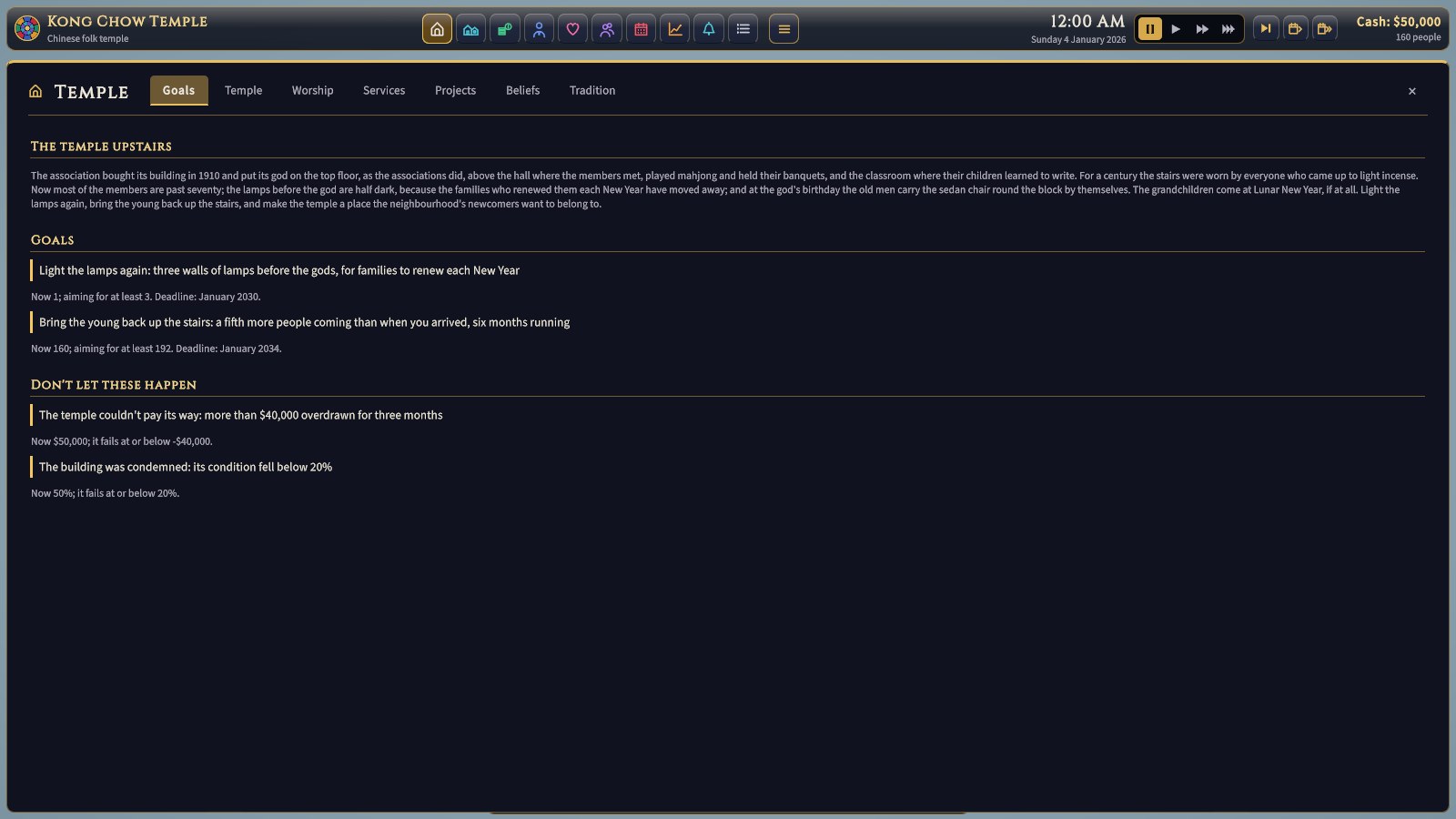
"The association bought its building in 1910 and put its god on the top floor, as the associations did, above the hall where the members met, played mahjong and held their banquets. Now most of the members are past seventy; the lamps before the god are half dark, because the families who renewed them each New Year have moved away." Played as a Chinatown association temple (Kong Chow Temple) or a Fujianese village temple (Lin Village Association Temple), both variants of the Chinese folk temple.
| You start with | About 160 devotees, most past 55 and a third past 75, on a city lot in the Northeast. A brick building of two storeys: downstairs the association hall, its kitchen, the office, a classroom for the Chinese school, and a lobby with the stairs and an old lift; upstairs the main hall, the god on the main altar with incense before it, the divination table, one wall of lamps, the ancestors' tablets, and chairs for the old. The great censer and the paper furnace stand on the pavement. The temple keeper. $50,000 and a $300,000 endowment; the building at 0.5. The Fujianese temple collects no association dues, but its families, younger and newer, give more. |
|---|---|
| To win | Three walls of lamps before the gods within four years. A fifth more people coming than when you arrived, six months running. |
| You lose if | $40,000 overdrawn for three months; condition below 20%. |
Walkthrough
- Watch the money. An old building and an ageing congregation cost more than the incense money brings in, and left alone the temple runs dry within three years. Lean on the endowment (a 5% drawdown, on the Budget), and spend on what brings people in.
- Bring the young in. A lion dance troupe in the first month, the Chinese school, and a desk for new arrivals in the neighbourhood (Community → Ministries): the troupe performs at Lunar New Year and the god's birthday, and the whole street comes to know the temple.
- Light the lamps. Hang lamps on the main hall's walls upstairs (about $10,000 each) as the money comes. Families renew a lamp each Lunar New Year, so every wall pays back year after year.
- See to the building, the worst system first, while it's under about 65%.
The steward's record: every run in both variants, the Chinatown temple in about four and a half years and the Fujianese in about five and a half: with no weekly gathering, the young come up the stairs a few at a time, through the open hours and the great days. Doing nothing never wins: the lamps stay dark, and the temple often runs out of money.
Raising the shikhara
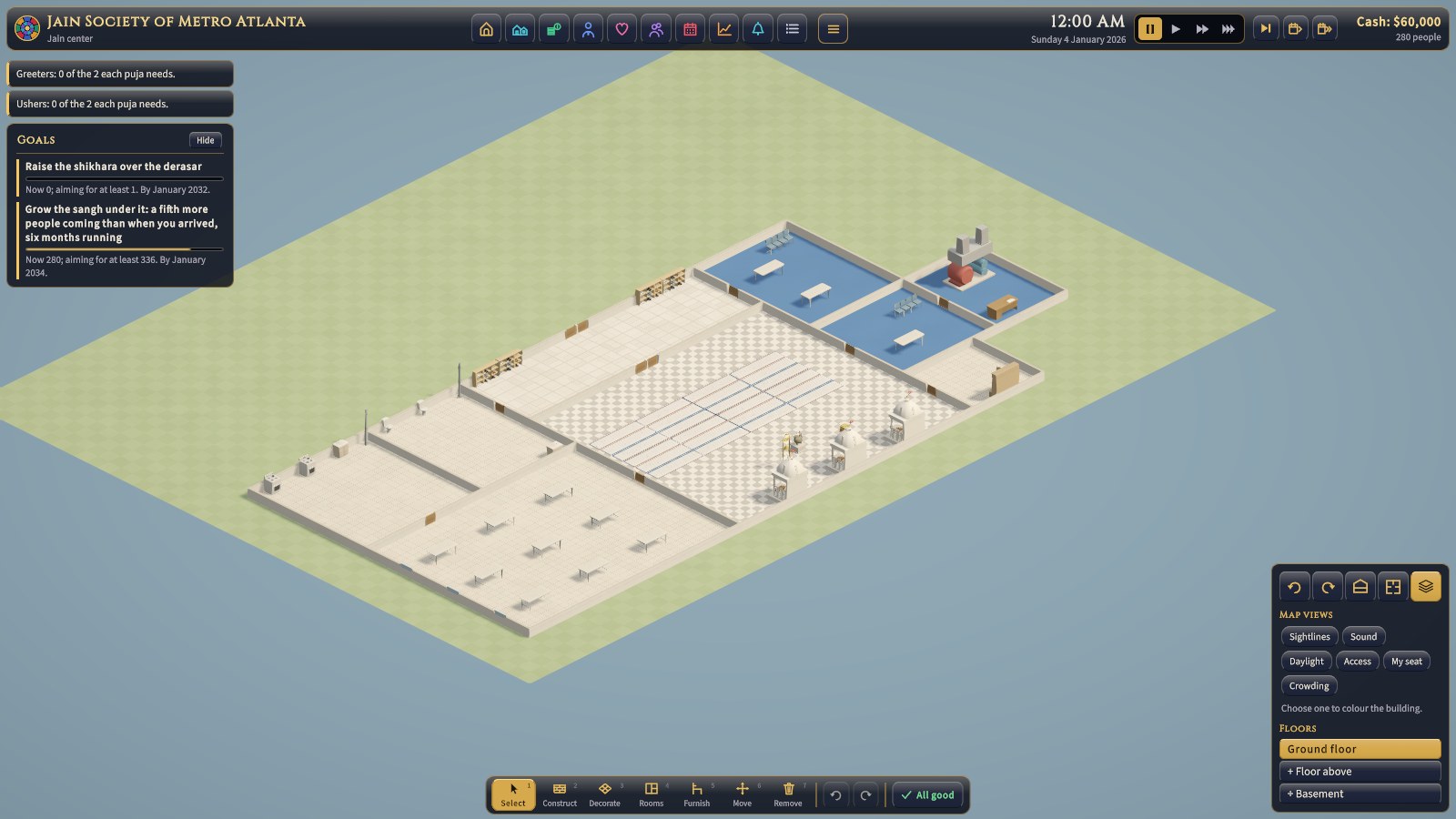
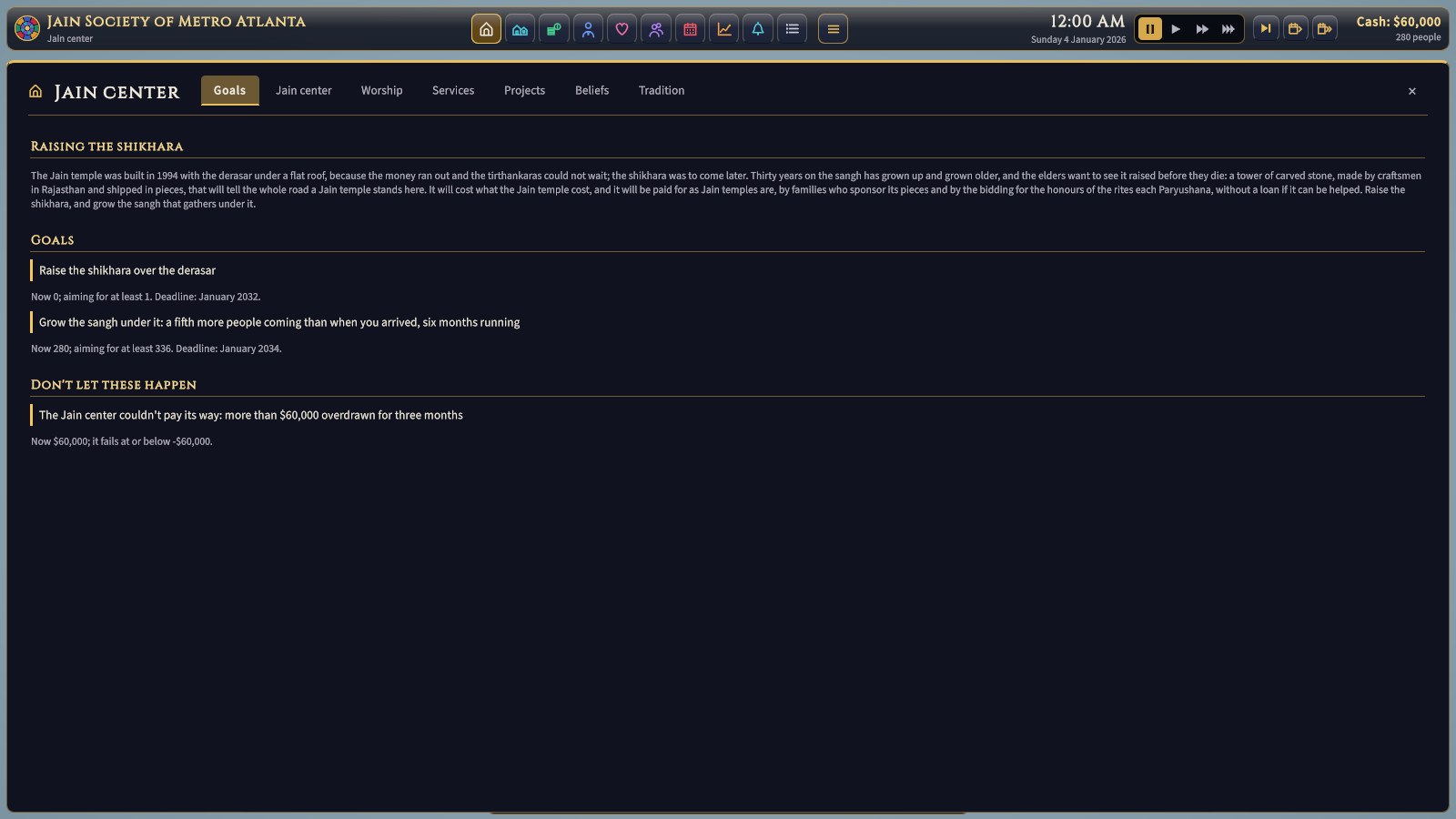
"The Jain temple was built in 1994 with the derasar under a flat roof, because the money ran out and the tirthankaras could not wait; the shikhara was to come later. Thirty years on, the elders want to see it raised before they die." Played as a Jain center (Jain Society of Metro Atlanta), Shvetambara as written, or its Digambara variant (Shri Digambar Jain Mandir), where the derasar is a jinalaya and Das Lakshana takes Paryushana's place.
| You start with | About 280 people on a suburban lot in the Southeast. The derasar with three tirthankaras in their marble shrines, the bell, the hundi and incense, and sheets on the floor for 192; a changing room for puja clothes; an entry for shoes; the bhojanshala, its kitchen, two pathshala classrooms and an office. A pujari to care for the shrines; the president leads, as there are no clergy. $60,000, no endowment; the building at 0.7. |
|---|---|
| To win | The shikhara raised over the derasar within six years: a carved stone tower on the roof, $200,000 and eighteen months' work, paid as it goes. A fifth more people coming than when you arrived, six months running. |
| You lose if | $60,000 overdrawn for three months. |
Walkthrough
- Start the campaign in the first month: $200,000 over three years, for families to sponsor the tower's pieces.
- Hold the boli each Paryushana (Community → Fundraising): the few families who can give most bid for the honours of the rites, and the money goes to the temple. A Digambara center holds no boli; hold an auction of honours each year instead, as the Shvetambara center can too.
- Raise the shikhara on the roof over the derasar once the campaign and the cash pass about $115,000: it's paid month by month while the craftsmen work, and it takes a year and a half, so don't leave it late.
- Grow the sangh meanwhile: Young Jains, the jiv daya work for animals, and the scholars who come for Paryushana.
The steward's record: every run in both, the Shvetambara center in about three and a half years and the Digambara in about three years and eight months. Doing nothing never wins: the center has the money in the bank, but no one raises the tower.
Long games: what changes over decades
- Fast-forwarding (+ Month, + Year) moves event by event instead of minute by minute. Services are still held and felt, but at once: everyone who's coming sits (or stands) as the service is decided, communion takes no time, and nobody is late.
- Succession, as the tradition has it (see Staff and volunteers). A Catholic priest is moved at the end of each six-year term, his successor arriving the same day, and a Chinese Buddhist temple's abbess likewise; turn moves off on the Staff screen to keep a good one. A Lutheran pastor settles for about eight years, a Reform or Conservative rabbi about twelve, then may be called elsewhere. A Chabad shliach, a Tenrikyo head minister, a Yiguandao master, and an Indo-Caribbean mandir's pandit serve for life, and a shrine's or a Konko church's post passes to the family. Most retire after 25 years. A sent successor comes within two months; a called one after a nine-month search (longer where clergy are scarce: an imam, a Hindu temple's priest, a shrine priest from Japan), with an interim (and three months more) where the tradition has one.
- Generations. Couples of 22 to 40 have children. Grown children leave home at a fifth a year, half to a household of their own in the church and half away. People who have drifted away for good are forgotten each January.