Chapter 13: Faiths and traditions · Part 2
The building
The nave tool builds the tradition's worship room by its own name: a nave, a sanctuary, a chapel, a meeting room, an auditorium, a prayer hall, a hondo, a zendo, a shrine hall, a darbar hall, a derasar, a haiden, a main hall. The build tray offers each congregation its own faith's things and the shared ones (seats, tables, kitchens, organs, stained glass, domes), and before a tradition is chosen, everything.
Which way it faces
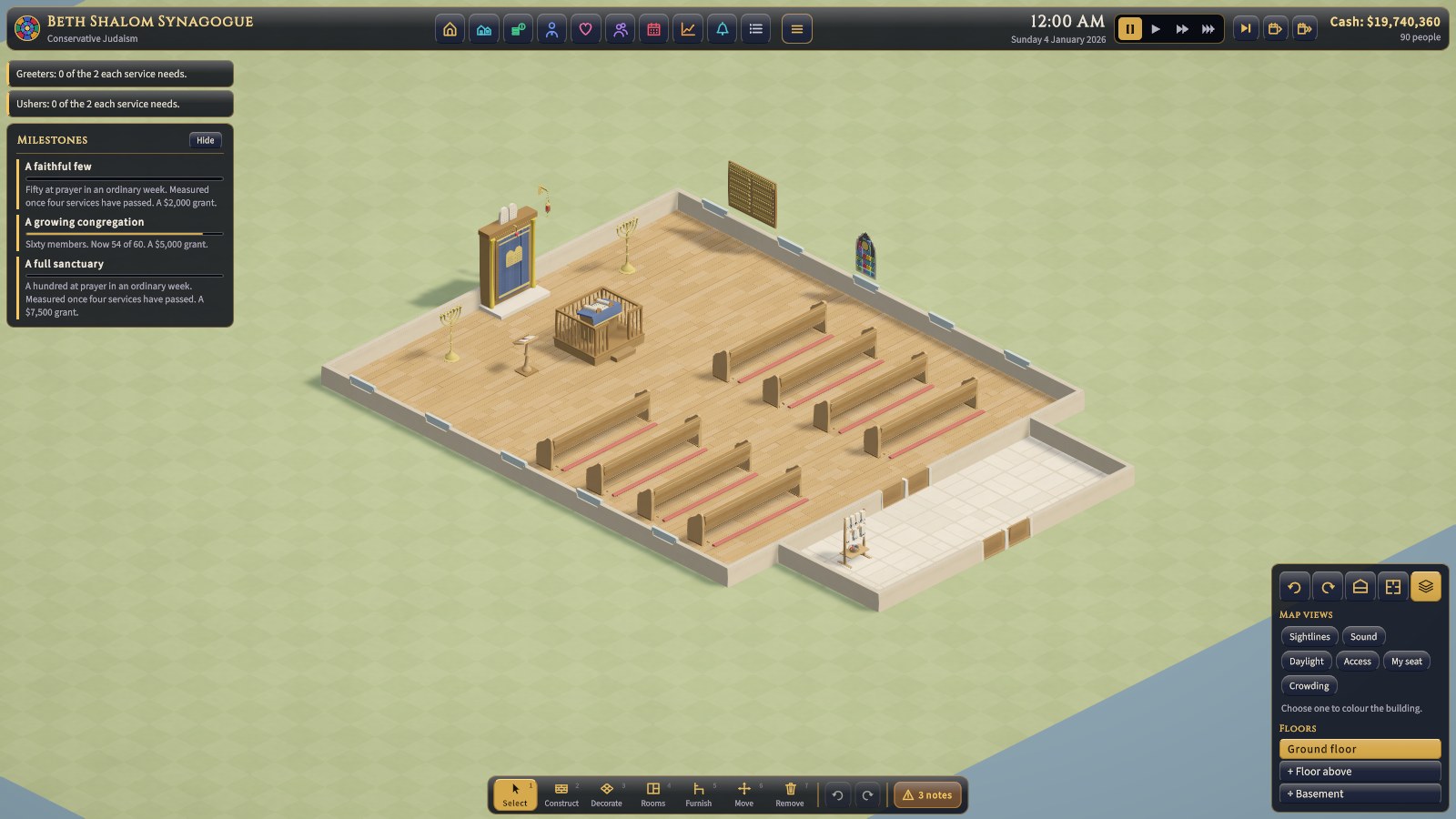
The lot can turn to any bearing, not only the four quarters. The Church screen's second tab says which way the congregation faces ("faces north-east (49°)"), and its Orientation section sets which way the lot's north edge points.
- Mosques must face the qibla, the direction of the Ka'ba in Mecca, along the great circle from where the congregation is: north-east from most of America (about 49° from Chicago). Where it's required, the Orientation section says where the qibla lies and offers Face the qibla, which turns the lot so the prayer rows point at it; place the rows first. Within 22.5° counts.
- Synagogues face east, with the ark on the eastern wall, as American synagogues do by custom (the great circle to Jerusalem is north-east).
- The Eastern churches (the Orthodox, Greek Orthodox, Ukrainian Catholic, and Coptic) face east too: turn the lot so the altar is at the east end.
- Facing the way the tradition wants is worth +0.04 to everyone, and facing another way −0.04.
Pews, chairs, and the floor
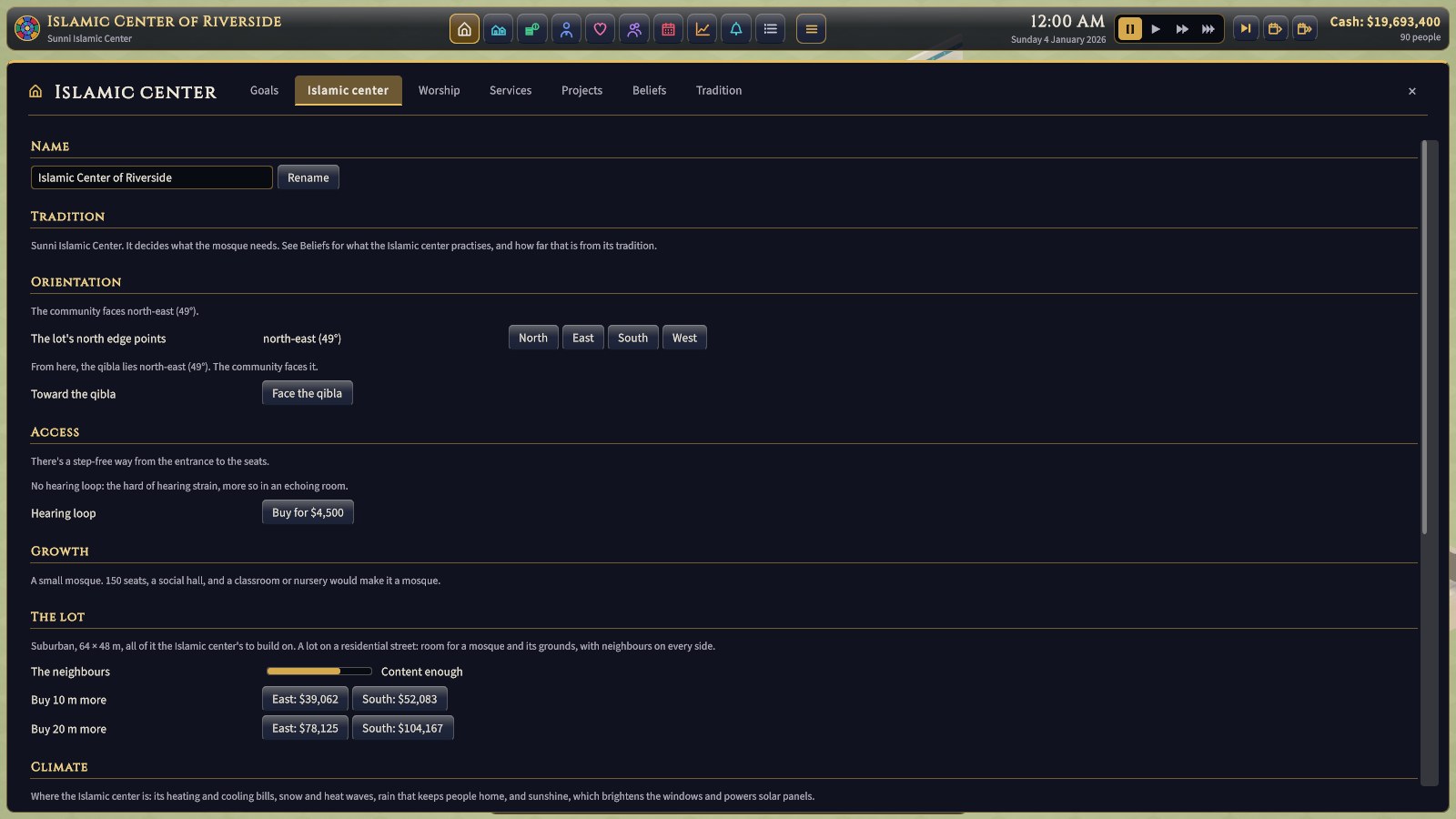
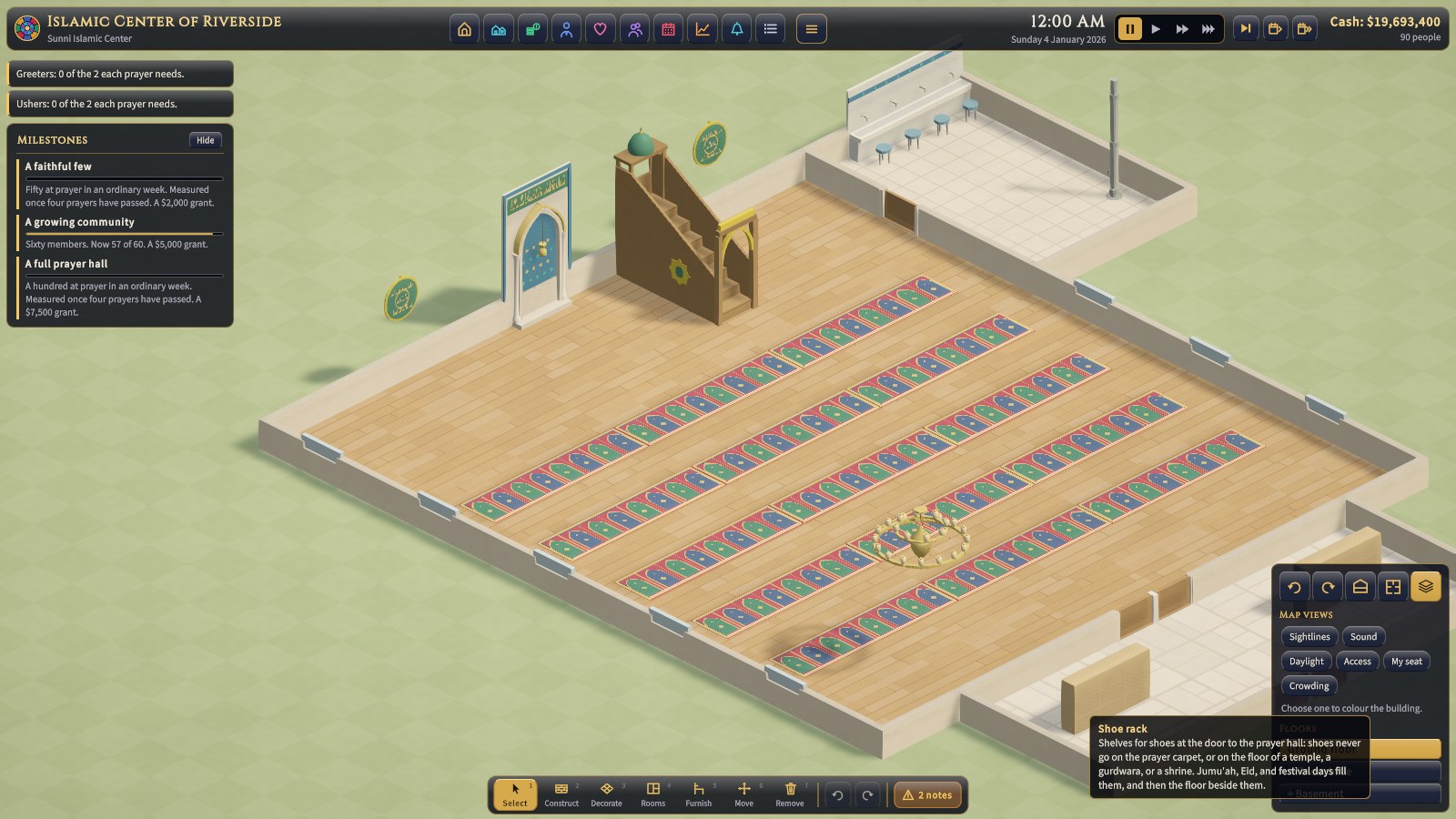
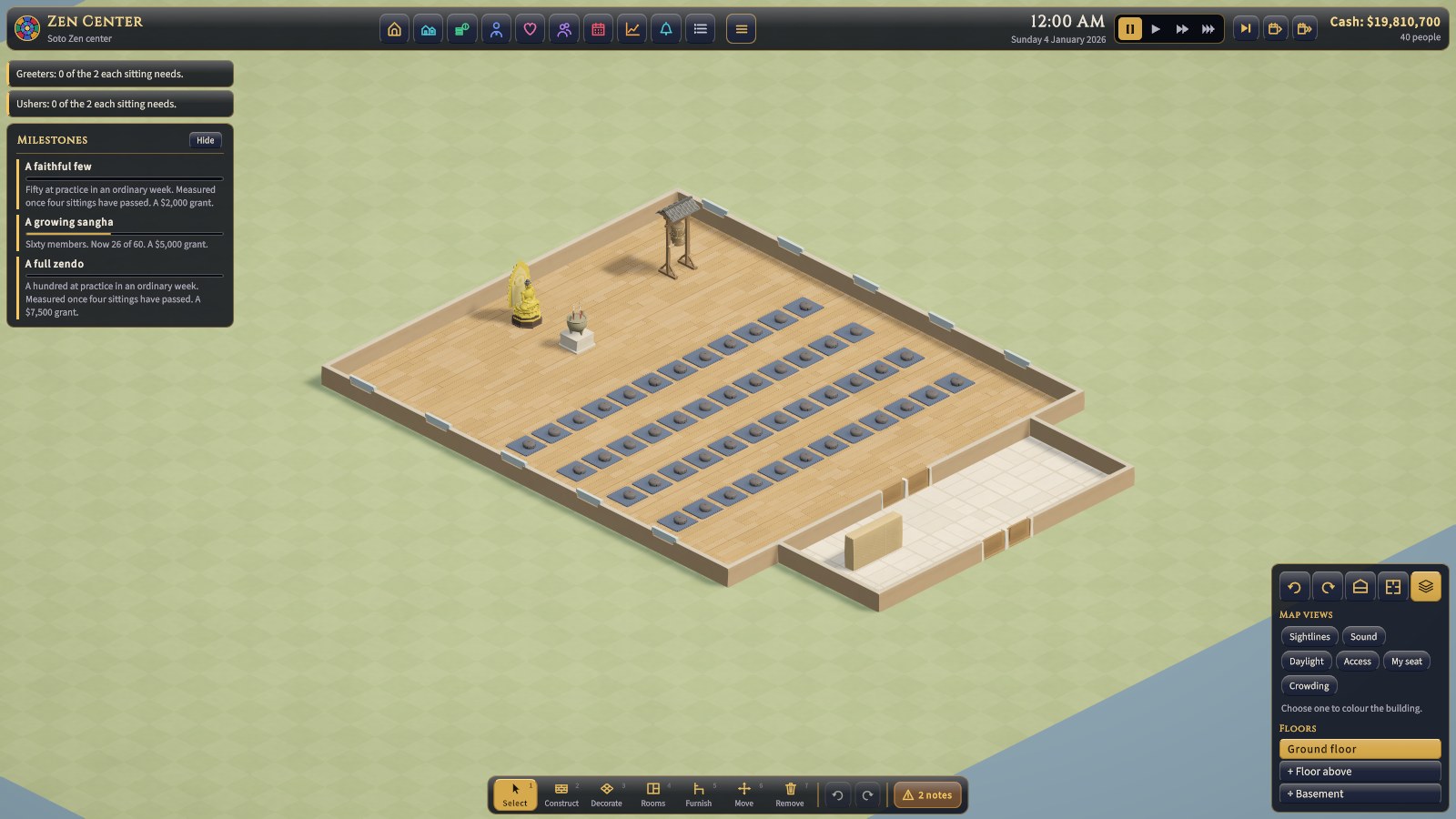
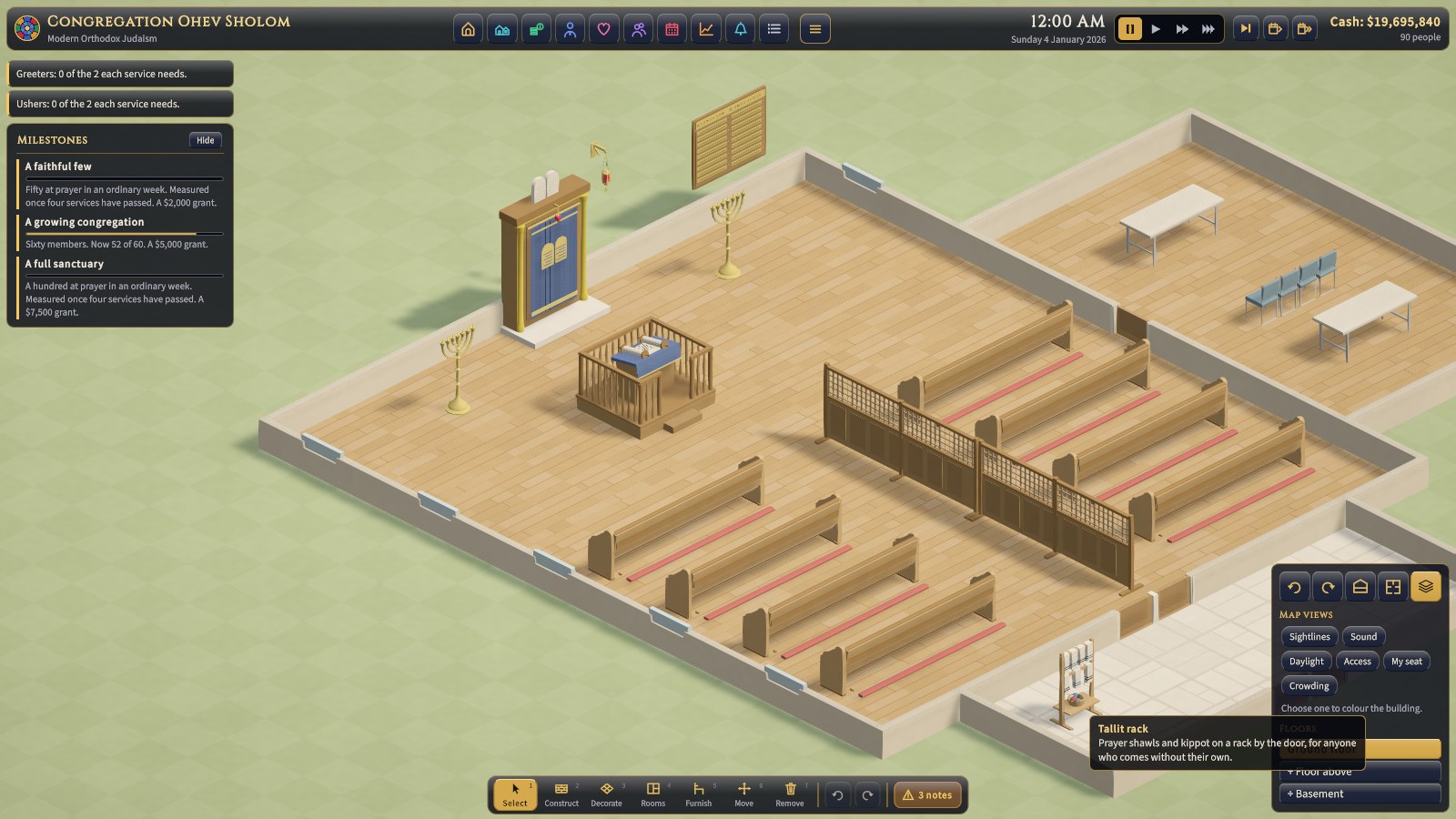
Most churches and synagogues sit in pews or chairs, and which suits is the tradition's to say (each profile below says what fits best): the liturgical churches and the traditional synagogues favour pews, the Pentecostal and charismatic churches chairs. The Orthodox traditionally stand, and Friends sit on meeting benches facing one another. Mosques and most temples sit on the floor. A prayer carpet (4 × 1 m, room for 8, $900) and a row of meditation cushions (4 × 1 m, 4 places, $600) count as seats, for capacity, growth stages, and which way the congregation faces, and people sit on them back on their heels. Pews are discouraged where prayer is on the floor or meditation is the focus; a few chairs at the back serve those who can't sit down. A shoe rack is expected by the door. Hindu, Sikh, and Jain congregations sit on floor sheets (white sheets or durries, 4 × 1 m, room for 8, $300), which count as seats in the same way: a gurdwara requires them and forbids pews, since everyone sits below the Guru Granth Sahib, and ISKCON's temple room and Jain Vishva Bharati's meditation hall discourage pews. The Shinto shrine and the Konko church sit in pews, as Hawaii's shrines and Konko's halls do.
The front of the room
- A church gathers at an Altar or a communion table, with a Pulpit to preach from and a Baptismal font or Baptistry to baptize in, as its tradition has them: a rail and a Tabernacle in the liturgical churches, an Iconostasis or a haikal screen in the Eastern ones, a mercy seat in the holiness churches, the Readers' desk in Christian Science, and nothing at all in a Friends meeting.
- A synagogue requires the Ark (aron kodesh) (the aron kodesh) on its front wall, a Bimah to read the Torah from, and a Torah scroll (bought, not placed, $30,000); a ner tamid and a yahrzeit board are expected, and a social hall for the kiddush. The menorah, tallit rack, kiddush cup, sukkah, and mikveh pool are its own too.
- A mosque requires prayer carpet and a wudu room; a Mihrab in the qibla wall, a Minbar for the khutbah, and a shoe rack are expected. Calligraphy panels, the chandelier, Qur'an stands, a ghusl table, and (for the Shia) the Alam are its own. The Nation of Islam's mosques are lecture halls: a pulpit, chairs, no qibla.
- A temple centres on its image: a Buddha image at a Zen, Theravada, Tibetan, or Vietnamese temple, the onaijin altar of Amida Buddha at a Japanese Pure Land temple, and the Gohonzon in its butsudan at an SGI center. Incense is expected; the kansho, mokugyo, and taiko, the thangka, alms bowls, prayer wheels, and the great temple bell are its own. A Chinese Buddhist temple requires the three Buddhas of its Main Shrine, and expects ancestor tablets and lamps of brightness.
- A Hindu temple keeps its deities in murti shrines, one for each, several to a hall, and requires them, with a shoe rack, wherever it worships before images; a temple bell and a Hundi (the offering box) are expected, and the navagraha shrine and havan kund are its own. The Arya Samaj worships without images: it requires the havan kund and forbids murtis.
- A gurdwara requires the palki, on which the Guru Granth Sahib is opened each day under its canopy, the sachkhand where it rests at night on its sukhasan bed, the Nishan Sahib on the grounds, head scarves at the door, a shoe rack, and floor sheets; the Golak, a kirtan stage for the ragis, and pangat mats for langar are expected.
- A Jain center with images requires a jin shrine, and expects a changing room with puja clothes lockers, a bell, and a hundi; every Jain center requires a shoe rack. The Samavasarana is its own.
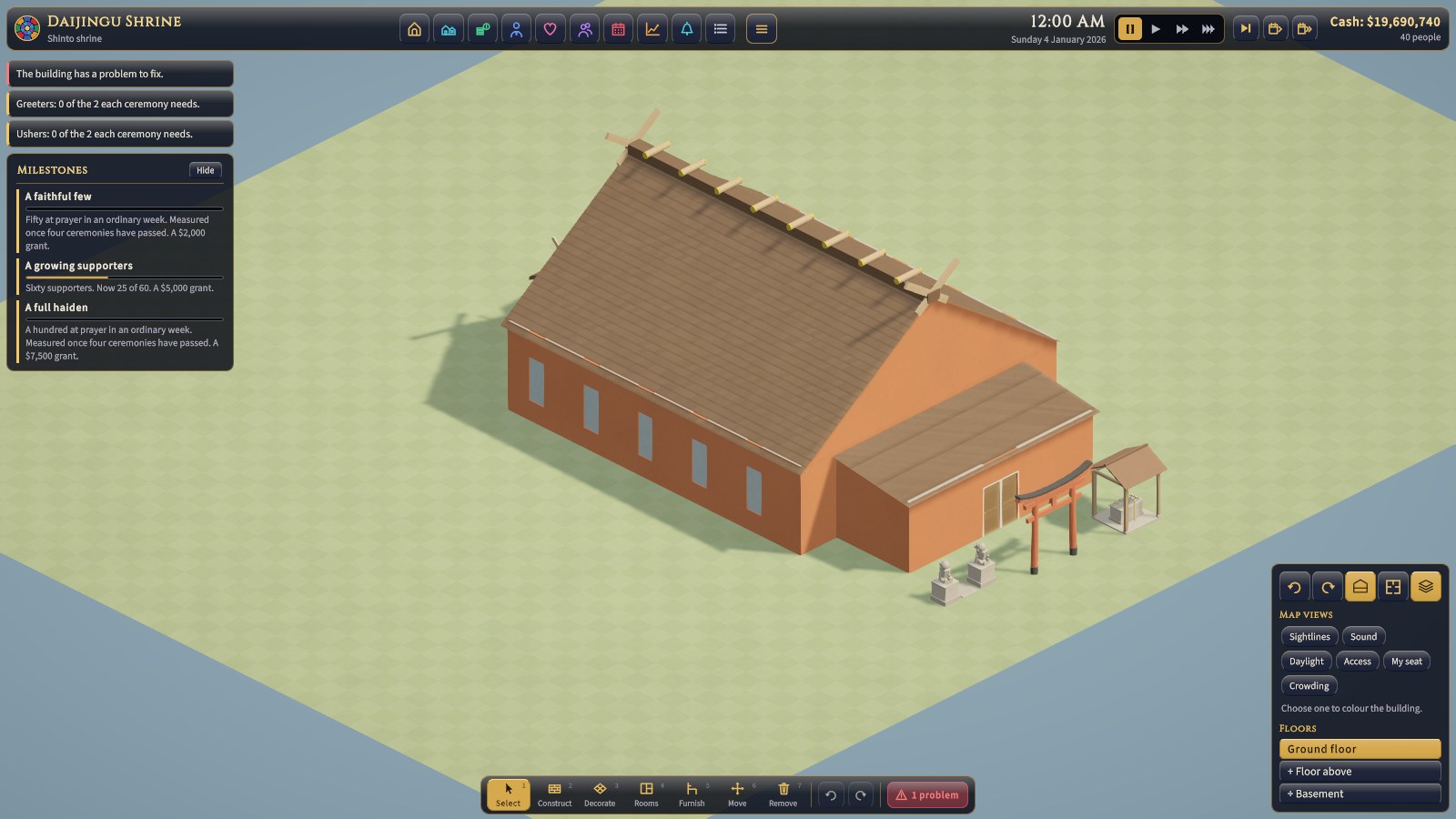
- A Shinto shrine requires the kami altar in its haiden, a Torii, a purification basin, and an offertory box, and expects the Honden, an amulet counter, and an ema rack. The honden is the inner sanctuary, on the grounds behind the hall under its own roof: a ground-floor worship room with no front of its own (no altar in it) faces a honden standing within three metres. Konko requires the kami altar and its mediation seat; Tenrikyo the altar and the nine kagura instruments; both expect a mitama altar for the ancestors.
- A Chinese temple requires its deity altar (Yiguandao, its Mother lamp altar); a folk or Daoist temple expects the great censer outside, an incense burner, and the lamps of brightness, and a folk temple the joss paper furnace and a divination table too. Guardian lions, red lanterns, and a Guanyin statue are its own.
Men and women apart. Where men and women pray on one floor, side by side or with women behind, an Orthodox or Chabad shul requires a Mechitza between them. Where women pray in a gallery (the Modern Orthodox variant, and the Ahmadis' women's hall), any seat off the ground floor serves, and no mechitza is needed: build a balcony. Where men and women sit on their own sides of one room (BAPS and the Swaminarayan temples, ISKCON, a gurdwara, a Sathya Sai center, Yiguandao), they simply do: nothing need stand between them.
Rooms of their own
| Room | What it's for | Who needs it |
|---|---|---|
| Sacristy | Where the vestments and the vessels are kept, and the leader robes | Required in most churches with an altar or a table; only Christian traditions have one |
| Reconciliation room | Confession, face to face or behind a screen | Expected at Catholic and Orthodox parishes |
| Social-service office | The corps's welfare work | Required at a Salvation Army corps |
| Reading Room | A room open to the public, with the church's literature | Required of a Christian Science church, whose literature goes out from it; another tradition's literature outreach can go out from it or an office |
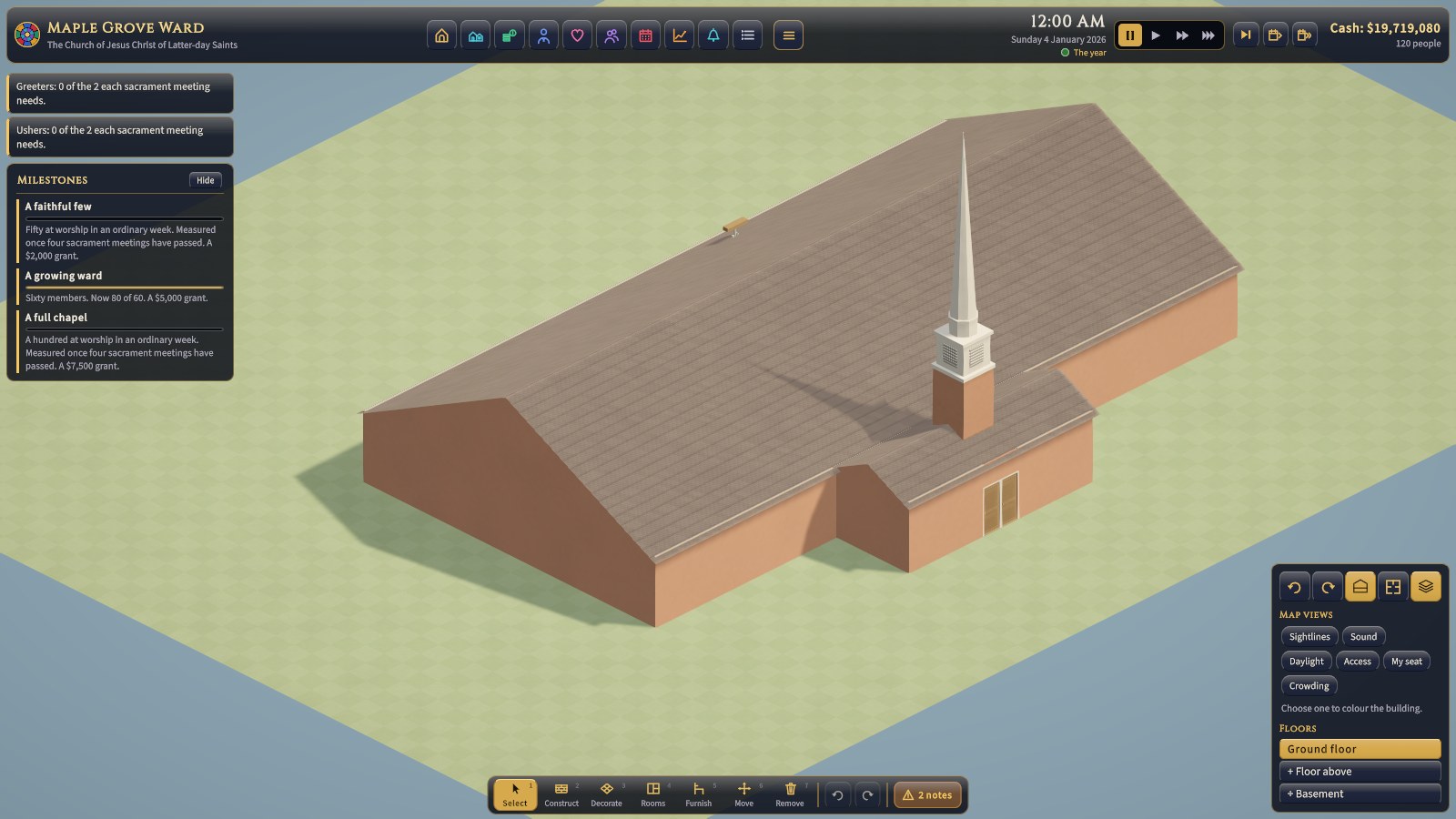
| Cultural hall | A ward's gym and hall, beside its classrooms and offices | Required, with a classroom and an office, at a Latter-day Saint meetinghouse |
| Beit midrash | A study hall lined with books, where the weekday minyan often prays | Expected at Orthodox and Chabad shuls |
| Mikveh | The ritual bath, in a quiet and private room | The congregation's choice (and a dilemma) |
| Wudu room | Washing before prayer, at a row of low taps | Required at every mosque that prays toward the qibla |
| Ghusl room | Where the dead are washed and shrouded before the funeral prayer | A mosque's choice |
| Imambargah | A hall for the majlis that remember Husayn and the martyrs of Karbala | Required at a Twelver Shia center |
| Monks' quarters | Rooms for the monks or nuns who live at the temple | Required, with a kitchen, at Theravada, Vietnamese, and Chinese Buddhist temples and at ISKCON (its ashram); required at a Vedanta Society and at Jain Vishva Bharati (the samanis') |
| Priests' quarters | Rooms where the priests who serve the deities live, often with their families, to keep the shrines from dawn to night | Expected at Hindu temples whose priests are housed; required at a Tenrikyo church, where the head minister's family lives |
| Sachkhand | The Guru Granth Sahib's own room, where it rests at night on its sukhasan bed | Required at a gurdwara |
| Changing room | Where people change into their puja clothes, kept in lockers, before going into the sanctum | Expected at a Jain center with images |
The rooms every congregation already has serve too: the hall as the fellowship hall, the social hall, the dining hall, or the langar hall (its name is the tradition's, and pangat mats can seat it in place of tables), a classroom for Sunday school, Hebrew school, or a madrasah, the balcony as a women's gallery, the columbarium at a church or a temple. Many traditions expect a hall, and some a kitchen too.
Steeples, domes, minarets, stupas, temple towers, gates, and temple roofs
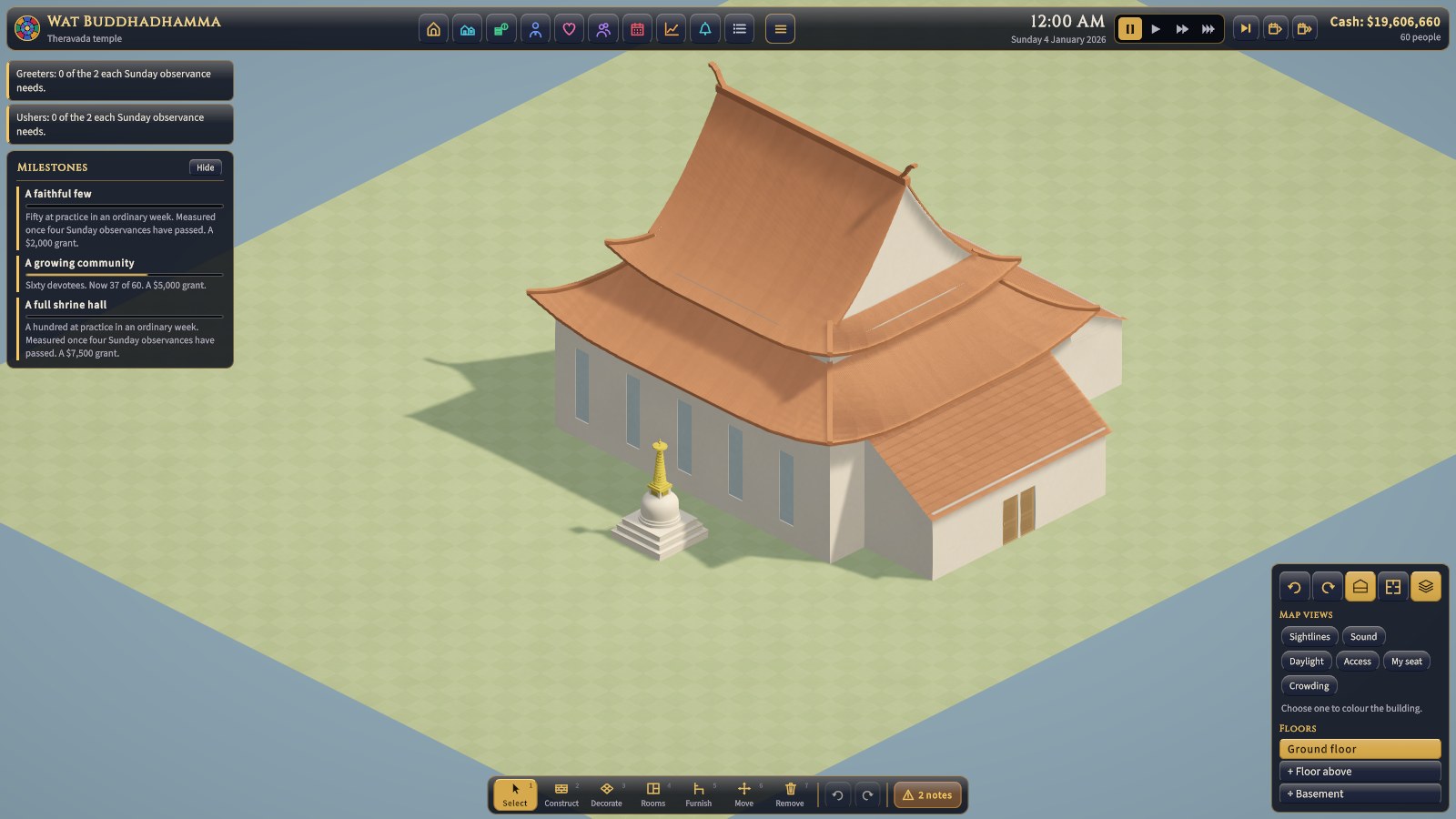
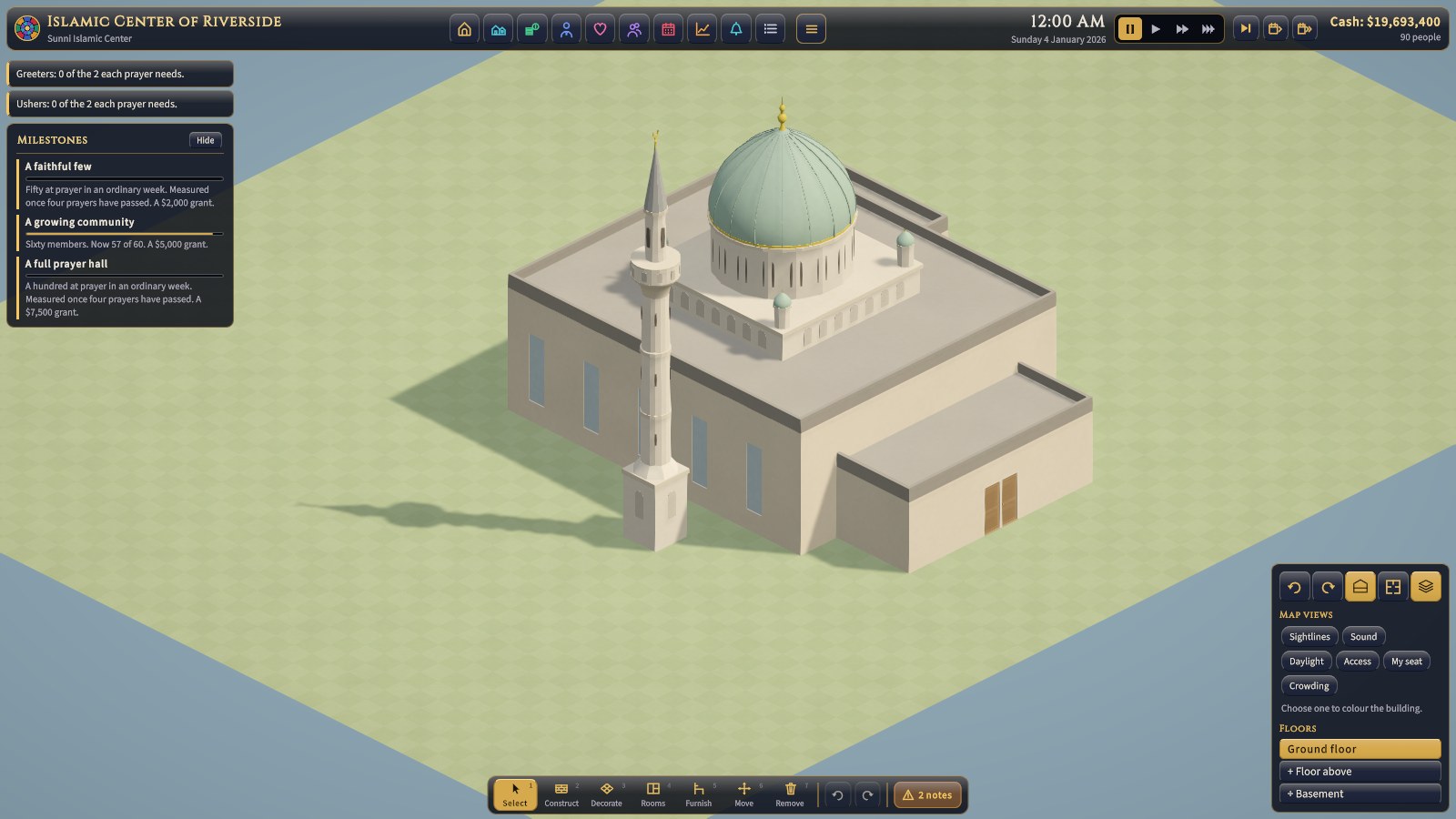
These stand on the roof over one part of the building, or on the grounds, at the same price, and each lifts the number of passers-by who notice you (all such items together lift it by half at most):
| Item | Footprint | Price | Takes | New visitors | Offered to |
|---|---|---|---|---|---|
| Steeple and bells | 3 × 3 m | $180,000 | 18 months | +25% | Christian |
| Plain spire | 2 × 2 m | $45,000 | 3 months | +15% | Christian (a Latter-day Saint meetinghouse's) |
| Small dome | 4 × 4 m | $85,000 | 8 months | +12% | every faith |
| Great dome | 8 × 8 m | $340,000 | 16 months | +25% | every faith |
| Minaret | 2 × 2 m | $150,000 | 12 months | +20% | Muslim |
| Stupa | 3 × 3 m | $60,000 | 8 months | +10% | Buddhist |
| Pagoda | 3 × 3 m | $220,000 | 18 months | +22% | Buddhist |
| Shikhara (Nagara, curved) | 4 × 4 m | $200,000 | 18 months | +22% | Hindu and Jain |
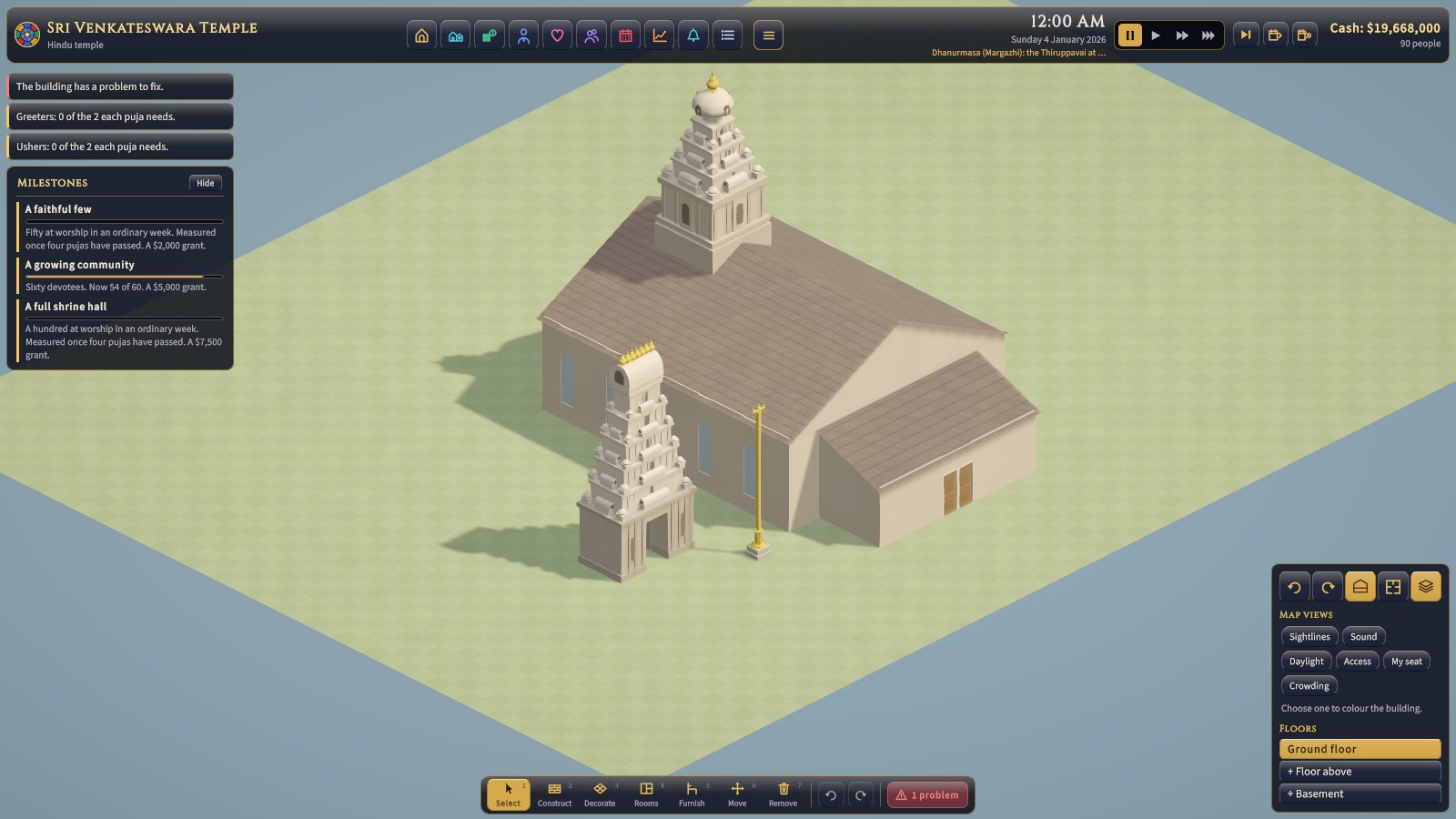
| Vimana (Dravidian, stepped) | 4 × 4 m | $210,000 | 18 months | +22% | Hindu |
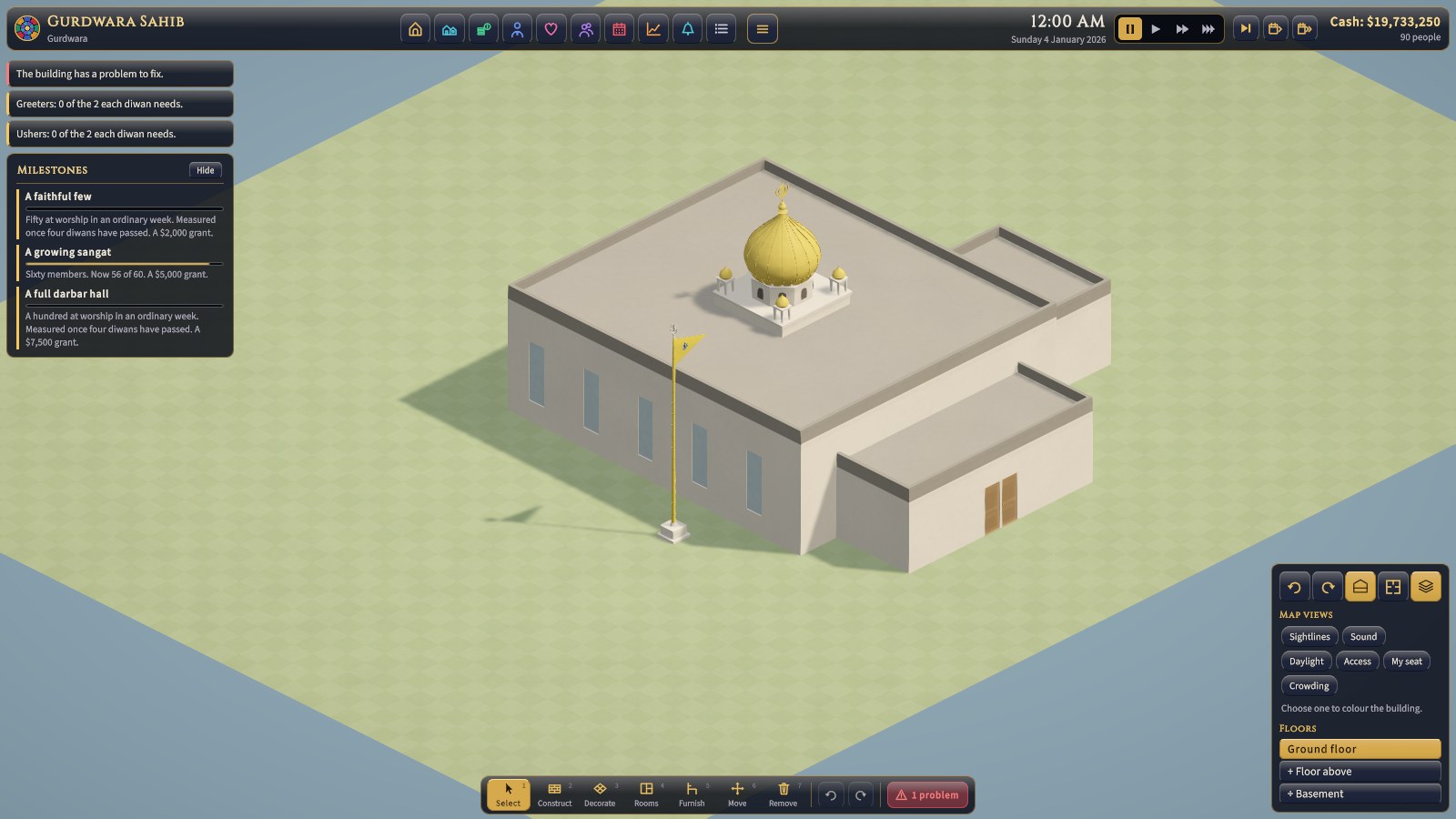
| Gilded dome | 4 × 4 m | $95,000 | 9 months | +12% | Sikh |
| Gopuram (a gateway tower; grounds only) | 5 × 3 m | $320,000 | 24 months | +25% | Hindu |
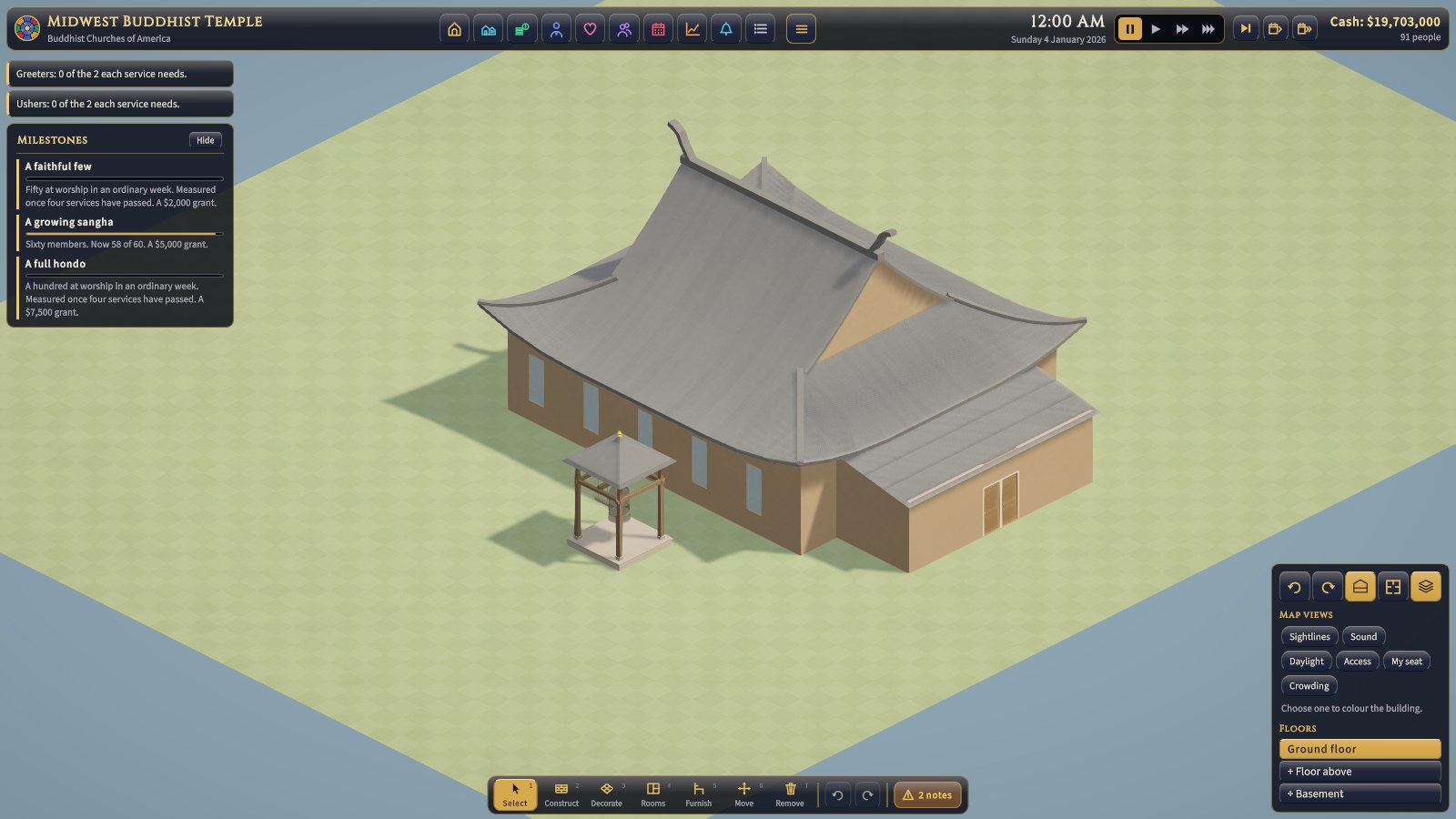
The steeple's bells ring out, and so does the temple bell, and the neighbours notice both; the minaret is silent (most American mosques give the call to prayer inside). Gates stand on the grounds and are walked through: the gopuram, the Shinto Torii ($18,000), and the Chinese Paifang ($60,000), each a little more visible (+2%). So do the Nishan Sahib, the gurdwara's flagpole in its basanti cloth, and a Hindu temple's gilded flagstaff, the Dhvajastambha; a shrine's Honden is a small building of its own, under its own roof. A temple roof, hip-and-gable with curved slopes and eaves turned up at the corners, comes tiled or layered, the layered one with a second, steeper tier as Thai and Lao temples have it, or in green glazed tile, its ridge sweeping up and forking at each end like a swallow's tail, as on a Chinese temple (yellow, the imperial glaze, is a roof colour); a gable can take a Shinto shrine's cypress bark, with chigi crossing above each end (see Keeping the building standing for their prices and lives). Twelve styles in all: colonial brick and Gothic, Islamic, Japanese temple, Thai temple, Modern synagogue, the Nagara and Dravidian temples of North and South India, Gurdwara, Jain marble, Shinto shrine, and Chinese temple. As with any style, the closer its formality to the tradition's, the better it suits (see Rooms, materials, styles and lots).