Chapter 13: Faiths and traditions · Part 14
The wider body, schism, and a tradition of your own
The wider body
Most traditions have a body over their congregations: a diocese, a synod, a conference, a stake, a movement's union, a national jama'at, a mother monastery, a line of parent churches. The game calls it the wider body, and names it in the tradition's own words. Church → Tradition (the last tab of the panel that takes your tradition's word: Church, Parish, Synagogue, Islamic center) shows it: its levels and their leaders (the diocese and its bishop, the district and its superintendent), its regard for the congregation and how often its leader visits, the congregation's status, any supervision, closure warning, or merger on offer, the places its people go, what it can make the congregation do, what's owed to it and what not keeping it costs, the help it gives, what it's done lately, and leaving it. A congregation with no wider body (the Churches of Christ, the Christian Churches, the nondenominational church, the Sunni Islamic center, the W. Deen Mohammed masjid, the Zen center, the Hindu community temple, the Indo-Caribbean mandir, the Chinese folk temple) is told so, and governs itself; a gurdwara's is the Akal Takht in Amritsar, which asks nothing of it and has no powers over it; a Twelver Shia center sends khums to the office of its marja' but answers to no one for it.
Its regard for the congregation
The wider body's regard for your congregation runs from 0 to 1. It falls with unpaid obligations whose consequence is its regard, and with drift from the tradition (below). It rises a little for a missionary sent (+0.05), a congregation planted (+0.1), a merger accepted (+0.1), each month a ministry of a kind the tradition values highly runs, and a visit that finds the building well kept. It falls a little for asking for a new leader (−0.05), turning down a merger (−0.1), and a visit that finds the building neglected. How fast it follows what you do depends on the wider body's presence: a fifth of the way each month where it's strong, half that where it's light, half as quickly again where it's total (AME, Latter-day Saints), and not at all where there's none.
| Regard | What follows |
|---|---|
| Below 0.7 | It won't approve or consent to your projects or calls, won't help, and won't move your leader at your asking. |
| Below 0.5 | It says it's troubled, and its visits strain those at the service instead of lifting them. |
| Below 0.3 for three months | It acts, as its powers allow (below). |
| Below 0.15 for six months | A body that can expel congregations, and doesn't hold the property, expels yours. |
What the congregation owes
Each tradition's wider body asks for one or more obligations (the Catholic diocese's assessment, the URJ's and USCJ's dues, the OU's membership dues, the BCA's assessment per member, a Tenrikyo church's offerings to its parent church, an ISKCON temple's share to its regional body), or none (the Latter-day Saints, the Salvation Army, SGI-USA, the Ahmadi chapters, and SRF's temples send everything up instead, below; BAPS, ISSO, and most other temples' bodies ask for nothing), each listed on the Tradition tab with its basis (a share of income or of tithes, a sum for each member, a yearly levy or goal), who pays it, and what not keeping it costs.
- Required obligations the congregation pays together, at the share you choose on Finances → Budget (0% to 200%: more than 100% pays off arrears). What goes unpaid builds arrears, and an obligation is not kept once its arrears pass three months of it.
- Voluntary obligations (the Cooperative Program, the ELCA's mission support, the Annual Program Fund, the ACNA's diocesan tithe, a Konko church's support for Konko Churches of North America) each have their own setting, from none to 150%. Giving less than half counts as not keeping it, where that has a consequence.
- Paid by members: what members pay upward themselves (Christian Science's per capita tax, Community of Christ's Mission Tithes, a Shia believer's khums to the marja', the Nation of Islam's Economic Blueprint) comes out of what they'd give the congregation. Paid by clergy: ministers' dues and tithes, which the pastor asks for in their salary.
What not keeping one costs is one of: the wider body's regard (a year of paying nothing to a Catholic diocese drops it to about 0.1; so do a synagogue's movement dues, the BCA's assessment, and a Tenrikyo church's offerings); no aid (the Unitarian Universalists' Annual Program Fund); or no voice (the Episcopal, Orthodox, Greek Orthodox, and AME churches' assessments, the National Baptist dues, the Reconstructionist affiliation dues), so the wider body turns down the congregation's projects and sends it the weakest leader. Paying half in a crisis month is a reasonable compromise; paying nothing for long is not.
Visits and requests
Where it's present, the wider body's leader visits on the tradition's main day (a Sunday, a Saturday, a Friday): once a year where its presence is light, twice where strong, four times where total. Those at the main service are lifted (+0.03) where it regards the congregation at 0.5 or more, and strained (−0.02) where it doesn't. Its review follows the building: condition 0.6 or more raises its regard, below 0.4 lowers it. It also asks things, as dilemmas: a special appeal, and where its presence is strong, hosting the regional gathering or the annual report.
Help in need
Many wider bodies help a congregation that stands well with them (0.7 or more, and not behind on an obligation that costs it aid). The Tradition tab offers what yours gives:
- A grant of three months' expenses (up to $30,000), once in three years, for a congregation with less than three months' expenses in hand.
- A loan of $50,000, $100,000, or $250,000 at 3% over 15 years, one at a time: half the bank's rate.
- Help with the leader's pay: 40% of their salary for three years, for a congregation in need.
What it can make the congregation do
Each wider body's powers are its own, and the Tradition tab lists them. After three months of regard below 0.3:
- Withdraw the leader's credentials, where the wider body holds its ministers' standing rather than the congregation's (the ACNA, American Baptists, Assemblies of God, Christian Reformed, Church of God, ELCA, Missouri Synod, Mennonites, PCA, UCC, United Pentecostals, Unitarian Universalists, Vineyard USA; Chabad; the Buddhist Churches of America and the Theravada and Vietnamese temples; ISSO, the Vedanta Society, and Chinmaya Mission; Jain Vishva Bharati; the shrine and Konko; Yiguandao). The leader must step down, and the matter is treated as settled (its regard recovers a little). At most once in two years.
- Take the congregation into its supervision, where it can (Catholic, Ukrainian Catholic, Orthodox, Greek Orthodox, Coptic, Episcopal, Presbyterian, COGIC, Moravian, Nazarene; BAPS, ISKCON). Every project and the leader are its to decide until its regard has been above 0.6 for three months. Where the tradition has a supervised status (an Episcopal mission, a Nazarene church with an appointed pastor), the congregation moves to it. (An Assembly of God in trouble goes to the district by its status instead, below.)
- Remove the leader the congregation called and send its own, where it can remove leaders.
And for a congregation of fewer than 20 active people for a year: where the wider body can merge congregations (among others beyond Christianity, the Ahmadis' national jama'at, BAPS, SRF, SGI-USA, Tenrikyo's line of churches, the Daoist temples' body, and Fo Guang Shan), it offers to merge another struggling one into yours (three to six households join; you have 60 days to answer, and turning it down costs 0.1 of its regard). Where it can close them, it warns you, and a year later, still small, it closes the congregation, which loses a scenario.
Statuses
Some traditions have affiliations a congregation moves between, each changing how it's governed:
| Tradition | Status | Moves |
|---|---|---|
| Assemblies of God | Sovereign / district-affiliated | To district-affiliated below 20 members or at 30% regard for six months; back by the members' vote with 20 members, its way paid, and 50% regard for three months. |
| Episcopal | Parish / mission | To a mission at 15 members for a year or 25% regard for six months; back by vote at 40 members, its way paid, 50% regard for six months. |
| Nazarene | Calling its pastor / an appointed pastor | To appointed below 35 members or at 30% regard for six months; back by vote at 35 members, its way paid, 50% regard for three months. |
| Latter-day Saints | Ward / branch | To a branch at 40 members or fewer for a year; to a ward at 120 for six months. |
| ARC | Launching church / partner church | Every church starts launching, repaying its launch funding at 10% of income; ARC makes it a partner once it has paid its own way (no help, and six months' books in the black) for two years running. A partner owes only a voluntary 2%. |
| Vineyard USA | Good standing / out of compliance | Out of compliance at 0.3 regard or less for six months: no help, and its regard follows what the church does faster; back in good standing at 0.5 for three months. |
A vote to move carries if most adult members are content (0.5 or more). ARC's and the Vineyard's moves are the wider body's, with no vote.
Funding and property
- Central funding (the Salvation Army, the Latter-day Saints, SGI-USA, the Ahmadiyya Muslim Community, whose chapters send all chanda to the national headquarters, and the Self-Realization Fellowship's temples): each month's giving goes up, and a budget of $25 for each active person, plus the building's costs, comes down. Growth is what raises your budget.
- The tithe goes up (Adventists): 15% of income to the conference, which pays the pastor.
- Property it owns (the Catholic and Ukrainian Catholic churches, the Adventists, the Witnesses, Community of Christ; BAPS, the Fung Loy Kok temples, and Fo Guang Shan): it insures the building.
- A rented building (a Nation of Islam mosque, a Sathya Sai center): the congregation can furnish and renovate, but can't build onto it; leaving costs it nothing for the building.
- A shared hall (Latter-day Saints, Witnesses): other congregations have it on the main day from noon to five, and its members clean it, so there's no caretaker to hire. The Witnesses' other congregations pay two thirds of its utilities and upkeep; a Latter-day Saint ward's building costs are the Church's already, so there's no share to pay.
- How each tradition's people give (the plate, pledges, dues, zakat, khums, dana, the golak, fees for rites, amulets and lamps) is under Giving, above.
Practice and doctrine
Changing practice
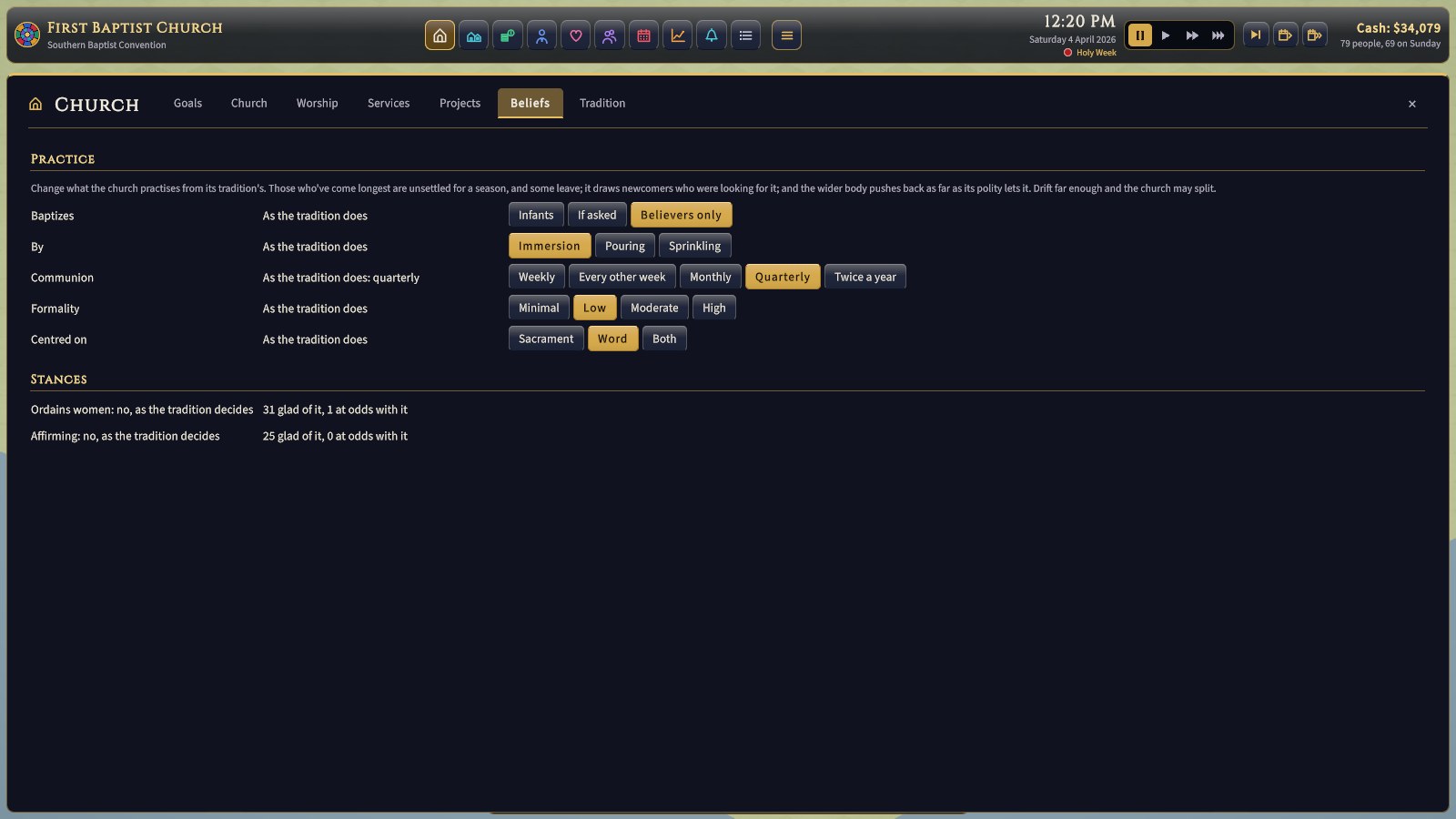
On Church → Beliefs you can change the congregation's practice from its tradition's: how formal worship is, and, in a Christian tradition, who is baptized and how, how often communion is celebrated (weekly, every other week, monthly, quarterly, or twice a year), and whether worship centres on the sacrament, the word, or both. (A synagogue, mosque, or temple has only formality to change: baptism, communion, and word and sacrament are a Christian tradition's.) Each change has a size: who is baptized 1, how 0.4, each step of communion frequency 0.2 (every other week is half a step from weekly), of formality 0.25, a change of focus 0.3 or 0.6.
- Where doctrine is held centrally (the Catholic, Ukrainian Catholic, Orthodox, Greek Orthodox, Coptic, and Episcopal churches, the Church of God and COGIC, the Adventists, Latter-day Saints, Community of Christ, Witnesses, Christian Science, the Salvation Army), the sacraments and what worship centres on are the whole body's: only how formally you worship is yours to change. Beyond Christianity only formality changes anyway, and the wider body minds most where it holds doctrine centrally: Chabad; the Ahmadis and the Nation of Islam; SGI-USA, the Tibetan center, and Fo Guang Shan; BAPS, ISSO, ISKCON, the Vedanta Society, Chinmaya Mission, SRF, and the Sathya Sai Organization; Jain Vishva Bharati; Tenrikyo; the Daoist temples' body and Yiguandao.
- The building follows. A Baptist church that starts baptizing infants (still by immersion) needs an Immersion font; the building check updates at once.
- Long-standing members are unsettled for 13 weeks (−0.08 a week), more likely the longer they've come. When it settles, each unsettled household leaves with up to a 30% chance.
- It draws newcomers looking for just that: up to half as many again, for a year.
- The wider body pushes back. Its regard moves toward 1 minus the distance drifted times 0.6 where doctrine is held centrally, 0.45 where it's confessional, or 0.2 where each congregation decides, as fast as its presence.
- Change your mind within the 13 weeks and nothing settles.
Practice changes are powerful but expensive. Make one big change, not many small ones, and make it when the congregation is young in tenure and the money is good. Congregations under a bishop pay a much higher price in standing.
Social stances
Each tradition says whether its congregations ordain women and whether they're affirming, or leaves it to each congregation. Where it's left to you (the affirming question in the ELCA, UCC, United Methodist, and Friends General Conference churches, a Conservative synagogue, a Tibetan center, and a Shinto shrine; women's ordination in the Christian Reformed, National Baptist, Christian Churches, Vineyard, ARC, and nondenominational churches), Church → Beliefs has Yes and No. Each person has a view. Those who hold a strong view (beyond 0.4 from the middle) feel the congregation's practice after every service: up to −0.2 if at odds, +0.06 if in accord. Visiting households at odds come back less than half as often and never join.
The Beliefs tab shows how many of your people are glad and how many are at odds with each choice. The game takes no side. Each choice shapes who joins you over the years, and the wider community newcomers come from is evenly split.
- Local variance. Where a tradition's congregations often depart from its stance on being affirming (the Catholic, Episcopal, Presbyterian, Moravian, American Baptist, Brethren, Friends United Meeting, and nondenominational churches; the Hindu community temple, the Indo-Caribbean mandir, and the Arya Samaj; Konko), yours can too, with Yes and No, but the wider body holds it against you: as much as half a change in who is baptized, by its pushback.
- Where the region decides (Mennonite Church USA, Community of Christ), the congregation can't: it is as its conference or region is, fixed for the game.
- Who serves. Where women may not govern, they're not on boards; where they may preach but not lead the congregation, they can be associates; where they may not hold the highest office, a woman stays a rung below it.
- Two kinds of leaning. A sermon leans on moral questions or economic ones, and some traditions lean differently on each: Catholics, conservative on moral questions and liberal on economic ones, take a sermon on social justice well (see Worship and the year).
Designations
Some traditions offer a public designation a congregation adopts by its own vote: Reconciling in Christ (ELCA), a Reconciling Congregation (United Methodist), Open and Affirming and a Just Peace church (UCC), a Welcoming Congregation (Unitarian Universalist), and a Welcoming and Affirming Baptist church (American Baptist). Put it to the members on Church → Beliefs; members vote for it as far as they'd like the congregation to take its stance, and a majority carries it. Once adopted, it takes the stance, draws more newcomers for a year (a fifth more for most), gains a little standing, and some households at odds with it leave (a quarter of them for most, three in ten for a Welcoming and Affirming Baptist church, a tenth for a Welcoming Congregation). A Just Peace church takes no stance, draws fewer newcomers, and loses no one over it.
Belonging and giving
- Kinds of belonging. Each tradition has its own: confirmed and baptized members, voting members and parishioners, senior soldiers and adherents, baptized and unbaptized publishers, Friends and attenders, member households, voting members and the wider community of a mosque, members and students of a dharma center, a Hindu temple's life members and devotees, satsangis, a gurdwara's General Body and its sangat, a shrine's sukeikai members and worshippers, Yiguandao's cultivators and the initiated. The People screen counts each, and says who votes, who may hold office, and who counts for what's owed per member.
- Commitment. Where a tradition asks much of its people (high, or total for the Witnesses), they come more faithfully (6%, or 10%, more often), serve more, drift less, and join more slowly; where it asks little (the ELCA), the reverse.
- What holds people. Formal discipline (and members below 0.3 are taken off the rolls each January), shunning (a household's leaving costs its friends), belonging where one lives (and the wider body divides a parish of 450), an exclusive belonging, holiness dress, a uniform, and the wider body's places all make households drift away less.
- Tithing. Where it's expected, people give 15% more; where it isn't emphasised, 10% less.
- How it's given. Where the tradition doesn't pledge, there's no pledge drive, and people give in the plate each week they come (in Christian traditions that pass one). A walked offering brings 15% more from members and half as much again from visitors; contribution boxes alone bring a tenth less and nothing from visitors; mailed or private giving comes in at the month's start; online givers give whether they come or not (8% more). Dues, holy-day seats, zakat, and dana are under Giving.
- Newcomers from other congregations. About half of newcomers come from another congregation, almost always of your own faith (one in twenty from any faith: a convert's path). The more alike its tradition is to yours (worship most, then the sacraments, doctrine and scripture, polity, and family least), the likelier they come back, and from one much like yours they settle in sooner. In a Christian tradition, whether they're received or baptized again depends on whose baptism it recognizes (Growing the congregation).
- Joining. Each tradition receives people its own way: its joining age, and in a Christian tradition its ages for baptism and confirmation, how long the baptized wait and the unbaptized prepare, its season, and whether its baptized children are members. Every tradition's page in Every tradition: services and what they need sets it out.
Schism, and leaving the tradition
Drift 1.5 or more from the tradition, and a change that settles with a third or more of the congregation still unsettled splits it: every unsettled household leaves together.
Or the congregation can leave its wider body, from Church → Tradition (Leaving the tradition): Propose leaving…, then Put it to the members. It goes to the members as the tradition's exit rule says, then to the wider body where it must consent (it consents once the settlement can be paid). Members vote to leave the further the congregation has drifted and the worse the wider body regards it, and less the longer they've belonged.
- Can't vote to leave: Catholic, Ukrainian Catholic, and Coptic parishes, Latter-day Saint wards, Witnesses congregations, Salvation Army corps, Ahmadi chapters, Nation of Islam mosques, SGI-USA centers, Chabad houses, BAPS mandirs, ISKCON temples, SRF temples, Chinmaya and Jain Vishva Bharati centers, Sathya Sai centers, Tenrikyo churches, Fung Loy Kok's Daoist temples, Yiguandao halls, and Chinese Buddhist temples (their property or leaders are the wider body's, or there's no vote). A gurdwara, a Jain center, and the temples with no wider body have nothing to leave.
- Two votes: the ELCA (two thirds each, three months apart) and the Christian Reformed (a month apart). Two thirds: American Baptist, Assemblies of God, Episcopal, Greek Orthodox, Missouri Synod, Moravian, Orthodox, United Methodist, Unitarian Universalist, the Buddhist Churches of America, the Tibetan center, the Vedanta Society, Konko, and an ISSO temple (whose diocese must consent, on negotiated terms). Everyone: both Friends bodies. The rest, a majority.
- What it costs: where the wider body holds the property, the congregation must buy it out, of the building's worth ($2,000 a square metre enclosed), plus anything owed: all of it where the building would stay behind (Episcopal, Greek Orthodox, AME, Free Methodist, Nazarene, Brethren, Moravian, the Pentecostal bodies that hold property in trust, the Adventists, Community of Christ); half by negotiation (Orthodox, Presbyterian); 30% by formula (United Methodist). Where the congregation owns its own and the wider body asks no buy-out (the ELCA, the Christian Reformed), it pays only what it owes. Where the wider body's claim wouldn't hold up (the Baptists, the ACNA, the PCA, Missouri Synod, Mennonites, UCC, Unitarian Universalists, both Friends bodies, Christian Science, Assemblies of God, United Pentecostals, the four networks with a body to leave (Calvary Chapel, Acts 29, Vineyard USA, ARC), the four Jewish movements with dues to their union, the Buddhist temples and centers that own their own, the Arya Samaj, the Vedanta Society, the shrine, and Konko), it costs nothing at all. An ISSO temple's diocese negotiates half. It can't leave without the money.
Once it's carried, the congregation governs itself: it decides what the polity used to, it owes nothing (arrears are settled), its standing no longer matters, any support ends, and it decides its own stances, keeping what it practised. Some of those most attached to the tradition stay with it: each household leaves with a chance of up to 50% by how long its adults have come, less the further the congregation had already drifted.
Founding a tradition of your own
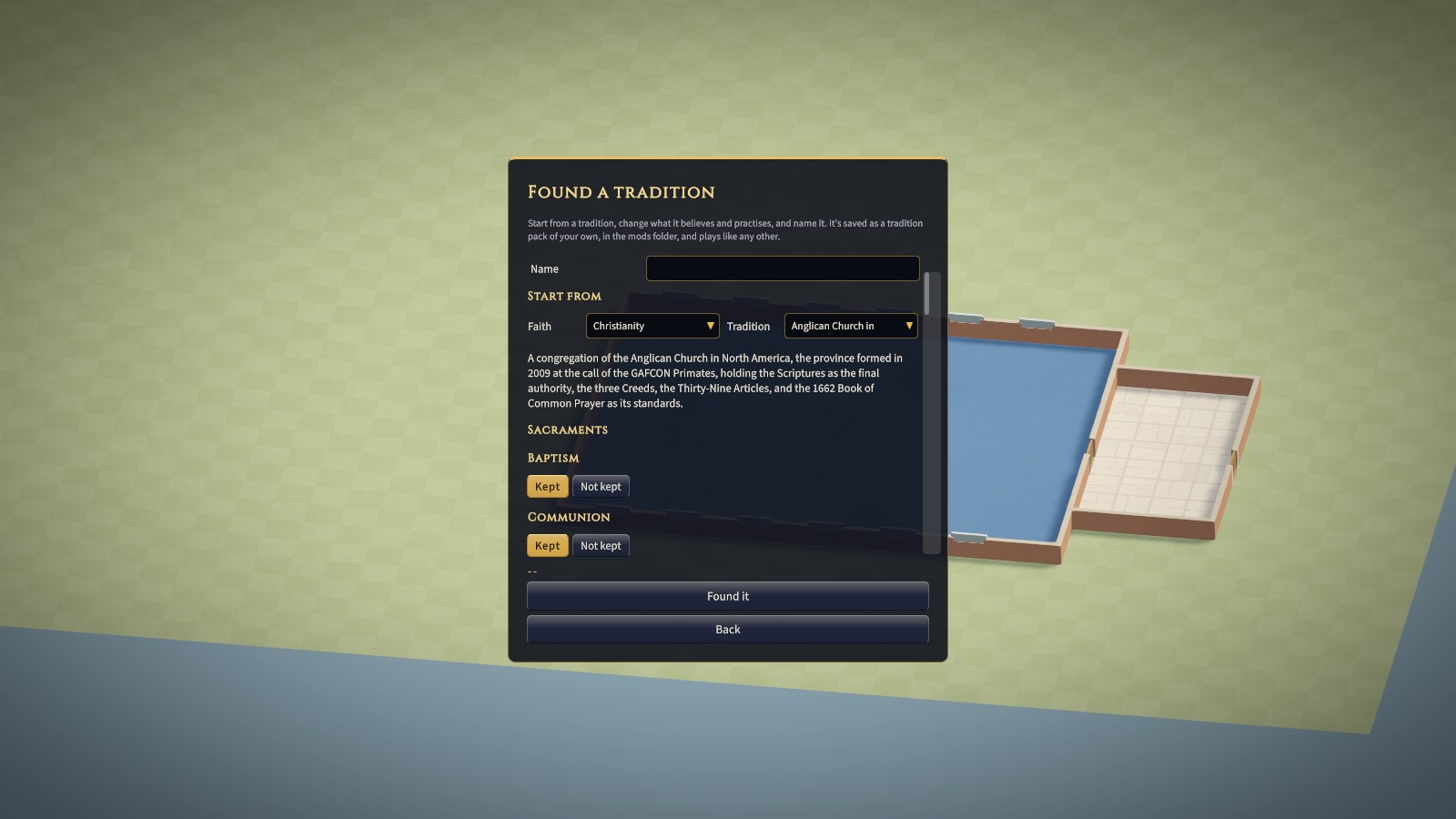
Mods → Found a tradition, or Found a tradition of your own… on the sandbox screen, lets you start from any tradition (choose its faith, then the tradition, as for a new game), change its attributes, name it, and found it. Started from a Christian tradition, it asks about baptism, communion, the rite, the church year, and Christian symbols; started from any other faith's tradition, it keeps its faith's own rites and calendar and asks about the rest. It's then chosen for a new sandbox game. The game checks it as it checks its own content: baptism and communion must be described if and only if they're observed, and nothing can be both wanted and forbidden.
Your tradition is saved as a tradition pack in the mods folder (my-traditions.rjpak), in exactly the format of the game's own; decompiled, it's a good starting point for a pack to share. Founding one of the same name again replaces it.
Tradition packs
Communities can add their own traditions, and correct the details of others, with tradition packs: content loaded from the mods folder, either a folder of files or a single .rjpak pack file compiled from one. No programming is needed. The Mods screen shows where the folder is (with Open the folder and Reload), what's installed, and any problems in it. The game comes with a sample pack, the made-up Meadow Brethren of the modding guide, in its SampleMods folder (meadow-brethren.rjpak): copy it into the mods folder to play it. A pack that's been damaged or edited is refused, and the Mods screen says so. A mod's item replaces the game's item with the same ID. Packs made for the game's earlier traditions are refused with a message saying they need updating.
Official expansions load the same way, marked as such on the Mods screen. There are none at present: the first, the Heritage Pack, is now part of the game, and its three traditions (the Anglican Church in North America, the Presbyterian Church in America, and the Greek Orthodox Archdiocese), its furnishings, and its materials are among the game's own. Saves made with it load as they are.