Chapter 7: Worship and the year · Part 3
Choosing the sermon
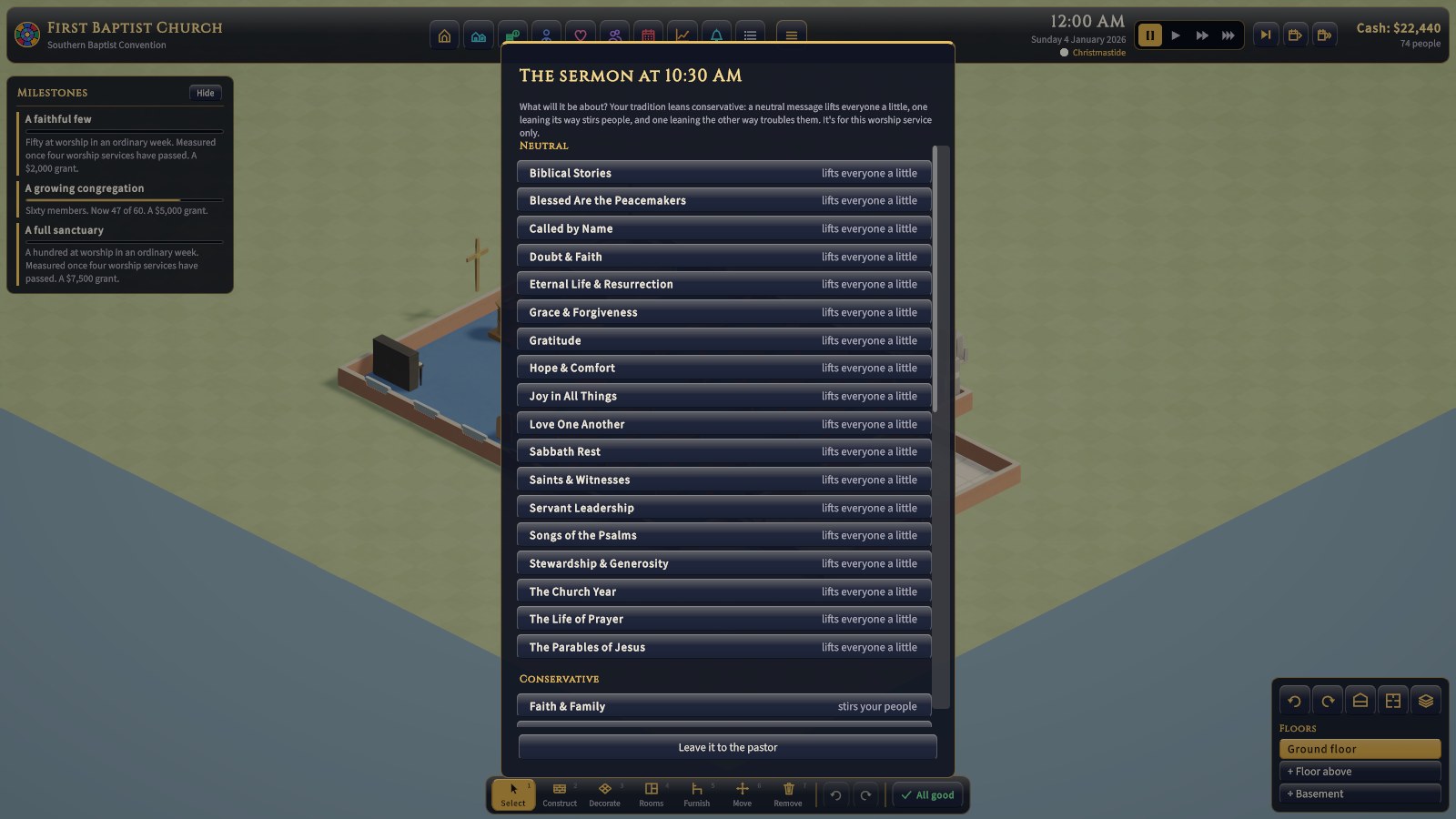
Half an hour before each service with a sermon (a khutbah, a d'var Torah, a katha, a dharma talk, a pravachan, a homily, as the tradition calls it), the game pauses and asks what it will be about. The choice is for that service only. Leave it to the rabbi (or the imam, the granthi, the pastor: the button names your leader), or Esc, means no particular message, which neither helps nor hurts.
Each topic's message leans neutral, conservative, or liberal, and each tradition's people lean one way too:
| Leaning | Traditions |
|---|---|
| Liberal | Lutheran (ELCA), Quaker, Reform and Reconstructionist Jewish, Zen, Jodo Shinshu, Soka Gakkai, Tibetan, the Vedanta Society, Konko |
| Neutral | Roman Catholic, Conservative Jewish, the Arya Samaj, Chinmaya Mission, SRF, Jain Vishva Bharati, the Shinto shrine, the Daoist temple |
| Conservative | Baptist, Pentecostal, Eastern Orthodox, Latter-day Saint, Orthodox Jewish, Chabad, every Muslim tradition, Theravada, Vietnamese and Chinese Buddhist, the Hindu temple and the Indo-Caribbean mandir, BAPS and ISSO, ISKCON, the Sathya Sai center, the gurdwara, the Jain center, Tenrikyo, the Chinese folk temple, Yiguandao |
After the service, everyone there (except those minding the nursery) feels the message, scaled by the topic's strength (1 for most, up to 2 for Fire & Brimstone):
| The message | Tradition leaning the same way | A neutral tradition | Tradition leaning the other way |
|---|---|---|---|
| Neutral | +0.015 | +0.015 | +0.015 |
| Leaning | +0.04 | −0.02 | −0.05 |
So Fire & Brimstone fires a conservative congregation up (+0.08), puts a neutral one off (−0.04), and troubles a liberal one deeply (−0.1). With no leader, or no sermon in the service (a gathering the members lead, a folk temple's offering, a Quaker meeting), the topic counts for nothing. The game models how the message is received; it takes no side.
The safe default is any neutral topic: a small lift for everyone, every week. A topic leaning your tradition's way earns nearly three times as much, so it's worth picking one each week if you know your people. In a congregation neutral on moral questions (a Conservative synagogue, the Arya Samaj, Jain Vishva Bharati, a Daoist temple, a Catholic parish), every topic leaning on them costs you. A sermon also travels on the live stream: members who watched at home are likelier to come in person next time if it suited them (see The congregation in its community).
The sermon topics
The game has 120 topics, and offers each congregation only those that fit its faith (and, for some, its family): the sixteen every faith shares, and its own. A synagogue hears 32 (the shared ones, six it shares with churches or with churches and mosques, and ten of its own, from the week's parashah to Zachor); a Sunni center 28 (the shared, three shared with synagogues and churches, and nine of its own, from justice and mercy to zakat; a Shia center adds Karbala); a Buddhist temple the shared ones and its school's (the Four Noble Truths and impermanence for all; Amida's vow for Pure Land temples, the Lotus Sutra for SGI, six more for a Chinese Buddhist temple); a Hindu temple its ten (karma and dharma, bhakti, the Gita chapter by chapter, the Upanishads, the Ramayana...); a gurdwara its eight; a Jain center its six; Konko and Tenrikyo five each; the Daoist temple and Yiguandao four each; and a church 42. A shrine has no topics of its own, only the shared ones, for its priest's short address at the monthly rite. A folk temple has no sermon at all, and nor has any gathering its members lead (a Jain center's Sunday, SGI's gongyo, Yiguandao's Tao meeting, a Daoist temple's practice, a Friends meeting).
Nine topics turn on money and the common good rather than on morals (care for creation, healing for all, social justice, stewardship, welcome the stranger, tikkun olam, tzedakah, "you were strangers", wealth and poverty), and they land by the tradition's economic leaning, which can differ from its moral one: a Conservative synagogue is neutral on moral questions but liberal on economic ones, so tikkun olam lifts it as a liberal congregation; a Reform synagogue, a Zen center, and a Reconstructionist synagogue lean liberal on both; an Orthodox shul, a Vietnamese temple, Yiguandao, and the Nation of Islam conservative on both. Most other traditions are neutral on economic questions, so a topic that leans on them costs them a little.
| Topic | Leans | Strength | What it's about |
|---|---|---|---|
| Every faith (16) | |||
| Gratitude | Neutral | 1 | Counting blessings, and living thankfully. |
| Hope & Comfort | Neutral | 1 | Strength for hard days: grief, illness, and worry, and the promise that sustains through them. |
| Stewardship & Generosity | Neutral | 1 | Using time, talents, and money well, and giving gladly. |
| Faith & Family | Conservative | 1 | Marriage, parenthood, and handing on the faith: the home as the first school of faith. |
| Faith of Our Fathers | Conservative | 1 | Holding fast to the faith and ways handed down, against the drift of the times. |
| Resisting Temptation | Conservative | 1 | The pull of a worldly culture, and how to stand apart from it. |
| Sanctity of Life | Conservative | 1.5 | Every life sacred, from conception to natural death. |
| Care for Creation | Liberal | 1 | Tending the earth as a gift held in trust: the climate, conservation, and simpler living. |
| Healing for All | Liberal | 1 | Health care, mental health, and building a society that cares for the sick. |
| Interfaith Understanding | Liberal | 1 | Learning from neighbours of other faiths, and what we hold in common. |
| Reading Scripture in Context | Liberal | 1 | The scriptures read with history and criticism: what the texts meant then, and mean now. |
| Swords into Ploughshares | Liberal | 1 | Nonviolence and peace between nations, and faith set against war. |
| Welcome the Stranger | Liberal | 1 | Hospitality to outsiders: refugees, immigrants, and anyone on the margins. |
| Racial Justice & Reconciliation | Liberal | 1.5 | Racism, and the work of repair and reconciliation it asks of us. |
| Radical Inclusion | Liberal | 1.5 | A table with room for everyone, LGBTQ people fully included in the life of the congregation. |
| Social Justice Call | Liberal | 1.5 | A call to act for the poor and the oppressed: fair wages, decent housing, and the dignity of every person. |
| Shared by Jewish, Muslim, and Christian congregations (6) | |||
| Sabbath Rest | Neutral | 1 | Rest as a gift and a commandment, for busy, tired people. (Jewish, Christian) |
| Songs of the Psalms | Neutral | 1 | Praise, lament, and trust in Israel's songbook, and the prayers it gives words to. (Jewish, Christian) |
| The Life of Prayer | Neutral | 1 | Praying when it is easy and when it is hard: listening, persistence, and silence. (Jewish, Muslim, Christian) |
| Obedience & Discipline | Conservative | 1 | Duty, submission to God's order, and the discipline of a faithful life. (Jewish, Muslim, Christian) |
| Personal Holiness | Conservative | 1 | Turning from sin to a disciplined, holy life: purity, sobriety, and self-control. (Jewish, Muslim, Christian) |
| The Prophets' Call | Liberal | 1 | Amos and Micah: let justice roll down like waters; do justice, love mercy. (Jewish, Christian) |
| Jewish (10) | |||
| A Palace in Time | Neutral | 1 | Shabbat as holiness in time, not space: a day to stop making and start being. |
| Israel and the Jewish People | Neutral | 1 | The bond between Jews here and the land and people of Israel: its history, its hopes, and its hard questions. |
| L'dor Vador | Neutral | 1 | From generation to generation: handing on the stories, the practice, and the love of being Jewish to our children. |
| Teshuvah | Neutral | 1 | Turning back: owning our wrongs, making amends to those we've hurt, and beginning again. |
| The Week's Parashah | Neutral | 1 | The Torah portion's story read closely: what the text says, what the sages made of it, and what it asks of us. |
| Tzedakah | Neutral | 1 | Giving as justice, not charity: what we owe one another, and Maimonides' ladder from the grudging gift to the one that makes the poor independent. |
| Zachor: Remember | Neutral | 1 | Memory as a duty: the Shoah, the survivors' witness, and what remembering asks of the living. |
| The Yoke of the Commandments | Conservative | 1 | Keeping the mitzvot whole, as the covenant asks: Shabbat, kashrut, and daily prayer, without picking and choosing. |
| Tikkun Olam | Liberal | 1 | Repairing the world: justice for the poor and care for the earth as a Jew's work, not God's alone. |
| You Were Strangers | Liberal | 1 | Welcoming the stranger, for we were strangers in the land of Egypt: the refugee, the immigrant, the newcomer at the door. |
| Muslim (10) | |||
| Honesty in Trade | Neutral | 1 | Full measure and fair weight: honest dealing in business, debts written down and repaid, and no gain from riba. |
| Justice (Adl) | Neutral | 1 | Stand firm for justice, even against yourselves: fairness at home and at work, and standing with the wronged. |
| Mercy (Rahma) | Neutral | 1 | In the name of God, the Most Merciful, the Ever Merciful: the mercy the Qur'an opens with, and the mercy we owe one another. |
| Patience (Sabr) | Neutral | 1 | Patience in hardship and in loss, and steadfastness in doing right: God is with the patient. |
| Rights of the Neighbour | Neutral | 1 | Jibril urged the Prophet so often to be good to the neighbour that he thought neighbours would inherit: kindness to those next door, of any faith or none. |
| The Prophet's Character | Neutral | 1 | The gentleness, honesty, and humility of the Prophet Muhammad, peace be upon him, as the example to follow. (not the Nation of Islam) |
| Unity of the Ummah | Neutral | 1 | Hold fast together to the rope of God: one community across languages and lands, and patience with one another in the mosque. |
| Zakat & Charity | Neutral | 1 | Zakat as a pillar of Islam and the right of the poor in our wealth, and the sadaqah that even a smile can be. (not the Nation of Islam) |
| The Lessons of Karbala | Neutral | 1.5 | Imam Husayn's stand at Karbala: refusing to bow to tyranny, and keeping faith when it costs everything. (the Shia only) |
| Family & the Ties of Kinship | Conservative | 1 | Honouring parents, kindness between husband and wife, raising children in faith, and never cutting off a relative. |
| Buddhist (16) | |||
| Amida's Primal Vow | Neutral | 1 | Amida Buddha's vow to embrace every being just as they are, leaving no one behind, with nothing to earn: the heart of the Pure Land teaching. (Shin and Vietnamese temples only) |
| Compassion for All Beings | Neutral | 1 | Karuna and loving-kindness: wishing every being well, the difficult neighbour and the stranger included. |
| Guanyin, Who Hears the World's Cries | Neutral | 1 | The Universal Gate chapter of the Lotus Sutra: the bodhisattva of compassion who takes whatever form will help, and how we become her hands and eyes. (the Chinese Buddhist temple only) |
| Humanistic Buddhism | Neutral | 1 | Buddhism for this life and this world, not only the next: a Pure Land built here, in the family, at work and in the street, by doing good deeds, speaking good words, and thinking good thoughts. (the Chinese Buddhist temple only) |
| Impermanence | Neutral | 1 | All that arises passes away: the falling leaf, the ageing body, the loss that comes to every family, and the freedom in seeing it. |
| Interdependence | Neutral | 1 | Nothing stands alone: the rice in the bowl holds the farmer, the rain, and the sun, and our lives hold one another. |
| Mindfulness in Daily Life | Neutral | 1 | Practice off the cushion: washing up, walking to work, listening to a child, one breath at a time. (not SGI or the Chinese Buddhist temple) |
| Okagesama de: Gratitude | Neutral | 1 | All that we are, we owe to causes beyond us. The nembutsu, said not to earn anything, but in thanks. (Shin temples only) |
| Reciting the Buddha's Name | Neutral | 1 | Amitabha's vows and the Pure Land: reciting his name with a single mind, at home, at work, and at the hour of death. (the Chinese Buddhist temple only) |
| Repaying Our Parents' Kindness | Neutral | 1 | Filial piety at Ullambana: Maudgalyayana searching for his mother among the hungry ghosts, the offering to the Sangha that freed her, and what we owe our parents, living and dead. (the Chinese Buddhist temple only) |
| Suffering and Its End | Neutral | 1 | The Four Noble Truths: that life brings suffering, that craving causes it, that it can end, and the path that ends it. |
| The Heart Sutra | Neutral | 1 | Form is emptiness, emptiness is form: the short sutra chanted at every service, in which Guanyin sees through the five aggregates and passes beyond all suffering. (the Chinese Buddhist temple only) |
| The Lotus Sutra's Promise | Neutral | 1 | Every person has the Buddha nature and can reveal it in this lifetime: chanting Nam-myoho-renge-kyo, and changing one's own life to change the world. (SGI only) |
| The Medicine Buddha's Vows | Neutral | 1 | The twelve great vows of the Buddha of healing, of the lapis lazuli light: health of body and mind, a long life, and the wish that every being be free of sickness. (the Chinese Buddhist temple only) |
| The Noble Eightfold Path | Neutral | 1 | Right view, intention, speech, action, livelihood, effort, mindfulness, and concentration: the Buddha's way, step by step. |
| The Five Precepts | Conservative | 1 | Not killing, not stealing, no harmful sexual conduct, no false speech, no intoxicants: the training rules of a Buddhist life. (not a Shin temple or SGI) |
| Hindu (10) | |||
| Bhakti, the Way of Love | Neutral | 1 | Love of God as the surest path: the saints and their songs, the holy names chanted, and the heart surrendered. (not the Arya Samaj or SRF) |
| Karma and Dharma | Neutral | 1 | As you sow, so you reap: right action in one's own life, as a student, a parent, a worker and an elder, and why one's own duty done imperfectly is better than another's done well. |
| Lessons of the Ramayana | Neutral | 1 | Rama's exile and return: the faithful brother, Sita's courage, Hanuman's devotion, and the cost of keeping one's word. (not SRF) |
| Service as Worship | Neutral | 1 | Seva: serving others as serving God, the hungry fed and the sick visited, and work done without wanting thanks. |
| The Bhagavad Gita, Chapter by Chapter | Neutral | 1 | Krishna's counsel to Arjuna on the battlefield, a chapter at a time: duty done without craving its fruits, and the paths of knowledge, work and devotion. |
| The Guru's Grace | Neutral | 1 | The teacher who leads from darkness to light: devotion to the guru, the guru's example, and keeping the guru's instructions. (not the Hindu temple, the Indo-Caribbean mandir, or the Arya Samaj) |
| The Light of the Vedas | Neutral | 1 | The Vedas as the source of true knowledge: one formless God, the meaning of the havan, and reason against superstition and caste by birth. (the Arya Samaj only) |
| The Upanishads | Neutral | 1 | Thou art That: the Self within and Brahman beyond, and the forest teachers' questions put to modern lives. |
| What the Festival Means | Neutral | 1 | Behind the lamps and the colours: light over darkness at Diwali, good over pride at Dussehra, and what each feast asks of us. (not SRF or a Sai center) |
| As Many Faiths, So Many Paths | Liberal | 1 | Sri Ramakrishna's harmony of religions: one truth called by many names, and every sincere seeker on a road to it. (Vedanta, Chinmaya, SRF, and Sai centers only) |
| Sikh (8) | |||
| Chardi Kala: Rising Spirits | Neutral | 1 | Guru Arjan on the hot plate, the younger Sahibzade walled up at Sirhind: keeping good cheer and faith in God's will when everything is against you. |
| Ik Onkar: The Mool Mantar | Neutral | 1 | The opening words of the Guru Granth Sahib: one Creator, the true Name, without fear, without hate, beyond time, self-existent, known by the Guru's grace. |
| Naam Japo, Kirat Karo, Vand Chhako | Neutral | 1 | Remember the Name, earn an honest living, and share what you have: the three pillars of a Sikh life, at work and at home. |
| Sarbat da Bhala: The Good of All | Neutral | 1 | The Ardas ends by asking for the good of everyone, not only of Sikhs: one light in every person, whatever their caste, creed, or sex. |
| Seva: Selfless Service | Neutral | 1 | Washing dishes in the langar, minding shoes at the door, sweeping the road before the Guru: service done with no thought of reward, wearing the ego away. |
| The Japji Sahib | Neutral | 1 | Guru Nanak's morning prayer, a stanza at a time: the hukam that orders all things, the realms the soul climbs through, and the Name that frees. |
| The Lives of the Gurus | Neutral | 1 | From Guru Nanak's journeys to Guru Gobind Singh passing the guruship to the Guru Granth Sahib: ten lives, told as the sangat's own history. |
| Vaisakhi: The Birth of the Khalsa | Neutral | 1 | Anandpur, 1699: Guru Gobind Singh asked for a head, and five stood up. The Panj Pyare, Amrit, and what it means to be Khalsa now. |
| Jain (6) | |||
| Ahimsa | Neutral | 1 | Harm no living being, in deed, word or thought: in what we eat and buy, how we speak to one another, and where we tread. |
| Many-Sidedness | Neutral | 1 | Anekantavada: no one sees the whole truth, as the blind men found with the elephant, and the humility to hear the other side out. |
| Michchhami Dukkadam | Neutral | 1 | Forgiveness asked and given: the year's wrongs confessed, and the words said to everyone, friend and stranger: if I have hurt you, may it be forgiven. |
| Non-Possession | Neutral | 1 | Aparigraha: owning less and wanting less, possessions as weights on the soul, and the freedom of setting a limit on what one keeps. |
| The Kalpa Sutra | Neutral | 1 | Paryushana's scripture read aloud: the life of Mahavir, his mother's fourteen dreams, and the rules of the monks' rainy season. (Shvetambara only) |
| The Ten Virtues | Neutral | 1 | Das Lakshana's ten days, a virtue each: forgiveness, humility, straightforwardness, contentment, truth, restraint, austerity, renunciation, non-attachment and chastity. (Digambara only) |
| Konko and Tenrikyo (10) | |||
| A Thing Lent, a Thing Borrowed | Neutral | 1 | The body is lent by God the Parent; only the mind is our own. Caring for what's lent, and passing away as changing old clothes for new. (Tenrikyo only) |
| All Children of Kami | Neutral | 1 | Everyone is a child of the Divine Parent of the Universe, so no one is a stranger: why the church welcomes whoever comes through the door. (Konko only) |
| Hinokishin: Daily Contribution | Neutral | 1 | Work done out of gratitude for being alive: sweeping a street, helping a neighbour, a day's labour given without wanting anything back. (Tenrikyo only) |
| Okage: Living in Blessings | Neutral | 1 | Breath, food, the ground underfoot: living aware of Kami's blessings in everyday things, and saying thank you for them. (Konko only) |
| Sweeping the Mind's Dust | Neutral | 1 | Miserliness, covetousness, hatred, self-love, grudges, anger, greed, and arrogance: the eight dusts that cloud the mind, and the daily sweeping that clears them. (Tenrikyo only) |
| The Divine Reminder | Neutral | 1 | Pray with a single heart; blessings lie in your own heart; ask with your heart today. The words of the Tenchi Kakitsuke above the altar, and what they ask of us. (Konko only) |
| The Founder's Call | Neutral | 1 | Kawate Bunjirō, a farmer who knew loss and grave illness, called in 1859 to leave his fields and sit at the mediation seat: what his life teaches about hardship and gratitude. (Konko only) |
| The Joyous Life | Neutral | 1 | God the Parent made human beings to see them live joyously, helping one another: what the Joyous Life asks of a family, a church, and a town. (Tenrikyo only) |
| The Ofudesaki | Neutral | 1 | The Tip of the Divine Brush: Oyasama's verses of God the Parent's intention, read a few at a time. (Tenrikyo only) |
| Toritsugi: Mediation | Neutral | 1 | Carrying a person's troubles to Kami, and Kami's wish back to them: what happens at the mediation seat, and how every believer can carry a neighbour's prayer. (Konko only) |
| The Daoist temple and Yiguandao (8) | |||
| A Clean Mouth | Neutral | 1 | Vegetarian living as compassion for every being, and the vow of the clean mouth: no meat, no pungent foods, and no lies. (Yiguandao only) |
| Five Teachings, One Tao | Neutral | 1 | Confucius, Laozi, the Buddha, Jesus and Muhammad as teachers of the one Way: honouring each, and the thread that runs through them all. (Yiguandao only) |
| Nourishing Life | Neutral | 1 | Health as practice: breath, movement, sleep and plain food, the body as a landscape to tend, and a long life lived well, not merely long. (the Daoist temple only) |
| The Daodejing | Neutral | 1 | Laozi's five thousand characters: the Way that can be spoken of is not the constant Way, and water, which overcomes the hard by yielding. (the Daoist temple only) |
| The Mother Calls Her Children Home | Neutral | 1 | The Venerable Mother waiting for the children who wandered from her, and the Tao given now, in the last age, as the way back. (Yiguandao only) |
| The Three Treasures | Neutral | 1 | What was given at the receiving of the Tao: kept in the heart, never spoken of outside the hall, and practised every day until it changes a life. (Yiguandao only) |
| Wu Wei: Acting Without Forcing | Neutral | 1 | Doing without striving: Cook Ding's knife that never dulls, water finding its way round the stone, a life that follows the grain of things. (the Daoist temple only) |
| The Eight Virtues | Conservative | 1 | Filial piety, care between brothers and sisters, loyalty, sincerity, propriety, righteousness, integrity, and a sense of shame: the old virtues as daily practice. (the Daoist temple only) |
| Christian (20) | |||
| Biblical Stories | Neutral | 1 | The great stories of scripture told and opened up: Abraham and Sarah, Ruth, the prodigal son, the road to Emmaus. |
| Blessed Are the Peacemakers | Neutral | 1 | Reconciliation close to home: in families, friendships, and the congregation itself. |
| Called by Name | Neutral | 1 | Belonging to God in baptism, and living as someone called. |
| Doubt & Faith | Neutral | 1 | Thomas, Job, and honest questions: faith that survives doubt. |
| Eternal Life & Resurrection | Neutral | 1 | The empty tomb, and the hope of life beyond death. |
| Grace & Forgiveness | Neutral | 1 | God's love freely given, and how to give it to one another. |
| Joy in All Things | Neutral | 1 | Paul's letter to the Philippians, written from prison: rejoicing whatever comes. |
| Love One Another | Neutral | 1 | The great commandment in daily life: at home, at work, and with those we find hard to love. |
| Saints & Witnesses | Neutral | 1 | The lives of the faithful who went before, and what they teach. |
| Servant Leadership | Neutral | 1 | Jesus washing the disciples' feet, and leading by serving. |
| The Church Year | Neutral | 1 | What the season means, from the waiting of Advent to the fire of Pentecost. |
| The Parables of Jesus | Neutral | 1 | The sower, the mustard seed, the lost sheep, the good Samaritan: what the stories Jesus told ask of us. |
| Spiritual Warfare | Conservative | 1 | The armour of God, and standing firm against the enemy. |
| The Authority of Scripture | Conservative | 1 | The Bible as the inerrant Word of God, and standing on it whatever the world says. |
| The Great Commission | Conservative | 1 | Go and make disciples: the urgency of every soul's salvation. |
| Marriage as God Designed | Conservative | 1.5 | Marriage as the covenant of one man and one woman, and keeping it holy. |
| The Last Days | Conservative | 1.5 | Prophecy, the return of Christ, and being ready when he comes. |
| Fire & Brimstone | Conservative | 2 | Sin, judgement, and the urgent call to repent before it is too late. |
| Wealth & Poverty | Liberal | 1 | The rich young ruler and Mary's song: a challenge to wealth and to the systems that keep people poor. |
| Women Who Led | Liberal | 1 | Deborah, Mary Magdalene, Phoebe, and Junia: women leading God's people, then and now. |