Chapter 7: Worship and the year · Part 2
At the heart of worship, faith by faith
Every faith has something at the centre of its worship that the game models in its own way: the Torah read before a minyan, Jumu'ah turned to the qibla, the monks fed before noon, the deities bathed and the lamps waved, the Guru Granth Sahib opened at dawn and langar served to all, Paryushana's eight days, a shrine's open doors and its monthly rite, the incense and the lamps of a Chinese temple, and a church's communion. Each faith's in turn:
Judaism: Shabbat, the Torah, and the minyan
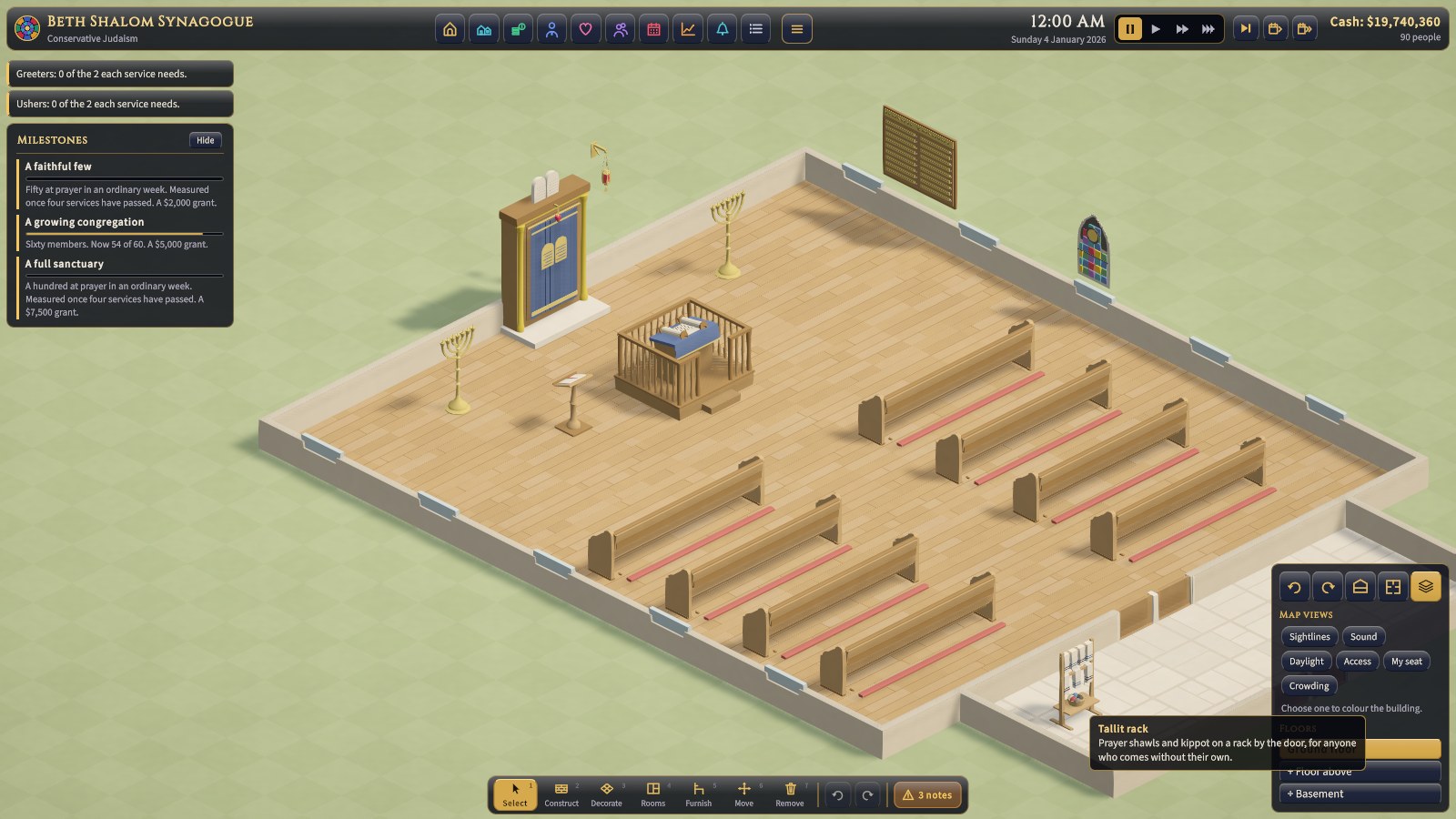
- Shabbat is kept as a span, from candle-lighting on Friday (18 minutes before sunset) to nightfall on Saturday, worked out for your region each week. The main service is Shabbat morning; Reform and Reconstructionist synagogues hold a Friday evening service at 6:30 too, and the others welcome Shabbat with Kabbalat Shabbat at candle-lighting. Weddings move to Sunday, and no funeral is held in Shabbat.
- The Torah service is the heart of Shabbat morning, read from the Bimah with the scroll taken from the Ark (aron kodesh): without the ark, the bimah, and a Torah scroll (all required), the Torah can't be read. A Torah reader (the ba'al koreh) is a worship helper among the volunteers: required at a Modern Orthodox shul, expected at a Conservative synagogue or Chabad (and two service leaders at a Reconstructionist one). A required helper missing costs everyone 0.03; an expected one there adds 0.02.
- The minyan. Conservative and Reconstructionist synagogues count ten adults, Modern Orthodox and Chabad ten men. A main service that starts with fewer costs everyone there 0.08 (Faiths and traditions). The weekday minyanim (above) are counted too.
- The High Holy Days are services of their own (below), the year's fullest, and where the synagogue sells seats, those who don't belong buy them ($150 an adult) in place of an offering (Money). At Sukkot, a Sukkah on the grounds dresses the synagogue for the festival.
- The kitchen keeps kosher at a Conservative or Orthodox synagogue or Chabad, so every meal costs 1.35 times as much (1.2 with a mashgiach on the staff).
Islam: Jumu'ah, the five prayers, and the qibla
- Jumu'ah is held half an hour after Dhuhr on Friday, so it moves through the year with the sun (the Ahmadis hold it at 1:00), and its khutbah is given from the Minbar. A Sunni center has a second Jumu'ah to add if the prayer hall can't hold everyone. A Shia center's main gathering is Thursday night's Du'a Kumayl instead; the Nation of Islam's, the Sunday Message.
- The five daily prayers are daily services, each a few minutes after its time, and in Ramadan taraweeh follows Isha every night (above).
- The prayer hall is laid with rows of prayer carpet turned to the qibla (both required: +0.04 facing it, −0.04 not), with a Mihrab in the qibla wall, and a wudu room to wash in first, its wudu station near a plumbing stack (Building your house of worship).
- Ramadan is the year's giving season: giving rises 1.8 times through the month, and in the month after Eid al-Fitr's, members give their zakat through the mosque, passed straight on to the needy (Money). The Eid prayer, an hour and a half after sunrise, is a service of its own on each Eid; a Shia center adds the Ashura majlis, and keeps no weddings through Muharram and Safar.
- Prompt burial. A funeral is held the next day, not five days later; a ghusl room lets the funeral committee wash and shroud the dead. The Sunni, Shia, W. Deen Mohammed, and Ahmadi communities borrow by Islamic financing, never at interest.
Buddhism: sitting, chanting, and the monks' meal
- A Zen center sits: zazen on cushions (required) on Sunday morning with walking meditation between and a dharma talk after, and at dawn and dusk through the week.
- A Shin temple (the Buddhist Churches of America) chants before the onaijin altar in pews, sings gathas to a piano or organ, and holds Dharma School first; Obon is its great day.
- A Theravada temple keeps its Sunday observance around the dana meal: the families offer food to the monks before noon, from the alms bowls, and the monks eat. The monks live at the temple, unpaid, so monks' quarters and a kitchen are required, and the monks' meal rota is its own ministry. A Vietnamese temple chants to the wooden fish, and keeps monks' quarters and a kitchen too.
- A Chinese Buddhist temple holds its Sunday dharma function before the three Buddhas, with a vegetarian lunch free to all after; it keeps a morning service at 5:30 every day, is open to visitors through the week, and lives much on its lamps (renewed at the lunar New Year for $100 a household) and memorial tablets. The Water and Land is its greatest rite.
- SGI meets without clergy, chanting daimoku before the Gohonzon in rows of chairs; a Tibetan center practises a sadhana before the thangkas and keeps the Tibetan calendar exactly.
Hinduism: darshan, the aratis, and the rites families book
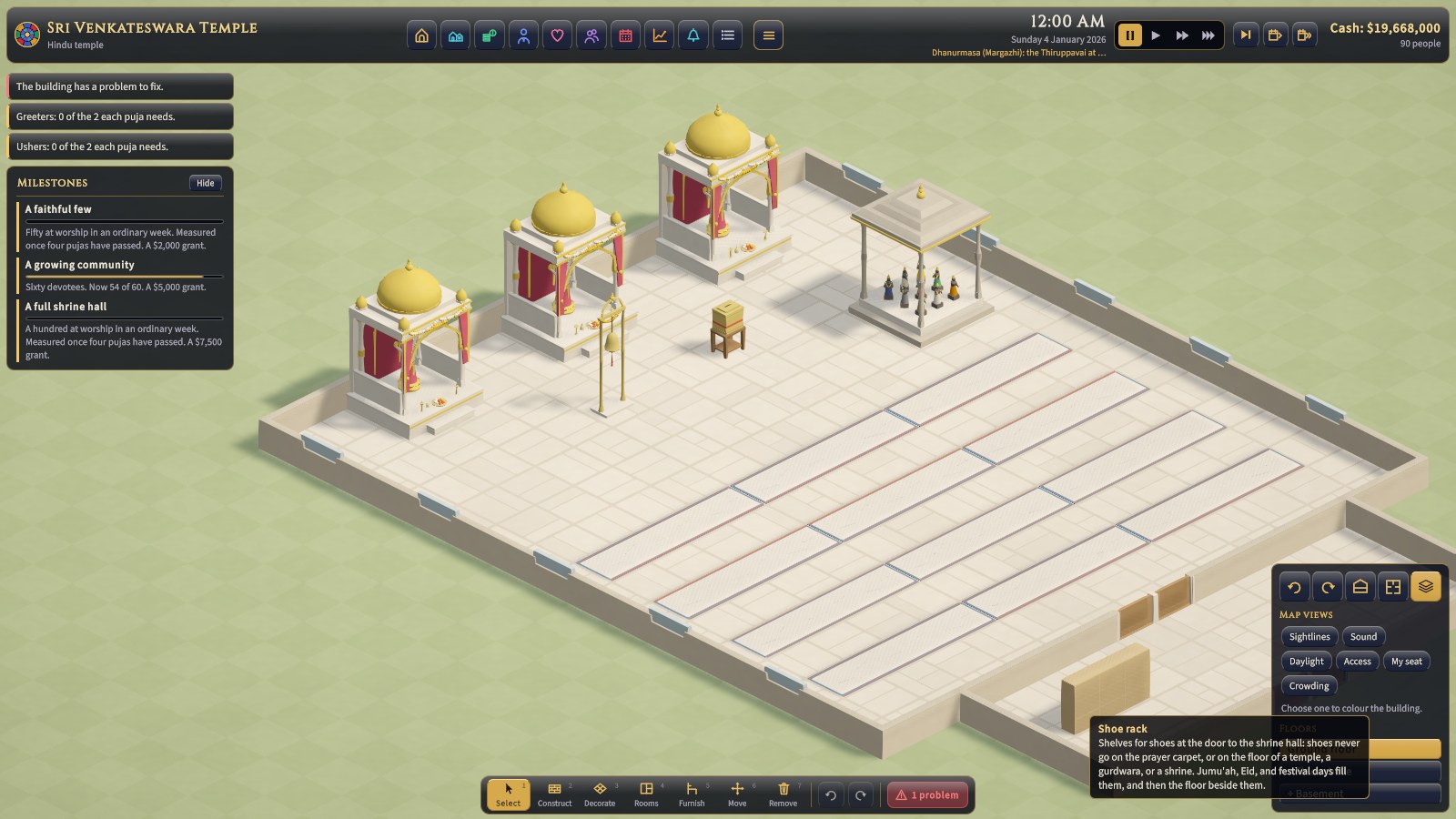
- Darshan. A Hindu temple, a BAPS or ISSO mandir keeps the deities' day whether anyone comes or not: open hours from early morning to night, households coming together for twenty minutes before the murti shrines (see the table above), busiest at the weekend.
- The rites of the day are daily services: the morning abhishekam and the evening arati at a community temple, the artis at a Swaminarayan mandir, six aratis from 4:30 in the morning at ISKCON. The Sunday abhishekam (or the sabha, or the Sunday Feast) is the main service, and its meal follows.
- Rites families book. Families ask for rites at the temple's listed prices: an archana ($11), a puja at home ($151), a naming ceremony ($151), the sacred thread ($501), a car puja ($51). Each is held when the head priest or a pujari is free, within four weeks (at a home, with half an hour's travel each way), and the fees, the temple's "puja fees", are much of its income (Money). Housing the priests is expected where they live at the temple.
- The great days fall on their lunar day as it stands at your temple: Diwali's Lakshmi puja an hour after sunset and Maha Shivaratri's abhishekam from 7:00 in the evening are services of their own; Janmashtami's midnight arati at ISKCON and Annakut at a Swaminarayan mandir draw the year's greatest crowds.
- Without images: the Arya Samaj gathers round the havan kund for its Sunday havan, and forbids murtis. The kitchens are mostly vegetarian and without eggs, and at BAPS, ISKCON, and the Swaminarayan temples without onion or garlic.
Sikhism: the diwan, langar, and the Akhand Path
- The Guru Granth Sahib's day. At 5:00 it's brought from the sachkhand and opened on the palki (Prakash and Asa di Var); at sunset Rehras is read; and an hour and a quarter later Kirtan Sohila is sung as it's carried back to rest on its sukhasan bed. A sevadar, a worship helper, sits behind it while it's open and waves the chaur sahib (expected).
- Open to bow from 7:30 to 7:00 every day: households come, bow, give at the Golak, and take karah prashad. Heads are covered and shoes come off at the door, so keep head scarves and a shoe rack there.
- The Sunday diwan runs from nine until two, with kirtan by the ragis (a paid ragi jatha lifts everyone, as music staff do) and katha by the granthi, people coming and going.
- Langar follows the diwan, and is served every day at noon too: free to all, everyone there and visitors alike. A household sponsors each (the cost and a fifth more, glad to do it: +0.05), volunteers cook (one for every 40), and diners sit in rows on pangat mats. See the free meal, above.
- The Akhand Path, booked by a family ($501), is the whole Guru Granth Sahib read without a break in about 48 hours, in two-hour shifts of two readers: each of the staff can take six shifts and each volunteer two, and at night only one volunteer in four will. A broken reading refunds the fee and costs the family 0.06. Vaisakhi and Guru Nanak's gurpurab are the year's crowds.
- A wedding, the Anand Karaj, is at ten in the morning, any day.
Jainism: the puja, Paryushana, and Samvatsari
- Darshan and puja from 7:00 to 7:30 in the evening: members come one by one, change into puja clothes (a changing room with lockers is expected), and perform the eightfold puja before the jin shrine, half an hour each. The aarti and mangal divo close each evening at 8:00.
- Sunday at the derasar is led by the members (a Jain center has a president, not a priest): the snatra puja, a swadhyay, the aarti, and a Swamivatsalya lunch, free to all, after.
- Paryushana, eight days in late summer, is the year: a vyakhyan every morning, a visiting scholar from India on the staff to give it, the fourteen dreams read at Mahavir Janma Vanchan (10:00, four hours), and Samvatsari, the year's greatest day, its pratikraman two hours before sunset (three hours). The honours of its rites are auctioned, the boli (Money), and no weddings are held through it. A Digambara jinalaya keeps Das Lakshana's ten days instead, ending at Anant Chaturdashi.
- The kitchen keeps out root vegetables, onion, garlic, and eggs (meals about 1.15 times as dear), and many eat nothing after sunset.
Shinto: open hours, the monthly rite, and New Year
- A shrine holds no weekly service. It's open from 8:00 to 5:00 every day for visitors to rinse at the purification basin, bow, clap, and pray at the offertory box, and buy an amulet: each visit drops about $2 and, with an amulet counter, buys about $4 more. Its supporters' association (the sukeikai) pays dues.
- The monthly rite (tsukinamisai) on the 1st and 15th at 10:00, and the autumn grand festival on the first Sunday of October, are its services: the drum, purification, the offerings, and the norito before the kami altar.
- New Year's first visit (hatsumode) brings thousands through the open hours, nearly all passing through; Shichi-Go-San in November brings families with their children for the rite ($120). Families also book a kitō prayer ($100), a house blessing ($200), or a car blessing ($50). A shrine keeps away from death and holds no funerals.
- Konko holds a Sunday service, and its minister sits at the mediation seat through the week's open hours to hear those who come. Tenrikyo's Sunday Service is danced to the nine kagura instruments: nine instrument players are required on the rota, and six dancers expected, as worship helpers. Its monthly service, on the third Sunday, and its Grand Services are services of their own.
Chinese religion: incense, lamps, and the gods' days
- A folk temple holds no weekly service. It's open for incense from 9:00 to 5:00: visitors plant incense in the censer, bow before the deity altar, put a question to the god with the fortune sticks at the divination table, and burn paper offerings in the furnace (whose smoke the neighbours notice). It has no clergy: a board, and a temple keeper on the staff.
- Lamps and rites. Households renew their lamps of brightness each lunar New Year ($30 at a folk temple), and book Tai Sui protection ($20) and fortune readings ($10). The great days are services of their own: the first incense at 11:00 on Lunar New Year's Eve, the god's birthday rite, and Pudu in the ghost month (which bars weddings).
- A Daoist temple gathers on Sunday for the tai chi set and chanting, with tai chi classes through the week (its way in: the tai chi classes ministry brings 15% more newcomers), and a priest for the rites for the dead. Yiguandao holds its Sunday Tao meeting and a vegetarian lunch free to all, offers incense to the Mother lamp morning and evening, initiates newcomers many at a time (qiudao), and keeps four Grand Ceremonies to the Mother.
Christianity: communion
Communion is a Christian sacrament, and this part is for the Christian traditions. On the Sundays a tradition celebrates it (weekly for Catholics, Lutherans, the Orthodox, and the Latter-day Saints' sacrament; monthly for Baptists and Pentecostals; never for Quakers), communion begins with its part of the service.
- Traditions that come forward to receive are served at an Altar, Communion table, Communion rail, or Communion station. Each serves one person per front tile at a time. A four-metre rail serves four at once; a one-metre station serves one.
- Baptists and Pentecostals pass the elements along the pews in Communion trays, which they expect to have.
- Each tradition gives communion from an age of its own: from infancy in the Orthodox and Eastern Catholic churches, and for Episcopalians, United Methodists, Presbyterians, and the UCC; at about 7 for Catholics; 6 in the ELCA; 9 for Baptists, about their age at baptism; 13 in the Missouri Synod and among Moravians, after confirmation; and 14 among Mennonites. Anyone younger who comes forward is blessed instead, which is quicker and costs nothing. The bread and wine (or juice) cost 6.5¢ for each who receives. At the Witnesses' Memorial the emblems are passed, and nobody partakes. The service report says how many received and how many were blessed. Every tradition: services and what they need gives each tradition's age.
- If communion takes too long, the service runs over, and everyone loses 0.05 for every 10 minutes over (up to 0.2). The service report says how long communion took. Add stations, or a longer rail.