Chapter 7: Worship and the year · Part 1
Services
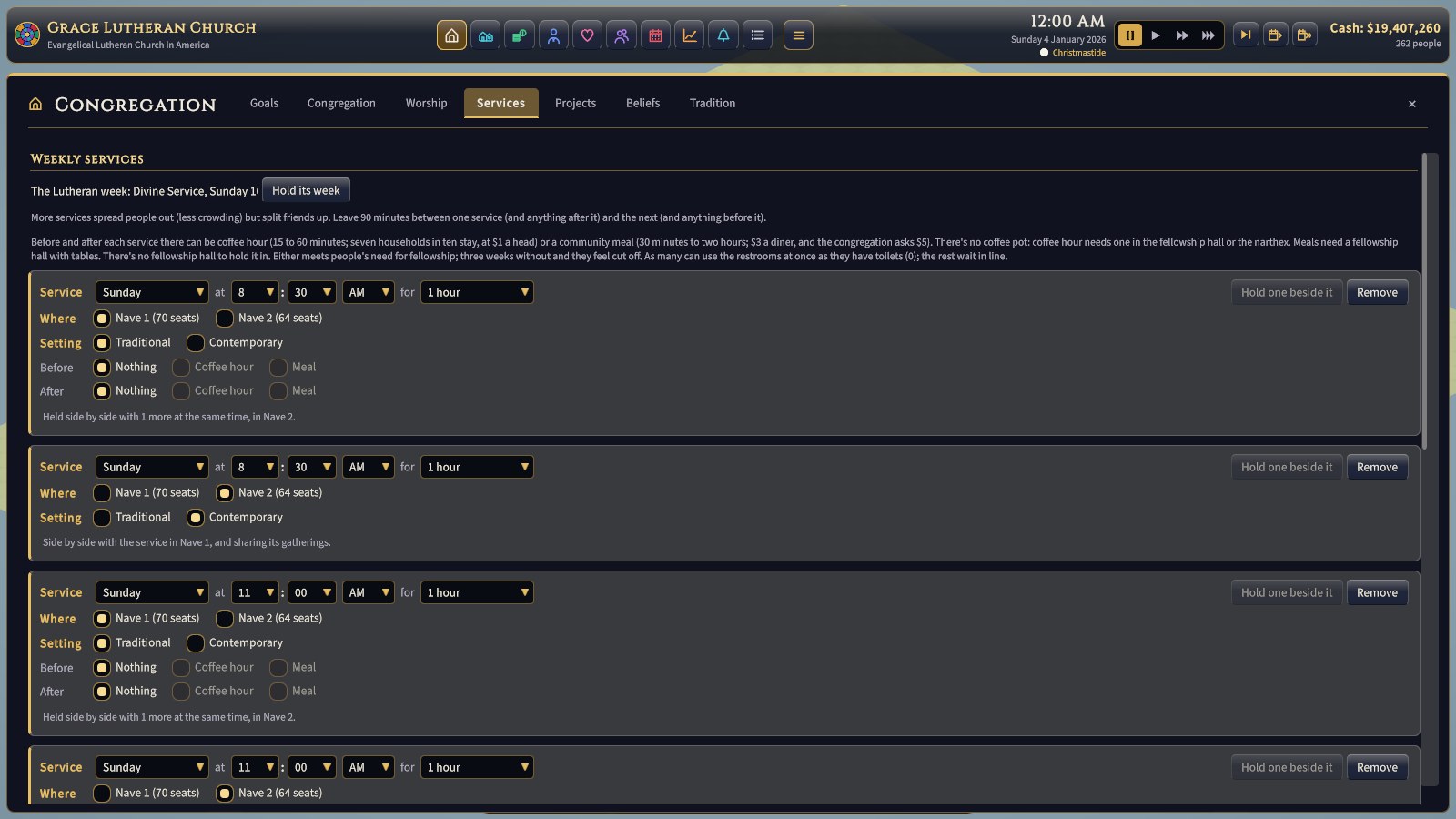
A congregation can hold up to eight main services a week, set in Church → Services (the tile's tooltip carries your tradition's word: Synagogue, Islamic center, Temple, Gurdwara, Parish). A new congregation starts with the week its tradition keeps, shown at the top of the tab; Hold its week puts it back. Each is a card: pick its day, its time (hour, minutes, AM or PM), and its length (60 minutes by default, from half an hour to six hours: a gurdwara's Sunday diwan runs from nine to two) from their lists, and Remove drops it. Each household keeps to one service. More services mean less crowding, but they split friends up and need more volunteers on duty. Leave 90 minutes between them. A week that keeps open hours needs no main service at all: a Shinto shrine's and a Chinese folk temple's don't hold one.
During a service, the line under the clock names the part under way and where it's led from, and a glow marks that piece of furniture in the building.
Bulletins and the projection screen
A bulletin gives the order of service, what's sung or recited, and the week's notices. The congregation prints one for each service, at $10 a service, unless it turns them off in Church → Services. A projection screen ($3,500, on a wall of the worship space) puts the words up instead: everyone can follow, heads up and hands free to sing (+0.02), and no bulletin is needed, though formal traditions find a screen out of place. With neither, visitors can't follow the service (−0.06) and regulars miss the notices (−0.02). An unprogrammed meeting has no order of service, so it prints nothing and misses nothing.
Service settings
Some Christian traditions hold their services in a traditional setting (the organ, the choir, the hymnal) or a contemporary one (a band, songs, the words on screens): the ELCA, Missouri Synod, Methodists, Presbyterians, Catholics, Baptists, Nazarenes, and others. (Settings are a Christian matter; no other faith's tradition has them.) Each service's Setting chooses one; a contemporary service's music is played by the band at a drum kit. Younger people lean contemporary (three in four under 30), older ones traditional (nine in ten from 75). Hold one of each and every household goes to the one it prefers, and is glad of it (+0.02); hold just one and nothing changes.
Services side by side
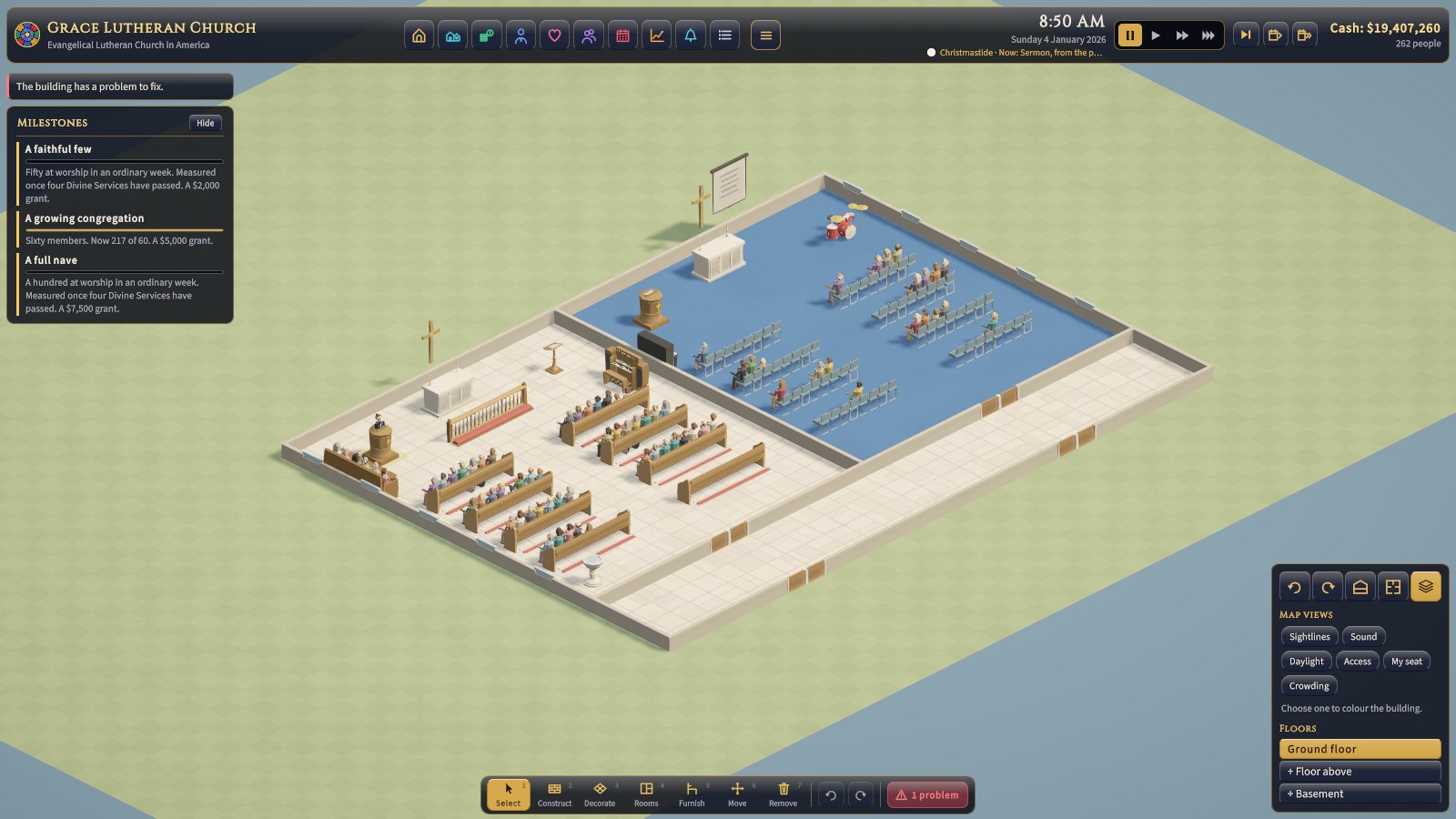
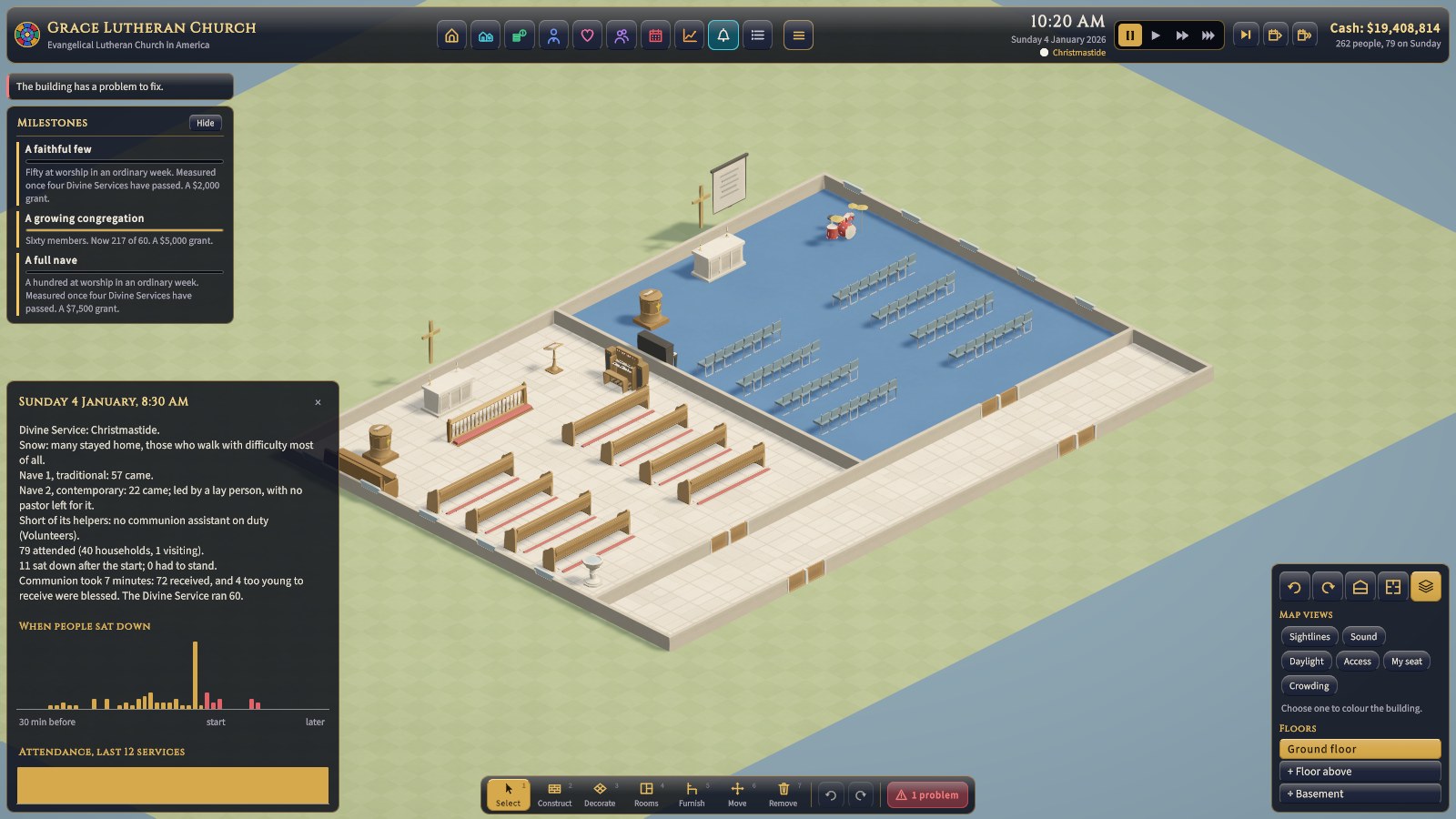
With two or more worship rooms, each service's Where chooses its room. Services at the same time in different rooms are held side by side: a traditional service in one nave and a contemporary one in the other, say, with each household at the one it prefers. Hold one beside it adds one. They last as long as each other and share the first one's coffee hour or meal. Each room has its own seats, music, communion, acoustics and daylight; each needs its own ushers, musicians and helpers, and costs what a service costs. A room with no leader left to lead it is led by a lay person (a lay reader in a Christian tradition, one of the members in another: −0.04), so hire an associate. Every service after the week's first wears the building a little.
To hold them, build a second worship room (a second worship room, off the same entrance hall, works well) with its own seats, an altar or table, and an instrument for its setting: a drum kit or piano for a contemporary service, an organ for a traditional one. Then, in Church → Services, set the first service's Where to one room and press Hold one beside it: the new service takes the other room, in the other setting. Change the first one's day or time and the one beside it moves with it. A congregation holding two pairs, at 8:30 and 11:00, with coffee hour between, holds four services a Sunday; up to eight main services a week can be scheduled.
Daily services, and services timed by the sun
Most faiths keep short services through the week besides the main ones: the five daily prayers at a mosque, a weekday minyan at a Conservative or Orthodox synagogue, a Hindu temple's aratis, a gurdwara's prayers at dawn and dusk, zazen at a Zen center (no Christian tradition in the game keeps them). They're daily services, listed in their own section of Church → Services, a row for each with a chip for each day it's held (up to 42 a week, beside the eight main ones). Most people don't come: each adult and teenager decides on their own, a quarter of an hour before, at a fraction of their usual chance (a tenth unless the tradition says otherwise); the retired come twice as often, and those of working age half as often on a weekday between nine and five. No plate is passed, no coffee hour is held, no sermon is chosen, no newcomers come, and it doesn't move anyone's satisfaction; its reports are kept apart, so the weekly figures are the main services'. A meal free to all may follow one, though: a daily langar (below).
A service can be timed by the sun: Jumu'ah half an hour after the noon prayer, Maghrib just after sunset, a Shabbat service from candle-lighting. Its time moves through the year with the sun at your lot's region; the card shows today's time, and Clock time fixes it at a clock hour instead. At normal speed the clock slows to a minute a second round a main service, as ever; a daily service and the ten minutes either side pass at 20 minutes a second, unless you turn on Watch every service in Settings. Where a tradition counts a quorum (ten adults, or ten men, for a minyan), a main service without one costs everyone there 0.08. See Faiths and traditions.
Each tradition's own daily services, as a new congregation holds them (the times are the defaults; change any of them in Church → Services):
| Faith | Daily services |
|---|---|
| Judaism | Conservative: Shacharit at 7:00 on weekdays and 8:00 on Sunday, the evening minyan at 7:30 Sunday to Thursday, and Minchah and Havdalah before Shabbat ends. Modern Orthodox: Shacharit at 6:30 (8:00 on Sunday), Minchah and Ma'ariv a quarter of an hour before sunset Sunday to Thursday, Kabbalat Shabbat at candle-lighting (a daily service there, drawing at 35% of each person's usual chance, against 2 to 20% for most daily services), and Minchah, seudah shlishit, and Ma'ariv late on Shabbat afternoon. Chabad: Shacharit at 7:00 (8:00 on Sunday), with Minchah and Ma'ariv and Shabbat afternoon's Minchah as you choose; its Kabbalat Shabbat is a main service. Reform and Reconstructionist synagogues keep none. |
| Islam | A Sunni center and the Ahmadis: the five prayers (Fajr, Dhuhr, Asr, Maghrib, and Isha, each a few minutes after its time), Dhuhr giving way to Jumu'ah on Friday, so 34 a week; and in Ramadan, taraweeh each night after Isha, at 30% of the usual chance. The W. Deen Mohammed community expects Dhuhr and leaves the rest to you. A Shia center may pray Maghrib and Isha together a quarter of an hour after sunset. The Nation of Islam keeps none. |
| Buddhism | A Soto Zen center: zazen at 5:40 Monday to Saturday and 5:40 in the evening Monday to Friday. A Chinese Buddhist temple: the morning service at 5:30, with the Heart Sutra, every day. |
| Hinduism | A Hindu temple: the morning abhishekam at 9:00 (Monday to Saturday) and the evening arati at 7:30. BAPS: the shangar arti at 7:30 and the sandhya arti at 7:00 in the evening. An ISSO temple: five artis, from the mangala arti at 6:30 to the shayan arti at 8:30 at night. ISKCON: the mangala arati at 4:30, the Bhagavatam class at 7:00, and four more aratis to the shayana arati at 9:00 at night, 40 a week. The Vedanta Society: vespers at 6:30 every evening. SRF: meditations on Sunday morning and Thursday evening. |
| Sikhism | Prakash and Asa di Var at 5:00, as the Guru Granth Sahib is brought out and opened; Rehras at sunset; and Kirtan Sohila an hour and a quarter after sunset, as it's carried to its rest (sukhasan) in the sachkhand. |
| Jainism | A Jain center: the aarti and mangal divo at 8:00 every evening, and through Paryushana the vyakhyan every morning at 10:30, at half the usual chance. Jain Vishva Bharati: the Paryushana pravachan each evening. |
| Shinto | Tenrikyo: services morning (7:00, Monday to Saturday) and evening (6:00, every day). Konko: the Winter Special Prayer at dawn through its season. |
| Chinese religion | Yiguandao: incense morning and evening. A Daoist temple: tai chi classes on Tuesday and Thursday evenings and a beginners' class on Saturday morning, which draw far more than a prayer (20 to 30% of the usual chance). |
Open hours
Some traditions don't gather their people so much as receive them, one by one: darshan at a Hindu temple, a gurdwara's open doors, a Jain center's puja, a shrine's or a Chinese temple's visitors, Konko's mediation. They keep open hours, listed with the daily services: a window from its opening time (or the sun's) to its closing, from half an hour to fourteen hours long, on the days it's held.
| Tradition | Open hours | A visit | Its people's chance | Visitors a day (against a week's newcomers) |
|---|---|---|---|---|
| Hindu temple: darshan | 8:00 to 8:30 pm on weekdays; 7:30 to 8:30 pm at the weekend | 20 minutes, a household together | 6%; 20% at the weekend | 0.5; 1 at the weekend |
| BAPS mandir: darshan | 7:00 to 8:00 pm, every day | 20 minutes, a household together | 5% | 0.4 (1.5 at a stone mandir) |
| ISSO temple: darshan | 6:50 to 12:30 and 3:30 to 8:45 pm | 20 minutes, a household together | 4 to 5% | 0.3 |
| Gurdwara: open to bow | 7:30 to 7:00 pm, every day, with langar at noon | 20 minutes, a household together | 12% | 0.2 |
| Jain center: darshan and puja | 7:00 to 7:30 pm, every day | Half an hour, one by one | 5% | 0.1 |
| Chinese Buddhist temple | 9:00 to 5:00, Monday to Saturday | Half an hour, a household together | 6% | 0.8 |
| Chinese folk temple: open for incense | 9:00 to 5:00, every day (no main service) | 20 minutes, one by one | 5% | 0.8 (2.5 in Chinatown, 2 at a Fujianese temple) |
| Shinto shrine: shrine visits | 8:00 to 5:00, every day (no main service) | 15 minutes, one by one | 5% | 2.5 |
| Konko church: mediation | 9:30 to 5:00, Monday to Saturday; noon to 1:00 on Sunday | Half an hour, one by one | 4% | 0.15 |
- Who comes. Members and regulars come at their own time through the window, at the window's share of their usual chance (from 4% to 20% a day, as the tradition sets it), the retired more and those at work less by the hour; at a Hindu temple or a gurdwara, a household comes together. Each stays about twenty minutes (fifteen at a shrine, half an hour at a Jain center), and feels the building and its worship room, a quarter as much as at a main service.
- Visitors who don't belong. Each day's window draws some, against a week's newcomers to the main services (a fraction of them a day at most temples, as many at a Hindu temple's weekend and half as many again at a BAPS stone mandir; at a folk temple, which holds no main service, nearly as many, and at a shrine two and a half times as many, nearly all passing through), and a feast day draws many more: a shrine's New Year brings thousands. Most pass through, counted, giving, and gone; a quarter of them, never more than three at a time, might come back, and become newcomers. A newcomer who comes only at open hours settles in after six visits, twice a main service's; where the week has no main service, the open hours are its gathering, so a newcomer comes back as often in a week as to a Sunday's service (spread over the days it's open) and settles in after three.
- What they bring. Where the tradition has a box, each visit drops about $2 in it; where it sells amulets and there's an amulet counter, each buys about $4 of them, half as much again on a feast day (Money).
- Rites within it. The window gives way to a rite held in it (a puja, a prayer, a service), and closes in time for a main service's 90 minutes of coming in; it needs no room of its own. It isn't led, so it goes on whether or not anyone leads it.
- Pacing. Open hours pass at 60 game minutes a second unless Watch every service at a minute a second is on, and keep a report of their own, a fortnight of them: how many came, how many visited, what they gave. The weekly report counts everyone who came by.
- A meal within them. Open hours can serve a meal free to all at a set time (a gurdwara's midday langar, from noon for an hour): those whose visit ends while it's on, and visitors passing through, stay twenty minutes to eat (see below).
- A week of open hours alone. A Shinto shrine and a Chinese folk temple hold no main service: their week is their open hours, and their rites are their feasts' (the shrine's monthly rite on the 1st and the 15th, the folk temple's great days), held as services of their own (see Big days, below). Their people come by visit and to those rites, and a household that belongs gives its week's offering (what it would give on a Sunday) at its first visit of the week; newcomers come through the window's visitors and the rites. Such a congregation's attendance, for a scenario's goals, is an ordinary day's at its open hours, feast days left out. Remove a week's last main service and keep open hours, and any congregation can live this way; without open hours, a week needs a main service.
Coffee hour and community meals
Each service can have a gathering before it and one after it, chosen on its card with the round option buttons (then its length, and how far from the service, from their lists): nothing, coffee hour (15 to 60 minutes, round a coffee pot in the hall or the entrance hall; seven households in ten stay, at 50 cents a head, as many as the pots make coffee for: 40 a pot, 200 a commercial one) or a community meal (30 minutes to two hours, in a hall with tables; three households in four stay). Each sits a gap from the service, in 15-minute steps: before, people come early, gather, and go in to their seats at its end, so leave a gap to find a seat; after, they go straight there. A meal's tables set how many eat: 16 at a folding table, 20 at a wooden one, and a household that won't fit is turned away (−0.03). Each diner costs $3 ($2 with a kitchen), more or less by the tradition's table: a kosher meal costs 1.35 times as much (1.2 with a mashgiach of your own on staff), halal 1.1, a vegetarian one 0.85, and any meal in a strict fast 1.1. The congregation asks a $5 donation, which most adults give; everyone who eats is a little happier (+0.04). A second service needs 90 minutes clear of the first's gathering after and its own before. The service report gives how many had coffee, and how many wanted to eat and had a seat.
Some traditions hold a meal of their own after the service, and set it there themselves: a gurdwara's langar, ISKCON's Sunday Feast, BAPS's Mahaprasad, a Jain center's Swamivatsalya, the Arya Samaj's Preeti bhoj, and the Sunday lunches of the Indo-Caribbean mandir, Yiguandao, and the Chinese Buddhist temple. (A Hindu temple's canteen sells its lunch.) It's free to all: everyone there eats, visitors too, and nobody is asked for anything. A household sponsors each one, the members taking turns (a household at most once in 26 weeks, the more engaged the likelier to say yes): it gives the meal's cost and a fifth more, booked as the meal's sponsors ("Langar sponsors"), and is glad to (+0.05); when nobody will, the congregation pays. It needs a stove, in a kitchen or the hall, and cooks, a volunteer role it alone has: one for every 40 there, with the sponsoring household as one more. Short of cooks, those it can't feed go without (−0.02). Diners sit at tables, or in rows on the floor on mats laid in the hall, which count as seats at the meal. When the meal can't be held (no hall, nowhere to cook), or it's taken off the schedule, its regulars miss it as they'd miss a rite (−0.04).
Many gurdwaras serve langar every day, and the game's does: a smaller daily langar from noon for an hour within its open hours (on Sunday, the diwan's langar takes its place). A meal free to all can follow a daily service too (everyone there stays), or be served at a set time within open hours (those whose visit ends while it's on stay twenty minutes, visitors passing through among them). A day's meal is the week's sponsor's: the household that last sponsored a free meal that week (Sunday's langar's) pays for the days' meals too, cost and a fifth, and is glad of it once that week; with none, one is found as for any free meal. Its cooks are the sponsor and any paid cook (a langri) first, each feeding 40, and then volunteer cooks, but only those with turns left this month: a day's meal asks no one beyond it. It's felt as a visit is, a quarter of a main service (the building, and the meal: +0.04 to share it, as at any meal), and nobody misses it when it can't be held. The weekly report's meals count them.
A tradition's kitchen may also keep out onion and garlic (meals cost 1.05 times as much) and root vegetables (1.1 times; a Jain kitchen, keeping out both, about 1.15), or eggs (which rules out the bake sale); where eating after sunset is forbidden, a meal that would end after the day's sunset isn't held.
The school
The tradition names its school: Hebrew school or religious school (on Sunday morning), a weekend Islamic school or madrasah, Dharma School, Bal Vihar or Bala Vihar, the Swaminarayan bal sabha, a Punjabi school, pathshala, a Chinese school, Sai Spiritual Education, Sunday school. It meets once a week for 30, 45, or 60 minutes, at a day and time you set in Church → Services, in 15-minute steps. It can run right up to a service or its meals, but not into one. Households decide whether to come on their own, about half as readily as they come to worship; where a service follows that morning, everyone at the school comes to it too, and the rest a little less often, so the service is as full as ever. A classroom holds a class when it has seating and a teacher (a volunteer) on duty, and takes as many as its seating holds; a household that can't all find seats is turned away. Those who went gain 0.04 at their next service, and those turned away lose 0.05. Someone at a service that runs into the school goes straight there; and from the school, everyone stays on for the service after it, going straight in (early, if it’s a while yet) rather than home and back. The school’s figures then come in that service’s report. Teaching materials cost $100 a year for each classroom with seating. After each session a note says how many came and how many had a seat.
Fellowship
Everyone needs time with the congregation beyond the service. Coffee hour, a community meal or a free meal such as langar, the school, or a small group meets it; anyone who goes three weeks without feels cut off (−0.03).
Weather
Each day has its weather, from the region's climate and the time of year: rain as often as the region's days are wet that month (one in five in the Pacific Northwest, one in twenty-odd in the desert), snow where winters are cold, heat waves where summers are hot (see Rooms, materials, styles and lots). Rain and heat waves keep a few people home; snow keeps more, and a blizzard most, especially those who walk with difficulty or use a wheelchair. The service report names the weather, and the clock's note before a service says if it's snowing.
Receiving members, and baptism
In every faith, a regular who has waited the tradition's time and stays content is received as a member at the next service they come to: a synagogue's new member household, a mosque's voting member, a gurdwara's General Body member, a temple's member family or satsangi. Being received is worth +0.1 to them, +0.05 to their family there, and +0.03 to everyone else who sees it, and the service report counts the receptions. Where a tradition has no formal membership (Chabad, a Theravada or Vietnamese temple, a Konko church), a content regular simply belongs after three months. Growing the congregation has each tradition's wait.
In the Christian traditions that baptize, babies (where infants are baptized), the church's children of age (where believers are), and candidates who've finished preparing wait to be baptized. At each service, everyone there who's waiting is baptized if the church has a font of its tradition's kind: a baptistry or an immersion font where it immerses (and an unbaptized adult in a Catholic or Orthodox church only at Easter or Pascha). Those received from other churches are received at the next service they come to, and the yearly confirmation confirms the church's children who've finished the class. Each is glad of it (+0.1), their family there with them (+0.05), and everyone else is moved to see it (+0.03). The service report says how many were baptized, confirmed, and received. See Growing the congregation.
The order of service
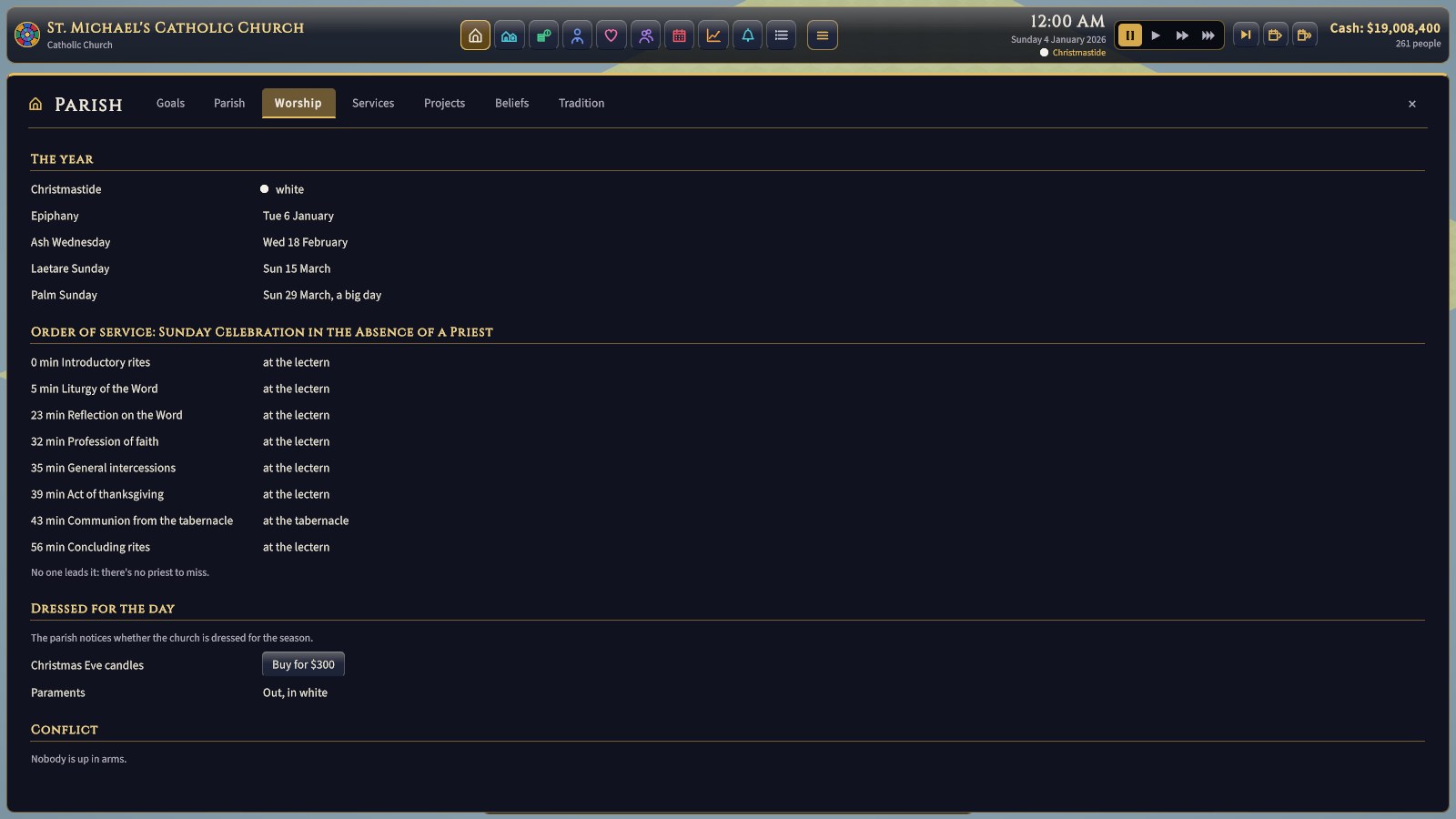
Each tradition has its own order of service. You set the service's length, and the parts are scaled to fit. Each part is led from the first of its listed items the building has, so a khutbah goes to the minbar if there is one and the pulpit or lectern if not, and a homily to the pulpit or else the lectern. Church → Worship shows your congregation's order with its timings. The main service of every tradition is below, faith by faith; the part in bold is its heart.
| Tradition | Service | Its parts (typical minutes) |
|---|---|---|
| Judaism | ||
| Conservative, Modern Orthodox, Chabad | Shabbat morning service | Morning blessings and Pesukei dezimra 25 (bimah) · Shacharit: the Shema and the Amidah 30 · The Torah service 40 (bimah, ark): the scroll carried, read, and the aliyot · Haftarah 10 · Sermon 15 · Musaf 25 · Aleinu, the Mourner's Kaddish, and Adon Olam 5 |
| Reform, Reconstructionist | Shabbat morning service | Morning blessings and songs 15 (piano or organ) · The Shema and its blessings 15 · The Amidah 15 · The Torah service 25 (bimah, ark) · Haftarah 10 · Sermon or d'var Torah 15 · Aleinu, the Mourner's Kaddish, and a closing song 10 |
| Reform, Reconstructionist | Erev Shabbat (Friday, 6:30) | Candle-lighting and welcome 5 · Kabbalat Shabbat: psalms and Lekha Dodi 20 (piano or organ) · Ma'ariv: the Shema and the Amidah 20 · Sermon 20 · Kiddush, Aleinu, and the Mourner's Kaddish 10 |
| Islam | ||
| Sunni Islamic center | Jumu'ah | Arrival, sunnah prayers, and the adhan 8 (mihrab) · Khutbah, in two parts, 25 (minbar) · Iqamah and the two-rak'ah prayer 8 (mihrab) · Announcements and appeal 4. People give at the boxes on the way out. |
| W. Deen Mohammed community | Jumu'ah with a teaching khutbah | Arrival and the adhan 8 · Khutbah, in English, 45 · Iqamah and the two-rak'ah prayer 8 · Announcements 9 |
| Twelver Shia center | Thursday night program | Maghrib and Isha in congregation 15 (mihrab) · Du'a Kumayl 45 (minbar) · Lecture 35 · Ziyarat Waritha 10 · Announcements 5 |
| Ahmadiyya | Jumu'ah (1:00) | The adhan and sunnah prayers 10 · Khutbah 25 · The Khalifa's sermon, summarised 10 · Iqamah and the two-rak'ah prayer 8 · Announcements 5 |
| Nation of Islam | Sunday Message | Greeting and opening prayer 10 · Opening remarks 15 · The Message 90 (pulpit) · Charity and announcements 15 · Closing prayer 5 |
| Buddhism | ||
| Buddhist Churches of America | Shin Buddhist service | Temple bell and calling bell 3 · Gassho and the nembutsu 2 · Sutra chanting 12 (onaijin altar) · Oshoko: offering incense 6 · Gatha 4 (piano or organ) · Reading: the Golden Chain 3 · Dharma talk 20 · Closing gatha 4 · Announcements 4 · Gassho and the nembutsu 2 |
| Vietnamese temple | Sunday chanting service | The great bell 5 · Offering incense 5 · Sutra chanting 30 (wooden fish) · Dharma talk 25 · The Three Refuges 3 · Dedication of merit 4 |
| Chinese Buddhist temple | Sunday dharma function | Bell and drum 5 · Offering incense 5 · The week's sutra 35 (three Buddhas) · Prostrations and the Buddha's name 10 · Dharma talk 25 · Dedication of merit 5. A vegetarian lunch follows, free to all. |
| Soka Gakkai | Gongyo meeting (led by the members) | Welcome 3 · Gongyo: the Lotus Sutra 10 · Daimoku 15 (Gohonzon) · Experiences 15 · Study lecture 15 · Encouragement and announcements 7 · Three daimoku 2 |
| Soto Zen | Zazen and dharma talk | The han and the bells 3 · Zazen 35 (cushions) · Kinhin 10 · Zazen 25 · Service: bows, incense, the Heart Sutra 12 (mokugyo) · Dharma talk 35 · The four vows 3 |
| Theravada temple | Sunday at the wat | Homage: three bows 5 · The refuges and the Five Precepts 10 · Chanting in Pali 15 · Dhamma talk 30 · Offering food to the monks 20 (alms bowls) · Blessing and sharing of merit 10 · The monks' meal 30 |
| Tibetan dharma center | Sunday practice | Prostrations and the mandala offering 8 · Guided meditation 25 (cushions) · Sadhana 35 (thangka) · Dharma talk and questions 45 · Dedication of merit 5 |
| Hinduism | ||
| Hindu temple | Sunday abhishekam | Sankalpam 10 · Bathing the deity, with Vedic chanting 40 (murti shrine) · Dressing the deity, and archana 20 · Arati, with bells and the conch 10 (temple bell) · Holy water, prasad, and the hundi 10. The canteen's lunch follows. |
| BAPS, ISSO | Sabha (BAPS on Sunday afternoon, ISSO on Saturday evening) | Dhun and prayer 10 · Kirtans 30 · Discourses 45 · Announcements 10 · Arti 10 (temple bell) · Offerings at the shrine 5 (hundi). Mahaprasad (or prasad) follows, free to all. |
| ISKCON | Sunday Feast program | Kirtan 30 · Arati 30 (murti shrine) · Class 50 · Closing kirtan and announcements 10. The Sunday Feast follows, free to all. |
| Indo-Caribbean mandir | Sunday service | Bhajans 20 · Havan 25 (havan kund) · Arati 10 · Reading from the Ramayan or the Gita 10 · The pandit's sermon 30 · Birthdays, anniversaries and announcements 10 · Prasad and the offering 5. Lunch follows, free to all. |
| Arya Samaj | Sunday havan | Sandhya and the Gayatri mantra 10 · Havan 35 (havan kund) · Bhajans 20 · Pravachan 35 · Announcements and the shanti path 5. The Preeti bhoj follows, free to all. |
| Vedanta Society | Sunday lecture | Opening chant 3 · Meditation 5 · Lecture 45 · Peace chant 2 · Questions 5 |
| Chinmaya Mission | Bala Vihar assembly and Vedanta class | Assembly: chanting and bhajans 10 · Arati 5 · Vedanta class for the parents 60 · Closing prayer 5 |
| Self-Realization Fellowship | Inspirational Service | Opening prayer 3 · Chanting 8 · Readings from Paramahansa Yogananda 8 · Meditation 10 · Talk 25 · The Prayer Circle 4 · Closing prayer 2 |
| Sathya Sai center | Devotional meeting (Thursday; led by the members) | Silence 3 · Bhajans 40 · A reading or talk 10 · Meditation 7 · Arathi and the Samastha Loka prayer 5 · Vibhuti, and leaving in silence 5 |
| Sikhism | ||
| Gurdwara | Sunday diwan | Coming in: matha tek and the golak 15 · Sukhmani Sahib 50 (palki) · Kirtan by the ragis 150 (kirtan stage) · Katha 45 · Anand Sahib 10 · Ardas, standing 10 · Hukamnama 5 · Karah prashad 15: from nine to two. Langar follows, free to all. |
| Jainism | ||
| Jain center | Sunday at the derasar (led by the members) | The Navkar mantra 5 · Snatra puja and stavans 40 (jin shrine) · Swadhyay 40 · Aarti 10 (temple bell) · Mangal and prabhavana 5. Swamivatsalya follows, free to all. |
| Jain Vishva Bharati | Preksha meditation and yoga (Saturday) | Welcome and the Navkar mantra 5 · Yoga and pranayam 25 · Preksha meditation 30 · The samani's talk 20 · Mangal path 5 |
| Shinto | ||
| Shinto shrine | Shrine rite (the monthly rite and the festivals: no weekly service) | The drum 2 · Purification 4 · Offerings carried up 5 · The norito 6 (kami altar) · Tamagushi offered 8 · Offerings taken down 3 · The priest's address 5 · Naorai 4 |
| Konko | Konko service | Bow and four claps 3 · Prayers before the altar 10 · Reading from the Kyoten 5 · The minister's talk 20 · Sharing of blessings 10 · Offerings before the altar 4 · Closing prayer, bow and claps 3 |
| Tenrikyo | The Service (Sunday, 7:00) | Prayer toward the Jiba 3 · Seated service 10 (kagura instruments) · Dance with Hand Movements 15 · Closing prayer 2 · Sermon 10 |
| Chinese religion | ||
| Chinese folk temple | Offering before the gods (its great days: no weekly service) | Bell and drum 5 · Incense to Heaven and to each god 10 (censer) · Chanting the god's scripture 25 (deity altar) · The offerings and the petition 10 · Asking the god 10 (divination table) · Burning the paper offerings 5 (furnace) |
| Daoist temple | Sunday practice (led by the members) | Loosening and stretching 10 · The tai chi set 40 · Incense before the altar 5 · Chanting the scriptures 20 · A word on the virtues 10 · Dedication 3 |
| Yiguandao | Sunday Tao meeting (led by the members) | Welcome 5 · The lecture 50 · A holy song 5 · Discussion 25 · The mid-day rite before the Mother lamp 25 · Seeing the Buddhas off 3. A vegetarian lunch follows, free to all. |
| Christianity | ||
| Baptist | Preaching service | Welcome 3 · Congregational singing 12 (piano, organ, or drums) · Pastoral prayer 3 · Offering 4 · Scripture reading 3 · Sermon 25 · The Lord's Supper 7 (on communion Sundays) · Benediction 3 |
| Catholic | Mass | Introductory Rites 6 · Liturgy of the Word 12 · Homily 9 (lectern) · Creed and Universal Prayer 4 · Preparation of the Gifts 4 · Eucharistic Prayer 8 · Communion Rite 12 · Concluding Rites 5 |
| Lutheran | Divine Service | Gathering 8 · Readings and psalm 10 · Sermon 12 (pulpit) · Hymn of the day 4 (organ) · Creed and prayers 5 · Peace and offering 5 · Great Thanksgiving 5 · Communion 9 · Sending 2 |
| Pentecostal | Praise and worship | Welcome 2 · Praise and worship 25 (drums, sound system) · Prayer 3 · Tithes and offerings 5 · Sermon 30 · The Lord's Supper 5 · Altar call 10 |
| Orthodox | Divine Liturgy | Great Litany and antiphons 15 · Little Entrance 3 · Epistle and Gospel 8 · Homily 10 · Great Entrance 7 · Anaphora 15 · Holy Communion 10 · Dismissal and antidoron 7 |
| Calvary Chapel | Worship and teaching | Welcome 2 · Worship 25 (drums, sound system) · Prayer 3 · Teaching through the Word 45 · The Lord's Supper 6 (on communion Sundays) · Closing prayer 3. No offering in the service. |
| Christian Churches | Worship around the Lord's table | Welcome 2 · Songs of worship 15 · Prayer 3 · Scripture reading 3 · Communion meditation and prayers 3 · The Lord's Supper 8 · Offering 4 · Song 4 · Sermon 28 · The invitation 4 · Benediction 2 |
| Quaker | Meeting for worship | Settling into silence 2 · Waiting worship 25 · Vocal ministry 10 · Settled silence 20 · Close of worship 3. No pulpit, no sermon, no one appointed to lead. |
A tradition from a mod that names no service gets a generic one from its worship focus: a liturgy for sacrament-centred traditions, a preaching service for word-centred ones, an unprogrammed meeting for silent ones.