Chapter 7: Worship and the year · Part 4
The year, weddings and funerals
Each tradition's year
Every tradition keeps a year of its own, reckoned with the calendar its people use, and the line under the clock shows its season. Synagogues keep the Hebrew calendar and mosques the Islamic one, so their holy days move against the Gregorian year (Ramadan comes about eleven days earlier each year). Hindu and Jain congregations keep lunisolar years, each festival on its lunar day (its tithi) as it stands at sunrise, noon, or midnight, reckoned at the temple's own location or in India, and their solar days by the sun's entry into a sign of the sidereal zodiac. A gurdwara keeps the Nanakshahi calendar's fixed dates or the SGPC's lunar ones. Buddhist temples keep the lunar calendar, the full moons, or their school's own days; Chinese temples the Chinese lunar year, its 1st and 15th every month (leap months too), with Qingming and the solstice by the solar terms; a shrine New Year, Setsubun on the eve of spring, and its own festivals. Most Christian traditions keep a church year: Western churches the Western calendar, the Orthodox the Eastern, with Pascha by the Julian reckoning (never earlier than Western Easter); the Quakers keep none. Only the church year has liturgical colours. Faiths and traditions covers every calendar.
| Faith | Its seasons | Seasons and days without weddings |
|---|---|---|
| Judaism | Elul, the Days of Awe, Sukkot, Hanukkah, Passover, the Omer | Where two festival days are kept (Conservative, Orthodox, Chabad): Passover, the Omer, and the Three Weeks, and the festivals. Everywhere: Rosh Hashanah, Yom Kippur, Sukkot, Passover, Shavuot, Tisha B'Av |
| Islam | Ramadan; for the Shia, the Muharram majalis and the mourning to Arba'een | For the Shia, Muharram and Safar, to Arba'een |
| Buddhism | Obon (Shin); the rains retreat and the Kathina season (Theravada); Vu Lan month and the summer retreat (Vietnamese); the filial month, the Water and Land, and the Amitabha recitation (Chinese); Saka Dawa (Tibetan); the Rohatsu sesshin (Zen) | None |
| Hinduism | Navaratri; chaturmas (North Indian and Swaminarayan temples); Dhanurmasa (South Indian); the Damodara month (ISKCON); Durga Puja (Vedanta) | Chaturmas, at a North Indian or Swaminarayan temple |
| Sikhism | Shaheedi week, for the Sahibzade | None |
| Jainism | Paryushana (Das Lakshana for the Digambara), the Ayambil Olis, chaturmas | Paryushana and Samvatsari; Das Lakshana |
| Shinto | Hatsumode (a shrine); New Year visits and the Winter Special Prayer (Konko) | None |
| Chinese religion | The New Year fortnight; the ghost month (the seventh) | The ghost month, at a folk temple |
| Christianity | The church year, below, with its colours | The Orthodox and Coptic strict fasts |
| Western church year | Colour | Eastern church year | Colour |
|---|---|---|---|
| Advent | violet | Nativity Fast | red |
| Christmastide | white | Nativity and Theophany | white |
| Season after Epiphany | green | Before Great Lent | gold |
| Lent | violet | Great Lent | violet |
| Holy Week | red | Holy Week | black |
| Eastertide | white | Paschal season | red |
| Ordinary Time | green | After Pentecost | gold |
Big days
Some feasts make the congregation more likely to come to a service near them, or to the feast's own service where it has one, and newcomers feel them twice as much: a feast that makes regulars twice as likely to come (up to 98%) brings three times the usual newcomers. The year's great days in every faith:
| Faith | Feast | Regulars | Newcomers | Notes |
|---|---|---|---|---|
| Judaism | Rosh Hashanah, Kol Nidre, Yom Kippur | ×2.5 (×3 Reform, Reconstructionist) | ×4 (×5) | Each a service of its own (below). Where seats are sold, those who don't belong buy them. |
| Islam | Eid al-Fitr; Eid al-Adha | ×2.5; ×2.2 (Shia ×2.2; ×2) | ×4; ×3.4 | The Eid prayer is a service of its own on each. |
| Islam | Ashura (Shia) | ×2.2 | ×3.4 | The Ashura majlis is a service of its own. |
| Buddhism | Obon (Shin); Vesak and Songkran (Theravada); Tết, the Buddha's birthday, and Vu Lan (Vietnamese) | ×2 | ×3 | Kathina, the Theravada temple's great offering, ×1.8. |
| Buddhism | Lunar New Year, the Buddha's birthday, the Water and Land (Chinese Buddhist) | ×2.5 | ×4 | Each a service of its own. |
| Hinduism | Diwali (Deepavali); Phagwah at an Indo-Caribbean mandir; Maha Shivaratri | ×2.5; ×2.5; ×2.2 | ×4; ×4; ×3.4 | Diwali and Shivaratri are services of their own. |
| Hinduism | Janmashtami at ISKCON; the Swaminarayan New Year and Annakut | ×3 | ×5 | Janmashtami's midnight arati is a service of its own; ISKCON's Ratha Yatra ×2.5. |
| Sikhism | Vaisakhi, Guru Nanak's gurpurab | ×2.5 | ×4 | Guru Gobind Singh's gurpurab and Bandi Chhor Divas ×2. Celebrated at the diwan nearest them. |
| Jainism | Samvatsari; Mahavir Janma Vanchan, Anant Chaturdashi | ×3 (×2.5 at Jain Vishva Bharati); ×2.5 | ×5; ×4 | Each a service of its own. Mahavir Jayanti ×2. |
| Shinto | Hatsumode, the shrine's New Year | ×5 | ×9 visitors | No service: the crowd comes to the open hours, thousands, nearly all passing through. Shichi-Go-San ×2.5; the autumn grand festival ×2, a service of its own. |
| Chinese religion | Lunar New Year's Eve and New Year, the god's birthday; the Ghost Festival (Pudu) | ×3; ×2.5 | ×5; ×4 | A folk temple's first incense, the god's birthday, and Pudu are services of their own. |
| Christianity | Christmas, Easter Day (Western); Pascha; the Nativity (Eastern) | ×2; ×2.2; ×1.8 | ×3; ×3.4; ×2.6 | Christmas Eve is a service of its own (below). Palm Sunday, Theophany, and Pentecost are a little busier than usual. |
The lesser feasts' pull on newcomers is capped: over any 30 days they may bring at most half as many newcomers again as the usual 30 days' (counting all of a feast's own service's newcomers, and those a feast day's open hours bring who might come back). The year's great days stand outside the cap (any feast drawing at least as many again as usual, or the calendar's biggest: every row of the table above), so a calendar crowded with lesser days, a shrine's 1st and 15th or a Hindu temple's autumn festivals, doesn't bring a steady stream of newcomers no congregation sees. Who among the congregation comes is unchanged.
On some days a congregation holds none of its own main services: General Conference and stake conference Sundays for a Latter-day Saint ward, which gathers with the wider church instead. Daily services, where a tradition keeps them, still go on.
Special services
Some days have one service for everyone, not just one service's share. Church → Services lists those your tradition keeps, with the next date of each; untick Hold it on any your congregation doesn't hold. Most faiths hold some of their greatest days this way, drawing the day's crowd and its newcomers (a gurdwara, a Shin or Theravada temple, and BAPS keep theirs at the main service nearest them instead):
| Service | When | Who keeps it |
|---|---|---|
| Rosh Hashanah | 9:00, four hours | Every synagogue |
| Kol Nidre | 20 minutes before sunset on the eve of Yom Kippur, two hours | Every synagogue |
| Yom Kippur | 9:30, five hours | Every synagogue |
| The Eid prayer | An hour and a half after sunrise on each Eid, an hour | Every Muslim community |
| The Ashura majlis | 10:00, three hours | A Twelver Shia center |
| The New Year blessing, Bathing the Buddha, Ullambana, the Emperor Liang Repentance, the Water and Land | From 9:00 or 10:00, two to six hours | A Chinese Buddhist temple |
| Diwali's Lakshmi puja (a Diwali service at an Indo-Caribbean mandir) | An hour after sunset (half an hour at a mandir), two hours | A Hindu temple, an Indo-Caribbean mandir |
| The Shivaratri abhishekam | 7:00 in the evening, five hours | A Hindu temple, an Indo-Caribbean mandir |
| Janmashtami's midnight arati | 10:00 at night, two hours | ISKCON, a North Indian temple |
| Kali Puja | 9:00 at night, three hours | The Vedanta Society |
| The all-day Christmas meditation | The third Saturday of December, from 10:00, six hours | SRF |
| Mahavir Janma Vanchan | 10:00 in Paryushana, four hours | A Jain center |
| The Samvatsari pratikraman | Two hours before sunset, three hours | A Jain center, Jain Vishva Bharati |
| The Anant Chaturdashi vidhan | 9:00, four hours | A Digambara jinalaya |
| The monthly rite (tsukinamisai) | The 1st and 15th, 10:00, 45 minutes | A Shinto shrine |
| The autumn grand festival (reitaisai) | The first Sunday of October, 10:00, two hours | A Shinto shrine |
| New Year's Day service | 1 January, 10:00, an hour and a half | A Konko church |
| The monthly service; the Spring and Autumn Grand Services | The third Sunday, 10:00, two hours; the second Sundays of April and November, two and a half hours | A Tenrikyo church |
| The first incense | 11:00 on Lunar New Year's Eve, an hour | A Chinese folk temple |
| The god's birthday rite; Pudu | 10:00, three hours; 10:00 in the ghost month, four hours | A Chinese folk temple |
| The All Souls rite | 10:00 in the seventh month, three hours | A Daoist temple |
| The Grand Ceremonies to the Mother | The 15th of the third, sixth, ninth, and eleventh lunar months, 10:00, two hours | Yiguandao |
| Christmas Eve | 24 December, 5 pm | Christian traditions with a church year (nearly everyone comes, with four times the newcomers) |
| Ash Wednesday | 46 days before Easter, 7 pm | Western liturgical Christian traditions (under half a Sunday) |
| Good Friday | The Friday before Easter, 7 pm | Christian traditions with a church year (under half a Sunday) |
| Easter sunrise | Easter morning, 6:30, before the usual services | Christian traditions with a church year (half a Sunday) |
| Thanksgiving eve | The Wednesday before Thanksgiving, 7 pm | Christian traditions that keep the nation's holidays (half a Sunday) |
Where the tradition keeps communion (the Christian ones), each special service has it as your tradition would on that day (every one, where communion is weekly) until you set its Communion toggle, on or off; the congregation's own special services have it too.
Church → Services can add the congregation's own special services too, in any tradition, in a dialog: Add a special service, or Change on one already there. Give it a name, and say how it comes round: one day or yearly on a date (picked from a calendar), a weekday of a month (the third Sunday of October, the last Friday of November), or, where the tradition keeps the church year, so many days from Easter (Ascension is 39 days after; your tradition's own Easter, so Orthodox churches follow Pascha) or from Christmas (Epiphany is 12 days after). Then when it starts, how long it lasts (− and +), and whether it draws fewer than an ordinary week's main service, as many, or more. The dialog says when the next one falls, and nothing changes until you save it.
Most special services are extras, felt half as much as an ordinary service: Easter sunrise, Good Friday, a shrine's monthly rite, Tenrikyo's monthly service, the congregation's own. The year's greatest are felt in full, as an ordinary week's main service is, in every faith alike: Christmas Eve, and a great day's own service (one whose feast draws at least as many again as usual, or the calendar's biggest): Rosh Hashanah, Kol Nidre and Yom Kippur, the Eid prayers and Ashura, Diwali's Lakshmi puja, Maha Shivaratri and Janmashtami, Samvatsari, the folk temple's first incense and its god's birthday, the Buddha's birthday, the shrine's autumn grand festival, Tenrikyo's Grand Services, Yiguandao's Grand Ceremonies.
On a great day, people are two and a half to three times as likely to come (up to 98%), and four or five times the usual newcomers come with them: the High Holy Days, the Eid prayer, Diwali, Samvatsari, the folk temple's first incense, Christmas Eve. A building sized for an ordinary week overflows and people stand. It's your best recruiting day of the year if you have the seats and the greeters: consider extra seats (chairs, or more rows of carpet or sheets), and every greeter and usher on duty.
Dressed for the day
Every faith's year has its seasons and festivals to dress for: the Christian church year's paraments, Advent wreath, Christmas candles, and Easter lilies; a synagogue's Sukkah at Sukkot and its Hanukkah lamp; a mosque's lanterns through Ramadan; Diwali's lamps at a mandir, a derasar, or a gurdwara; a gurdwara's lights for Vaisakhi and the gurpurabs; the New Year couplets at a Chinese temple; the lanterns of Obon, Ullambana, and Vesak; the kadomatsu at a shrine's gate for New Year. Each piece is out (and drawn in the church) only in its season or within a few days of its festival, and the build tray offers it only to its own faiths.
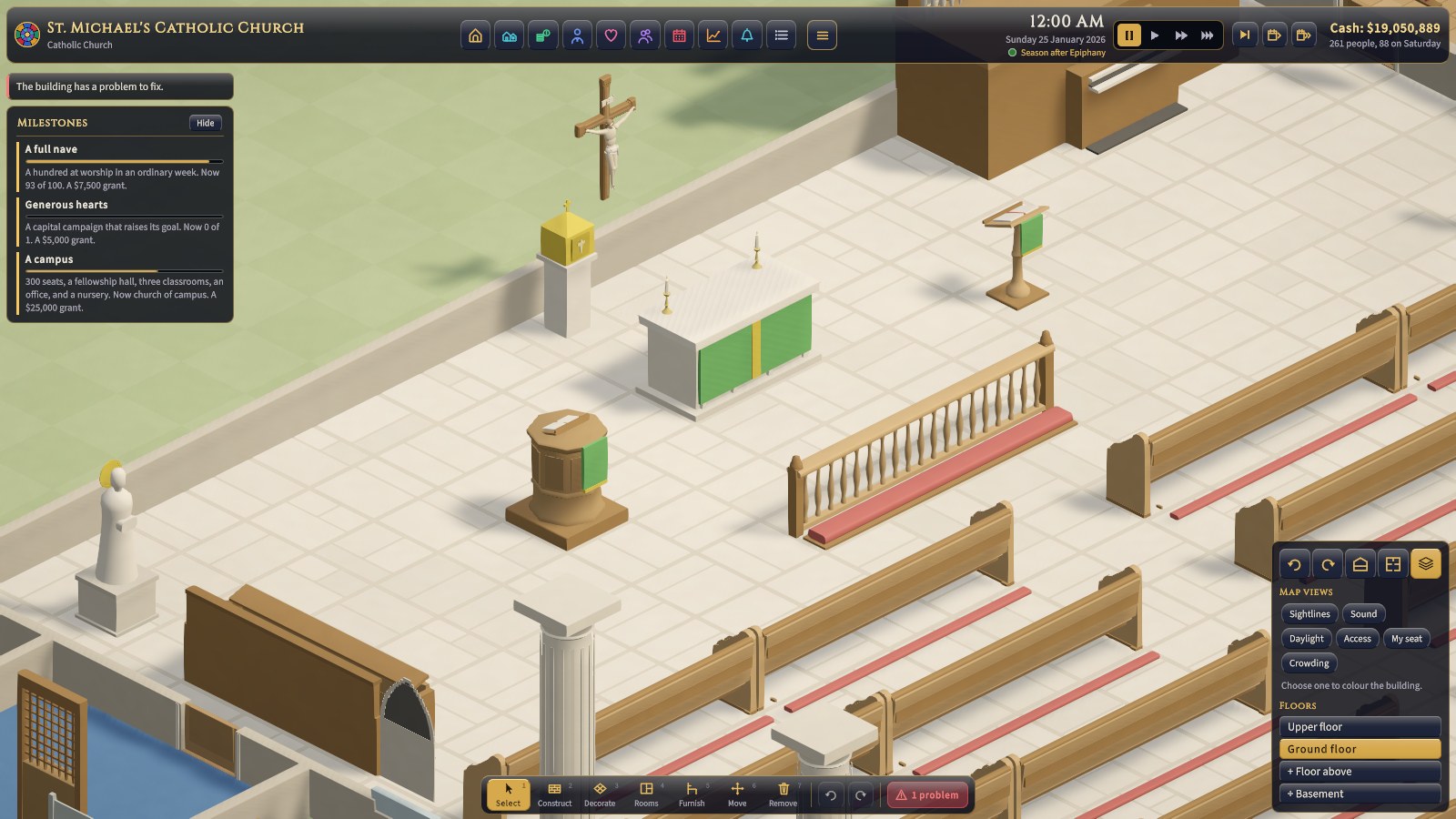
Traditions with seasons to dress for notice whether the building is dressed for them. After each service (and each visit at open hours) they compare the decor the day calls for with what the congregation owns, placed or in the cupboard: from −0.04 with none to +0.04 with all, scaled by the tradition's formality (in full for the most formal traditions, a third for the least). A Christian church's paraments are called for all year; every other piece, in any faith, only in its season, and outside the seasons nothing is called for, so the factor is neither plus nor minus.
| Item | Who | Price | Out |
|---|---|---|---|
| Sukkah | Every synagogue | $2,500 | Sukkot |
| Paraments | Christian | $2,400 | Always, in the colour of the day, on the altar, table, pulpit, and lectern |
| Advent wreath | Christian | $250 | Advent |
| Christmas Eve candles | Christian | $300 | Christmas through Christmastide |
| Easter lilies | Christian | $400 | Easter Day through the Easter season |
| Hanukkah menorah | Jewish | $350 | The eight nights of Hanukkah |
| Ramadan lanterns | Muslim | $500 | Ramadan, its Nights of Power, and Eid al-Fitr |
| Muharram cloths | Muslim (where the calendar keeps Muharram: the Shia) | $350 | The first ten days of Muharram and Ashura |
| Diyas | Hindu, Jain, Sikh | $300 | Diwali or Deepavali and its days (Dhanteras, Annakut, Bhai Dooj), Karthigai Deepam, Kali Puja; the Jains' Mahavir Nirvana and New Year; the Sikhs' Bandi Chhor Divas |
| Marigold garlands | Hindu | $400 | Navaratri (or Durga Puja) through Dussehra |
| Gurpurab lights | Sikh | $400 | Vaisakhi, Guru Nanak's and Guru Gobind Singh's gurpurabs, Bandi Chhor Divas |
| Dreams of Trishala | Jain | $500 | Mahavir Janma Vanchan, in Paryushana (a Svetambara derasar's) |
| Vesak lanterns | Buddhist | $400 | Vesak, Saga Dawa, Poson, the Buddha's birthday (Hanamatsuri, Phat Dan) |
| Bon lanterns | Buddhist, Chinese | $400 | Obon and its service, Segaki, Ullambana, Vu Lan; the ghost month, Pudu, and the All Souls rite |
| New Year couplets | Chinese, Buddhist | $250 | Lunar New Year (Tet) and its eve, through the Lantern Festival |
| Kadomatsu | Shinto, Konko, Tenrikyo | $400 | New Year and the first visits; the year-end purification |
Church → Worship lists the decor the season calls for, with a Buy button for anything you're missing. A church's four Christian pieces together cost $3,350, a synagogue's two $2,850, and every other faith's a few hundred dollars a piece: an easy lift at the festivals for any formal congregation. Only a Christian church feels its decor (the paraments) all year; elsewhere it's felt at the festivals alone, and missing it costs nothing the rest of the year.
Weddings and funerals
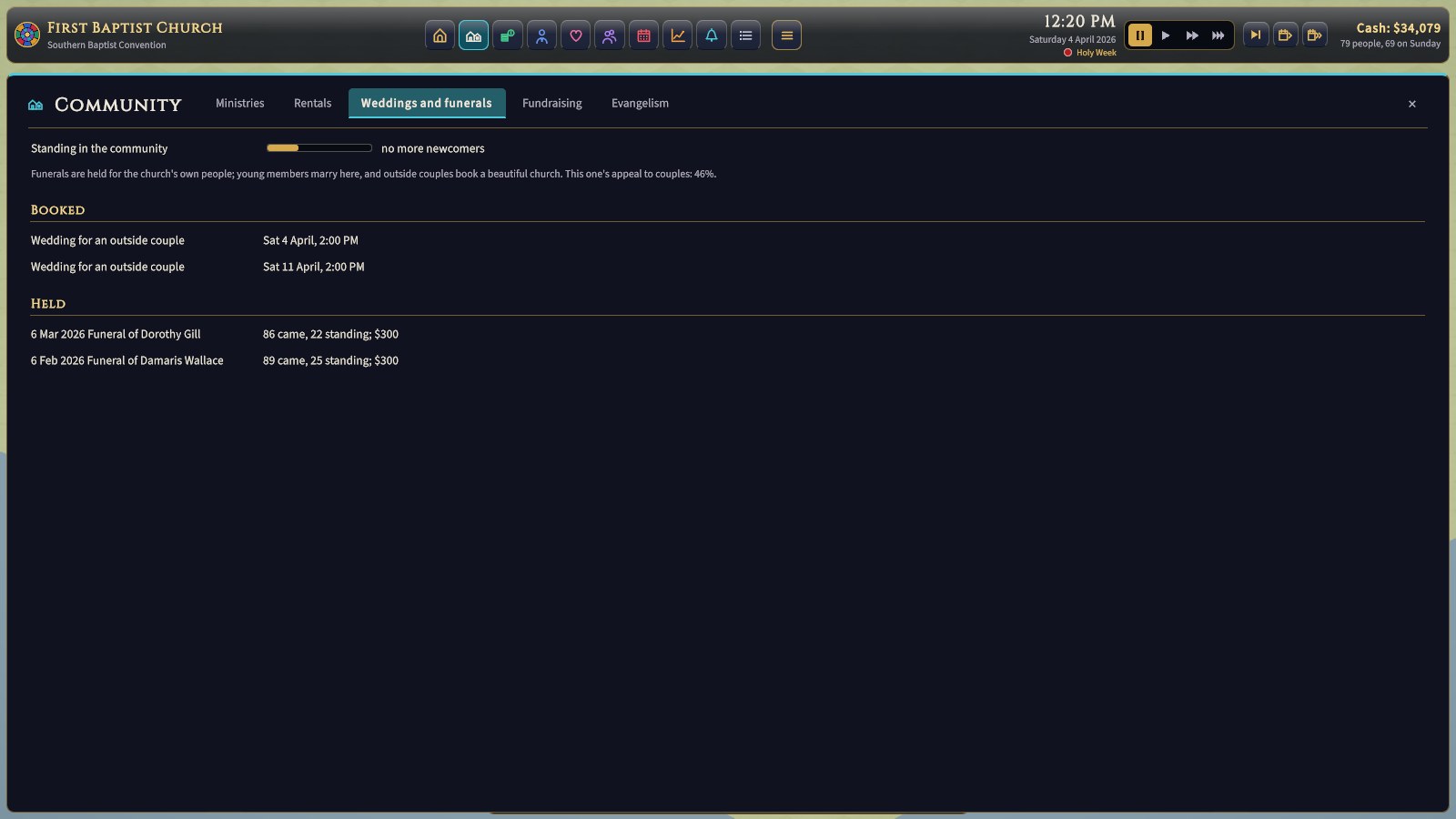
- Funerals. When one of the congregation's people dies, the funeral is held there five days later, on a weekday morning; in the Jewish and most Muslim traditions, which bury promptly, it's the next day, or the first after it that isn't the Sabbath or a holy day kept as one. It's held with the tradition's own rite where it has one: the janazah at a mosque, a shiva minyan at a synagogue, the Antim Ardas at a gurdwara, a prarthana sabha at a Jain center, a Buddhist memorial, Konko's celebration of life, a Daoist priest's rites for the dead, a church's memorial service. A Shinto shrine keeps away from death and holds none, nor does a Hindu temple (cremation is elsewhere) or a Sathya Sai center: the family's funeral is held elsewhere, and the congregation earns nothing from it. About 25 come, plus a share of the congregation that grows with how long the person had come (15%, and 3% more a year, up to 80%). The congregation receives $300, and the family feel cared for (+0.05).
- Weddings of your own. Young adults (22 to 34) in the congregation marry at about 5% a year, by their tradition's own rite: a wedding under the chuppah, a nikah, a Hindu wedding (vivaha), the Anand Karaj, a Buddhist wedding before the Buddha, a Shinto wedding before the kami, holy matrimony. Each is on a Saturday afternoon (on Sunday where Saturday is a Sabbath the tradition keeps), unless the tradition holds its weddings at another hour or on other days: a Hindu temple's at nine in the morning and a Sikh Anand Karaj or an Arya Samaj wedding at ten, any day; a Swaminarayan wedding at ten; an Indo-Caribbean wedding on a Sunday morning. Each earns $400. None falls in a strict fast, or in a season or on a holy day that bars weddings (above).
- Rites asked for. Where a tradition keeps rites that families ask for (an archana or a puja at home, an Akhand Path or a Sehaj Path, a snatra puja, a kitō or a house blessing, the 7-5-3 rite, a memorial tablet, Tai Sui protection, a fortune reading), each is booked when the leader, or a member of staff who performs rites, is free, held at the temple, gurdwara, or shrine, at a home, or on the grounds, and paid for at its listed price. A long rite, such as the 48-hour Akhand Path, is kept in shifts. How they're asked for and what they bring is in Money.
- Outside weddings. Couples from outside book a beautiful building, up to one a month for the grandest, for $2,500. How much they want yours depends half on the style's formality and half on the average looks of what stands in the worship room. A Jain marble derasar, a Dravidian temple hall, or a Gothic nave full of handsome furniture is a steady income.